XRP Smart Money Accumulation: $XRP Price Prediction 2026 Outlook


XRP smart money accumulation is becoming a key narrative as institutional investment products continue to attract capital while the token trades below several major moving averages.
The market is currently caught between strong support near $1.11 and resistance at $1.28, $1.38, and $1.51. ETF flows provide evidence of institutional demand, but they do not automatically prove that large investors are accumulating through spot markets.
This XRP price prediction 2026 analysis combines ETF flows, RSI, EMA structure, Fibonacci levels, and price action to outline bullish, base, and bearish scenarios.
XRP Price Analysis Today: Key Support and Resistance Levels
As of June 17, 2026, the $XRP price is trading around $1.2186 on the daily chart. The 20 EMA stands at $1.2091, while the 50 EMA and 200 EMA are positioned at $1.2802 and $1.3733, respectively. Price remains below the major moving averages, showing that the broader technical structure has not yet turned decisively bullish.
The XRP RSI is currently at 48.52, slightly below the neutral 50 level. This suggests that momentum remains balanced, with neither buyers nor sellers holding a clear advantage. A move above 50 would improve momentum, while a deeper decline in RSI could signal renewed selling pressure.
For the XRP price prediction today, the $1.11 to $1.21 area remains important. Buyers previously defended the $1.11 zone aggressively, while $1.21 has become an early recovery level. The broader $XRP support and resistance structure now places $1.28 as the first major hurdle.
Why the $1.11 Support Zone Matters for the Price Forecast
The sharp decline from the $1.38 to $1.51 resistance area in May pushed price toward the $1.08 to $1.11 region. Buyers eventually stepped in near $1.11, creating a long lower wick on the daily chart.
That wick shows that sellers were unable to maintain control at the lows, but it should not be treated as confirmation of a guaranteed reversal. Instead, it highlights the importance of the $1.11 zone as a key demand area.
The recovery back above $1.21 improved the short-term structure, but the broader trend remains unconfirmed while price trades below the 50 EMA and 200 EMA. A sustained move above $1.28 would provide the next important confirmation.
For the current price forecast, a daily close below $1.11 would invalidate the immediate bullish recovery setup and could expose lower support levels, including the $0.88 area highlighted in the referenced analyst chart.
XRP Support and Resistance: The Levels Bulls Must Reclaim
The current xrp forecast depends heavily on how price reacts around the XRP support and resistance levels that define the market's short-term structure.
-
$1.21: This is the first recovery area that buyers need to defend. Holding above it would keep the short-term recovery structure intact.
-
$1.28: This is the first major resistance level. A clean daily close above $1.28 would improve market structure and could shift momentum toward buyers.
-
$1.35 to $1.38: This zone represents stronger structural resistance. A breakout here would indicate that buyers are gaining greater control.
-
$1.51: This remains the major breakout level. A sustained move above $1.51 could confirm a larger expansion phase.
-
$1.61 to $1.67: These are the next potential upside targets following a confirmed breakout, with $2.30 representing a more extended bullish scenario.
The EGRAG Crypto chart from June 16, 2026, also shows a symmetrical triangle forming on the larger timeframe. Price is inside the triangle compression zone, approaching the apex.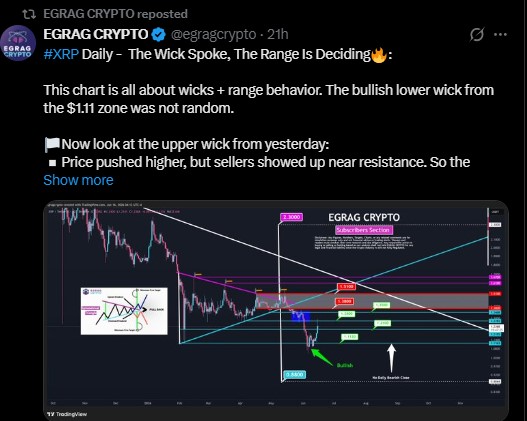
Therefore, the immediate XRP price prediction 2026 setup remains range-bound until price either breaks above $1.51 or loses the critical $1.11 support.
Is a Symmetrical Triangle Setting Up the Next Price Move?
The daily chart shows two converging trendlines. Lower highs and higher lows are squeezing the price into a tighter range. This is the textbook definition of a symmetrical triangle.
A symmetrical triangle does not predict direction on its own. It is a compression pattern. The breakout direction determines the next move.
For bulls, the key is that price holds above $1.11 and starts posting daily closes above $1.28. A breakdown below $1.11 on a daily close would shift the picture bearish and open the $0.88 area as a possible target, according to the analyst's chart.
What Do $XRP ETF Inflows Say About Institutional Interest?
This is where things get more concrete. The SoSoValue ETF data from June 16, 2026, shows:
-
Daily Total Net Inflow: $5.30 million
-
Cumulative Total Net Inflow: $1.44 billion
-
Total Net Assets: $1.06 billion, representing 1.40% of market cap
The biggest single-day inflow came from Franklin Templeton's XRPZ product, which pulled in $5.30 million on June 16 alone. Its cumulative inflows now stand at $406.38 million with net assets of $270.39 million.
Bitwise's XRP ETF (ticker: XRP on NYSE) leads in net assets at $473.71 million. Canary Capital's XRPC on NASDAQ holds $460.58 million in net assets.
These are not retail flows. This is institutional money buying into an asset that is still sitting near its local lows.
What Should Investors Watch in Weekly ETF Flows?
The seven-day ETF flow trend may provide a clearer picture than any single trading session.
Sustained positive inflows could strengthen the institutional-demand narrative, while consecutive outflows could reduce bullish momentum.
Investors tracking the XRP price prediction this week should therefore monitor both cumulative flows and the latest weekly net-flow figure rather than relying on one day's data.
XRP Smart Money Accumulation: What the Data Actually Shows
The term XRP smart money accumulation should be used carefully. ETF inflows provide evidence of institutional interest, but they do not confirm that whales are directly accumulating tokens through spot markets.
A stronger accumulation thesis would require confirmation from multiple data points, including declining exchange balances, increased large-wallet holdings, OTC desk activity, and sustained spot trading volume.
Without that evidence, the more defensible conclusion is that institutional demand is growing through investment products while the underlying price remains below several key technical resistance levels.
This distinction is important because institutional interest and direct token accumulation are not always the same thing.
XRP Price Prediction 2026: How Analyst Targets Compare
Longer-term price targets vary significantly depending on the analyst, timeframe, and methodology. Standard Chartered has previously been associated with a roughly $2.80 base-case target, while EGRAG Crypto has presented much more aggressive long-term cycle scenarios in the $7 to $10 range.
The technical setup discussed in this article is considerably more conservative. The first upside targets after a confirmed breakout are $1.61 and $1.67, followed by the $1.9854 Fibonacci level and a potential extended target near $2.30.
These targets should not be treated as competing predictions for the same timeframe. Institutional forecasts, cycle-based analyst projections, and technical chart targets use different assumptions. The key takeaway is that price confirmation above $1.28, $1.38, and $1.51 remains more important for the near-term setup than any distant price target.
XRP Price Forecast: Bull, Base, and Bear Case Scenarios
Bull Case: Target $2.30 | Probability 25% | Key Trigger: Breakout above $1.51 with strong momentum | Invalidation: Daily close below $1.11
Base Case: Target $1.61–$1.67 | Probability 50% | Key Trigger: Reclaim of $1.28 and $1.38 | Invalidation: Loss of $1.11
Bear Case: Target $0.88 | Probability 25% | Key Trigger: Confirmed breakdown below $1.11 | Invalidation: Reclaim above $1.38
These probabilities are a technical model estimate rather than a market consensus. The framework considers RSI momentum, 20-day, 50-day, and 200-day EMA positioning, support and resistance, Fibonacci levels, trading volume, price structure, and ETF flow trends.
A bullish breakout supported by rising trading volume would carry more weight than a low-volume price spike. Similarly, a breakdown below $1.11 accompanied by increasing selling volume would strengthen the bearish case.
What Is the Price Prediction If the $1.51 Resistance Breaks?
Multiple analyst charts point to similar targets on a sustained $1.51 breakout:
The EGRAG Crypto analysis marks $1.61 and $1.67 as intermediate targets. Beyond that, $2.30 is listed as a longer-term target if the symmetrical triangle resolves to the upside and holds.
The Fibonacci retracement levels on the daily chart place the 0.618 level at $1.5886 and the 0.5 level at $1.9854. Those act as natural targets and resistance zones on the way up.
But none of this is confirmed yet. XRP still needs to close above $1.28, then $1.38, and then $1.51 to begin the expansion phase.
XRP Price Prediction Roadmap: What Happens Next?
$1.11: Buyers defend support — Completed
$1.21: First daily close above — Completed
$1.28: Structure improves — Pending
$1.35 to $1.38: Bulls gain control — Pending
$1.51: Major breakout zone — Pending
The market is waiting for the next daily close to decide which side of the range wins.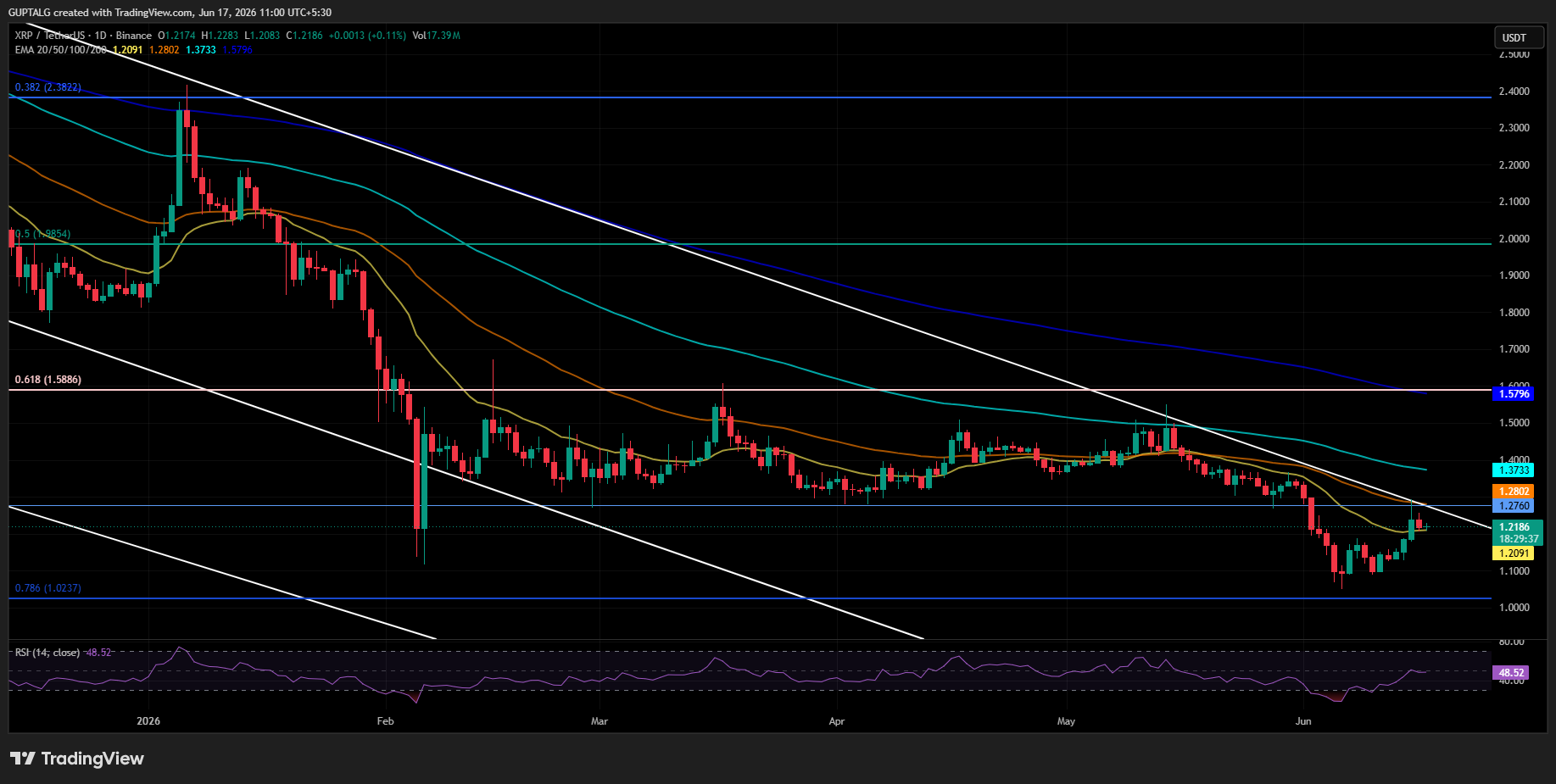
The roadmap shows that the recovery is still incomplete. Buyers have defended $1.11 and reclaimed the $1.21 area, but the market still needs to clear $1.28, $1.38, and $1.51 before a larger bullish expansion can be confirmed.
XRP Price Prediction Today: Why Daily Closes Matter
For anyone following the XRP price prediction today, daily closing prices currently provide a more reliable signal than short-term intraday spikes. Upper wicks near resistance indicate that sellers remain active, while lower wicks around $1.11 show that buyers continue to defend the support zone.
The XRP price prediction this week will largely depend on whether price can establish daily closes above $1.28 and then challenge $1.38. A sustained move above $1.51 would provide stronger breakout confirmation.
Conversely, a drop below $1.21 would weaken short-term momentum, while a confirmed daily close below $1.11 would significantly damage the bullish recovery thesis.
Therefore, the answer to "will XRP go up tomorrow?" cannot be determined with certainty from the current chart. The more important question is whether buyers can produce sustained daily closes above resistance with improving momentum and trading volume.
Disclaimer: This article is for informational purposes only and does not constitute financial advice. Cryptocurrency investments carry a high level of risk, including potential total loss of capital. Always conduct your own research and consult a licensed financial advisor before making any investment decisions.










.jpg)




