XRP Ripple Price Prediction After CLARITY Act Progress

XRP Ripple Price Prediction After CLARITY Act Progress
XRP Ripple is gaining attention again as traders assess the potential impact of the CLARITY Act and XRP's ability to recover from recent weakness. The proposed legislation aims to create clearer rules for digital assets in the United States, an issue that has remained important for XRP and Ripple for years.
If lawmakers deliver greater regulatory certainty, $XRP could benefit from stronger institutional confidence and broader market participation. However, the legislation itself would not guarantee a Ripple rally. Price action will still depend on ETF flows, trading volume, market liquidity, Bitcoin's direction, and XRP's ability to reclaim key resistance levels.
For investors following the XRP price prediction 2026, the key question is whether regulatory progress can become a catalyst strong enough to push it through major resistance and support a broader recovery.
Why Could the CLARITY Act Trigger a Ripple Rally?
The CLARITY Act has become one of the most closely watched regulatory developments in crypto because clearer asset classification could reduce uncertainty around digital tokens in the United States.
For $XRP, this is particularly important because Ripple and XRP have spent years at the center of regulatory discussions. If the legislation provides a clearer framework, potential benefits could include:
- Greater clarity for financial institutions exploring crypto
- More confidence for investment products and ETF issuers
- Reduced regulatory uncertainty for blockchain businesses
- Potentially broader payment and settlement adoption
- Greater institutional interest in XRP
However, investors should distinguish between regulatory clarity and guaranteed adoption. A law can reduce uncertainty, but it cannot guarantee that banks will use XRP, that ETF inflows will increase, or that the token will immediately rise. The broader CLARITY Act crypto impact should therefore be evaluated alongside actual capital flows, trading activity, and network adoption.
XRP Technical Analysis: Key Levels to Watch
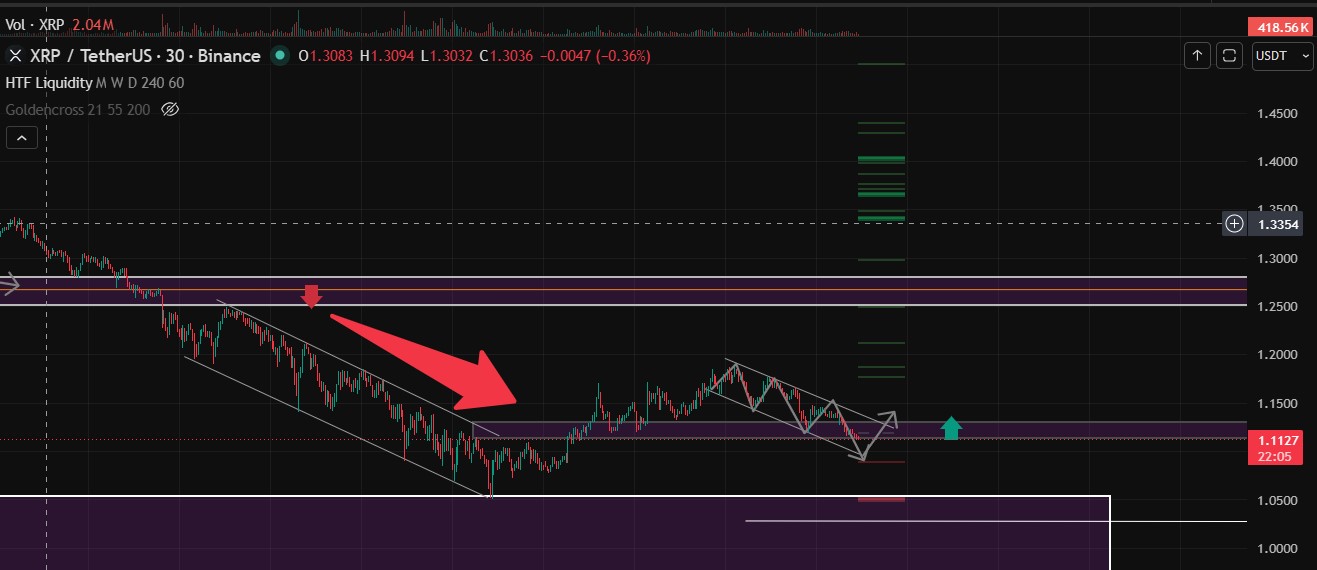
The technical analysis presents a mixed picture across different timeframes. On the 30-minute chart, it has been consolidating above the $1.10 support zone following a prolonged downtrend. If buyers maintain control, the token could attempt a rebound toward $1.15–$1.25.
On the longer-term chart, the $1.05–$1.10 demand area remains important. Holding this region could preserve the recovery structure, while a breakout above $1.25 could open the way toward higher liquidity zones.
30-Minute Chart
Short-Term:
Consolidating above the $1.10 support zone after a prolonged downtrend, with a potential rebound toward $1.15–$1.25 if buyers maintain control.
Long-Term:
Holding above the $1.05–$1.10 demand area keeps the broader recovery structure intact, while a breakout above $1.25 could accelerate a move toward higher liquidity zones.
Support
- $1.10
- $1.05
- $1.00
Resistance
- $1.15
- $1.25
- $1.28
Traders tracking XRP support and resistance levels should focus on whether $1.10 continues to hold. A move below $1.00 would weaken the short-term recovery setup, while reclaiming $1.25 could improve the bullish outlook.
Weekly Chart
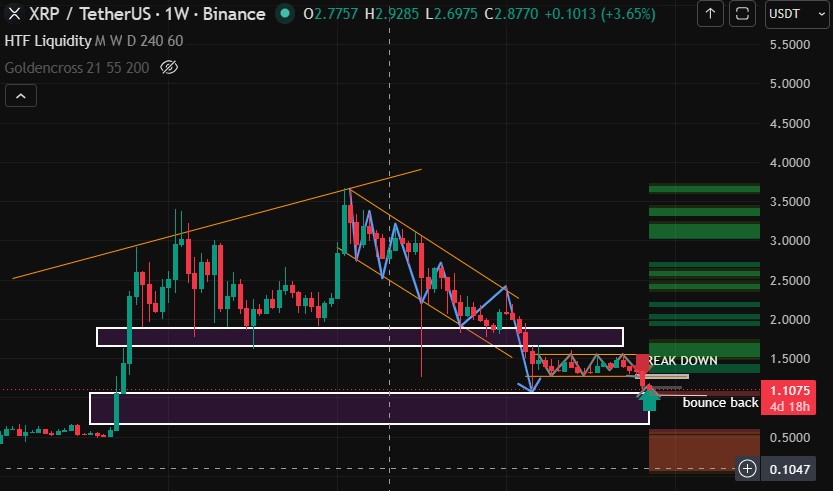
Short-Term:
XRP is attempting a recovery after defending the $1.00–$1.10 demand zone, but reclaiming $1.50 would provide stronger confirmation.
Long-Term:
As long as it remains above major weekly support, the broader structure could favor a gradual recovery toward $2.00–$3.50.
Support
- $1.10
- $1.00
- $0.60
- $0.10
Resistance
- $1.50
- $1.90
- $2.20
- $2.60
$XRP Ripple Price Prediction 2026–2030
| Year | Bear Case | Base Case | Bull Case | Extreme Bull |
| 2026 H2 | $0.80–$1.10 | $1.40–$2.20 | $2.20–$3.00 | $3.00–$3.55 |
| 2027 | $0.90–$1.30 | $2.00–$3.00 | $3.00–$4.50 | $4.50–$6.00 |
| 2028 | $1.00–$1.80 | $2.50–$4.00 | $4.00–$6.50 | $6.50–$10.00 |
| 2029 | $1.20–$2.50 | $3.50–$6.00 | $6.00–$9.00 | $9.00–$14.00 |
| 2030 | $1.50–$3.00 | $5.00–$8.00 | $8.00–$12.00 | $12.00–$20.00 |
These scenarios depend heavily on regulation, institutional demand, crypto-market liquidity, and broader adoption.
Scenario Breakdown: Four Paths for $XRP
Bear Case: $0.80–$1.10
The bearish scenario assumes regulatory progress disappoints the market, ETF demand weakens, and the broader crypto market enters another risk-off phase. Under these conditions, it could lose the $1.00 support area and revisit lower demand zones. A deeper Bitcoin correction could increase pressure on it and other altcoins.
Base Case: $1.40–$2.20 by Year-End 2026
The base case assumes the CLARITY Act makes meaningful progress and regulatory uncertainty gradually declines. Institutional interest could improve while $XRP ETF products attract more consistent capital. It could first reclaim $1.25 and then challenge $1.50 before targeting the $2.00–$2.20 region.
Bull Case: $2.20–$3.55
The bull case assumes stronger regulatory clarity, rising institutional participation, improving ETF demand, and continued growth in tokenization and blockchain infrastructure. It could eventually challenge its previous all-time-high region. A move toward $3.55 would require significantly stronger market liquidity and sustained buying pressure.
Extreme Bull: $5–$10
The extreme bullish scenario assumes it becomes significantly more integrated into global payment and settlement infrastructure. This would require substantial growth in Ripple's payment ecosystem, increased XRPL adoption, expanding tokenized assets, and stronger institutional usage. A move toward $5–$10 should therefore be considered a long-term speculative scenario rather than a near-term XRP price forecast.
CLARITY Act: A Major Potential Catalyst for $XRP?
The CLARITY Act could become an important catalyst if it delivers the regulatory certainty that market participants have been waiting for.
- Greater clarity around digital-asset classification
- More confidence for institutional investors
- Easier development of regulated investment products
- Potential expansion of blockchain-based payment infrastructure
- More certainty for companies building around digital assets
However, claims about specific banking partnerships, FedNow integration, or guaranteed $XRP utility should not be treated as confirmed without official announcements. The strongest argument is that regulatory clarity could reduce friction for institutional participation. Whether that translates into actual XRP demand will depend on how businesses and investors respond.
What Do $XRP ETF Flows Mean for the Price?
ETF flows have become an important part of the $XRP price narrative. Recent data supplied for this analysis showed mixed ETF activity, with periods of positive inflows followed by weaker sessions. A supply report covering June 30 through July 8 showed tracked U.S. spot XRP ETFs and index funds adding approximately 4.3 million XRP during the period, ending with about $1.09 billion in combined assets.
The existence of U.S.-listed XRP ETF products also provides regulated market access. REX-Osprey's XRP ETF, for example, provides investors with exposure to spot $XRP. Its official data showed fund assets of about $41.9 million as of July 17, 2026.
For the price prediction, the key factor is whether ETF demand remains consistently positive. Sustained inflows could provide additional buying pressure. Persistent outflows, especially during a technical breakdown, could reinforce bearish sentiment.
$XRP Ripple Price Prediction Model: Key Indicators
This $XRP price prediction model considers five major factors:
- RSI: Helps identify whether momentum is becoming oversold or overbought.
- Moving Averages: The 20-day, 50-day, 100-day, and 200-day moving averages help identify trend direction and resistance.
- MVRV: Helps identify periods when holders are experiencing unusually high profits or losses.
- Trading Volume: Strong breakouts are more credible when supported by rising spot volume.
- ETF Flows: Consistent inflows can indicate institutional demand, while persistent outflows may weaken the bullish thesis.
Fibonacci levels are also used as secondary references for potential retracement and extension zones.
$XRP Ripple Price Prediction: Bull, Base and Bear Scenarios
| Scenario | Target | Probability | Invalidation |
| Bull Case | $2.20–$3.55 | 25% | Sustained break below $1.00 |
| Base Case | $1.40–$2.20 | 50% | Sustained break below $1.00 |
| Bear Case | $0.80–$1.10 | 25% | Sustained breakout above $1.50 |
The base case currently carries the highest probability because it assumes gradual regulatory progress and improving institutional demand without requiring extreme adoption. The bull case becomes more likely if XRP reclaims $1.50 and later breaks $2.20 with strong volume. The bear case becomes more likely if the CLARITY Act fails to advance, ETF flows weaken, and $XRP breaks below $1.00.
How Do Analyst $XRP Price Targets Compare?
Analyst expectations remain widely separated. Standard Chartered has been associated with a more conservative XRP target around $2.80 in its institutional outlook. EGRAG Crypto has presented significantly more aggressive long-term cycle scenarios in the $7–$10 range.
Other technical projections have also suggested that it could eventually revisit its previous high and potentially move higher if adoption accelerates. These views should not be treated as consensus. The difference between a $2.80 target and a $7–$10 projection shows how dependent long-term XRP forecasts are on assumptions about regulation, institutional adoption, liquidity, and market cycles.
$XRP Ripple Price Prediction: What Happens Next?
The XRP Ripple price prediction remains cautiously optimistic if regulatory progress continues and the token defends its major support zones.
In the short term, $1.10 and $1.05 remain important levels. A move above $1.25 could improve momentum, while reclaiming $1.50 on the weekly chart would provide stronger confirmation of a broader bullish reversal.
For investors following the $XRP price prediction 2026, the next major catalyst could come from the interaction between regulation and capital flows. If the CLARITY Act progresses while ETF inflows remain positive, XRP could benefit from a stronger institutional narrative.
However, if ETF demand fades, the broader crypto market weakens, and XRP breaks below $1.00, the bullish thesis would face significant pressure. For traders asking will $XRP go up tomorrow, the answer remains uncertain. Short-term movement is likely to depend on volume, momentum, support levels, ETF flows, and broader crypto sentiment.
Overall, the CLARITY Act could be an important catalyst, but it is only one part of the XRP investment thesis. Regulatory clarity may reduce uncertainty, yet actual price appreciation will ultimately require sustained demand.
YMYL Disclaimer
IMPORTANT: This article is for informational and educational purposes only. It does not constitute financial, investment, legal, or tax advice. Cryptocurrency investments carry substantial risk of loss, including complete loss of principal. Past price performance is not indicative of future results. All price predictions are speculative estimates based on available information and assumptions as of the update date and are subject to significant uncertainty. Always conduct your own research (DYOR) and consult a qualified financial advisor before making any investment decisions. The authors and publishers of this content are not liable for any financial losses incurred.