Proof of Reserves vs Solvency: How to Choose an Exchange Now

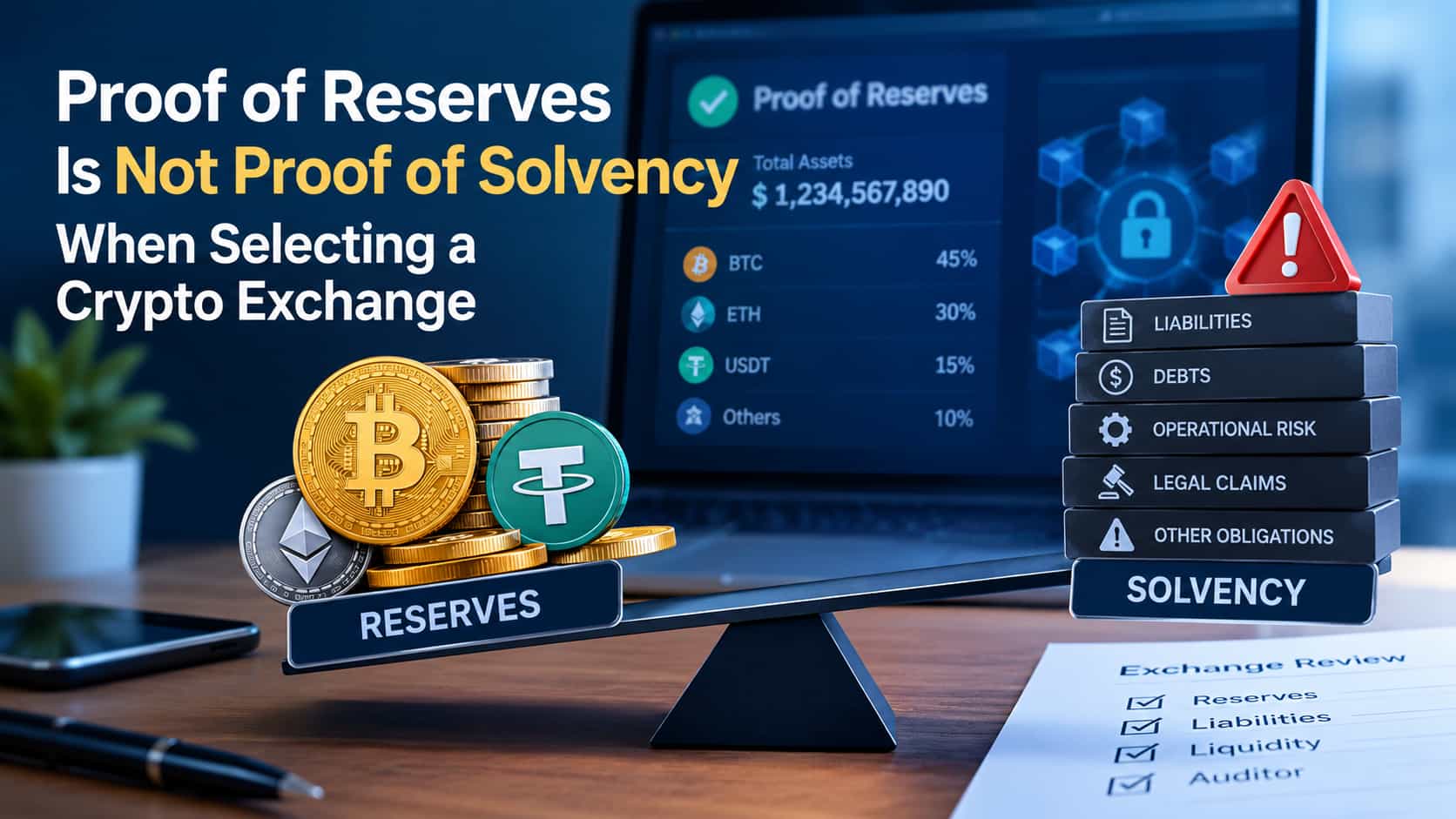
Proof of Reserves Is Not Proof of Solvency When Selecting a Crypto Exchange
Proof of reserves has become one of the first things crypto investors look for when evaluating an exchange. That makes sense. If a platform holds customer assets, users should have some way to confirm that those assets exist.
The problem starts when proof of reserves is treated as a complete financial health check.
A reserve report can show that an exchange controls certain Bitcoin, Ether, stablecoins, and other digital assets at a particular moment. It may even allow individual customers to confirm that their balances were included. What it doesn’t necessarily reveal is every debt, corporate obligation, or financial risk sitting elsewhere on the exchange’s balance sheet.
CryptoVantage encourages exchange users to examine proof of reserves as one useful signal rather than a blanket guarantee. The real question isn’t simply whether an exchange has assets. It’s whether those assets are sufficient, liquid, and available when customers want to withdraw.
What Proof of Reserves Actually Shows
Proof of reserves, usually shortened to PoR, is a method used by exchanges and other custodians to demonstrate that they control assets associated with customer deposits.
The process varies between platforms. An exchange might publish wallet addresses so users can inspect balances on a blockchain. It might hire an outside accounting or security firm to check those addresses. Some platforms also provide cryptographic tools that let customers confirm that their individual balances were included in the calculation.
That last part is important. An exchange could publish a collection of well-funded wallets without showing how those assets compare with the total amount owed to users.
A stronger proof-of-reserves process attempts to verify both sides of that specific calculation: the assets controlled by the exchange and the customer balances included in the report.
This still isn’t the same as a complete financial audit. It is better understood as a focused custody check. Useful, yes. All-encompassing, no.
How Merkle Trees Protect Customer Information
Exchanges don’t want to publish a public list containing every customer’s account balance. Customers probably wouldn’t be thrilled about that either.
Merkle trees offer a way to verify the inclusion of account data without publicly revealing the entire customer database. Balances are converted into cryptographic hashes and organized into a tree-like structure. The final result is represented by a single value called a Merkle root.
A customer can receive information that allows them to confirm that their account was included in the dataset used to produce that root. They don’t need to see anyone else’s identity or balance.
This improves privacy and makes it harder to change one record without affecting the final cryptographic result. However, the technology cannot independently determine whether the exchange supplied a complete list in the first place. The reliability of the process still depends on the methodology, the quality of the data, and any independent verification involved.
Cryptography can confirm that information fits together. It can’t magically confirm that nothing important was left out.
Start With the Available Reserve Data
Investors don’t need to examine blockchain addresses manually every time they compare an exchange. Tracking tools can organize reserve disclosures and make differences between platforms easier to see.
Readers can use CoinGabbar’s Proof of Reserve dashboard to review available exchange reports, transparency information, and reserve data. The dashboard can provide a useful starting point for identifying which platforms publish disclosures and which ones offer little public evidence about customer backing.
The presence of a report should begin the research process rather than end it. Look at when the information was last updated, which assets were included, and whether customer liabilities form part of the calculation.
A report covering Bitcoin, Ether and USDT may be helpful, but it doesn’t necessarily say anything about hundreds of smaller assets held by customers. Likewise, a report published months ago may not reflect the exchange’s current financial position.
Recency matters. So does scope.
Reserves Are Only One Side of the Balance Sheet
Imagine someone showing you a bank account containing $100,000. That sounds reassuring until you learn that the same person owes $150,000.
Crypto exchanges can face the same basic problem on a much larger scale. They may control substantial assets while also carrying customer obligations, loans, operational debts, derivatives exposure, legal claims, or liabilities to affiliated businesses.
A basic reserve snapshot may not capture all of those commitments. Even when customer balances are included, the report might not address obligations outside the trading platform.
Solvency requires more than owning valuable assets. A solvent company must have enough assets to meet its total liabilities. It must also be able to access those assets when obligations become due.
This distinction became painfully clear during the collapse of FTX. The company held assets, but customers couldn’t withdraw their money as the scale of its financial problems emerged. Its exposure to the FTT token and the relationship between FTX and Alameda Research showed why exchange-issued assets and connected companies deserve close attention.
The lesson wasn’t that reserves are pointless. It was that reserves without a broader understanding of liabilities can create false comfort.
The Type of Asset Matters
Two exchanges might report the same total value in reserves while presenting very different levels of risk.
Bitcoin, Ether, and widely traded stablecoins generally have deeper global markets than a small token issued by the exchange itself. An exchange holding a large share of reserves in its own token may face a circular problem. The reported value depends partly on confidence in the same company whose finances are being evaluated.
If confidence falls, the token price may drop. Selling a large position can push the price down further, particularly if market liquidity is limited. The exchange could then discover that the reserves were worth far less than their reported value at the moment they were most needed.
Users should look beyond the headline reserve ratio and inspect the composition of the assets. Ask how much consists of major liquid cryptocurrencies, recognized stablecoins, fiat holdings, or less liquid platform-related tokens.
A reserve ratio above 100% sounds impressive, but its usefulness depends on what makes up that percentage.
A Snapshot Is Still Just a Snapshot
Most proof-of-reserves reports describe conditions at a specific point in time.
That creates a fairly obvious limitation. Assets can be moved before or after the snapshot. Liabilities can change. Customers can deposit or withdraw funds. Market prices can rise or fall dramatically.
A single report from six months ago says less than a regularly updated disclosure supported by addresses that remain visible on-chain. Continuous or frequent reporting doesn’t eliminate risk, but it gives users a better chance of noticing unusual changes.
Check whether the exchange publishes reports on a predictable schedule. Look for previous editions rather than only the newest document. A consistent history can reveal whether the platform treats transparency as an ongoing responsibility or a temporary marketing exercise.
Sudden changes deserve attention too. A sharp reduction in a major reserve, a missed update, or the removal of previously available data doesn’t automatically prove that something is wrong. It does justify further questions.
Who Performed the Check?
The phrase “independently verified” can mean several things.
A report may come from a major accounting firm, a specialist blockchain auditor, or a security company. In other cases, the exchange may publish its own wallet information without any outside assessment.
Read the wording carefully. An attestation, an agreed-upon procedures engagement, and a full financial-statement audit are not interchangeable. They examine different information and provide different levels of assurance.
The report should identify who carried out the work, what information was examined, and what limitations applied. If the methodology is vague, the exchange logo and a large reserve percentage don’t fill that gap.
Auditor independence also matters. Investors should be able to determine whether the reviewing company has another financial relationship with the exchange and whether it has enough access to test the claims being made.
The CryptoVantage overview of how crypto exchanges publish proof of reserves provides additional context on exchange disclosures, third-party checks, and Merkle-tree verification.
How Major Exchanges Approach Transparency
Large exchanges don’t all disclose information in the same way.
Kraken has a history of using proof-of-reserves processes that allow eligible customers to verify that their account balances were included. Binance and OKX also publish reserve information and provide cryptographic verification features for supported assets.
Coinbase operates under a different corporate structure because it is a publicly traded US company. Its financial statements and regulatory filings provide information beyond an on-chain reserve page. That doesn’t remove operational, market, or custody risk, but public reporting gives investors another category of evidence to examine.
Indian users may also encounter reserve reports from platforms such as CoinDCX. Local exchange customers should consider how INR balances, banking relationships, and domestic regulatory requirements fit alongside reported cryptocurrency reserves.
Comparisons need to account for these differences. One exchange might publish wallet addresses frequently but provide limited corporate financial information. Another might release audited financial statements but offer less direct customer-level cryptographic verification.
There is no single disclosure that answers every question.
Withdrawal Performance Is a Practical Signal
An exchange can publish reassuring numbers and still create problems for customers trying to remove their assets.
Before depositing a large amount, examine the withdrawal process. Check whether the exchange supports withdrawals for the required cryptocurrency and network. Look at fees, processing times, minimum amounts, and any identity-verification requirements.
A small test withdrawal can reveal whether the process works as expected. It may carry an extra fee, but that cost can be worthwhile before committing a larger balance.
Repeated withdrawal delays, unexplained maintenance, or sudden restrictions should be taken seriously. Temporary interruptions can happen for legitimate technical reasons. A pattern of excuses across several assets is harder to dismiss.
Customer support matters here as well. When a withdrawal is delayed, users need access to a real escalation process rather than automated replies that lead nowhere.
Proof of reserves tells you something about assets. Withdrawal performance tells you whether customers can actually access them.
Five Questions to Ask Before Trusting a Reserve Report
Begin with the date. A recent report is more useful than an old snapshot that hasn’t been refreshed.
Next, check the scope. Identify which cryptocurrencies, customer accounts, and business entities are included. An exchange may operate through several legal companies, while the report covers only one.
Then look at liabilities. Does the report include a cryptographic representation of customer balances, or does it merely list wallets controlled by the exchange? Does it mention debts and obligations beyond customer deposits?
Review the asset mix as well. Reserves concentrated in an exchange-issued token or illiquid assets deserve more scrutiny than a diversified pool of widely traded holdings.
Finally, examine who performed the verification. The reviewer, methodology, limitations, and reporting standard should be clearly stated.
If these questions can’t be answered, the reserve percentage alone isn’t enough.
Proof of Reserves Doesn’t Replace Self-Custody
Even a transparent exchange remains a custodian. The platform controls the private keys and processes customer withdrawal requests.
Exchanges can still be useful for buying cryptocurrency with local currency, accessing liquid markets, and placing trades. Keeping funds on one may be reasonable for an active trader who needs immediate market access.
Long-term holders face a different decision. Moving assets to a personal wallet reduces exposure to an exchange’s financial health, but it introduces the responsibilities of self-custody. The owner must protect the recovery phrase, verify addresses, and understand what happens if the wallet or backup is lost.
A hardware wallet from Ledger or Trezor can keep private keys away from an internet-connected computer. It cannot prevent every mistake, and no device can recover a lost backup on the owner’s behalf.
The choice isn’t between risk and no risk. It is between different kinds of responsibility.
Transparency Is a Starting Point, Not a Guarantee
Proof of reserves has improved the amount of information available to crypto customers. Exchanges that publish verifiable wallet data and include customer balances give users more evidence than platforms asking for trust without proof.
Still, a reserve report shouldn’t be read as a promise that an exchange can never fail.
Users should consider total liabilities, asset quality, reporting frequency, auditor independence, and withdrawal reliability. They should also decide how much cryptocurrency genuinely needs to remain on a trading platform.
The strongest approach is simple: verify what can be verified, question what remains hidden, and avoid treating any single metric as a complete measure of safety.
About the Author
CryptoVantage is a cryptocurrency publication providing educational guides, news, analysis, and reviews covering Bitcoin, blockchain, exchanges, wallets, fintech, and digital assets. Its team of writers, researchers, and cryptocurrency specialists creates accessible content for both newcomers and experienced crypto users, helping readers better understand the rapidly evolving digital-asset industry.














.webp)