US Digital Credit ETF: DCAP Brings a New Bitcoin Income Bet


US Digital Credit ETF Debuts as Tuttle Capital and Strive Launch DCAP
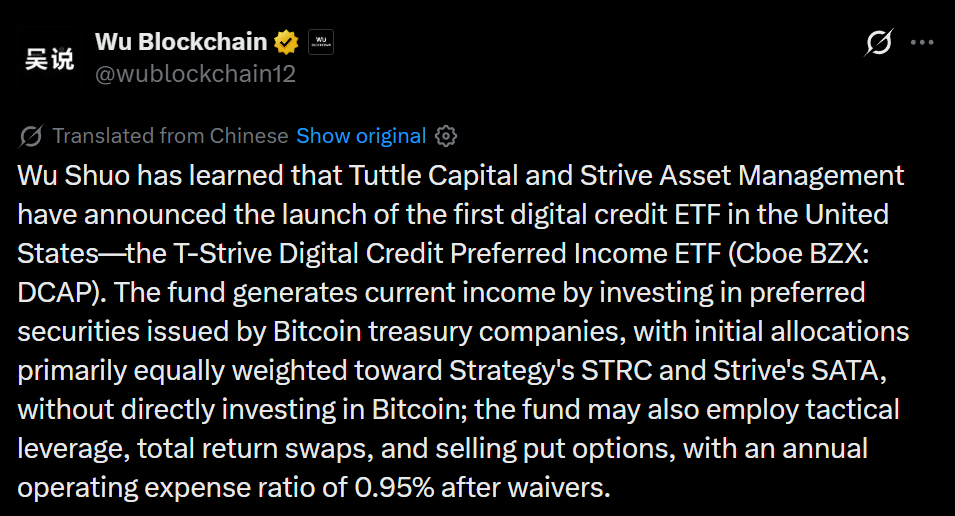
Something genuinely new just hit the market. Tuttle Capital Management and Strive Asset Management have launched what they're calling the first US Digital Credit ETF, a fund that lets everyday investors earn income tied to Bitcoin treasury companies without actually holding a single Bitcoin.
Here's a full, easy-to-follow breakdown of what this fund actually does and why it's different from a typical crypto ETF.
Source: WuBlockchain on X
What DCAP Actually Is
According to the official launch announcement, the T-Strive Digital Credit Preferred Income ETF, trading under the ticker DCAP on Cboe BZX, is an actively managed fund that generates income by investing in preferred securities issued by companies that hold Bitcoin on their balance sheets.
Importantly, the fund itself never buys Bitcoin directly; its returns instead depend on whether these companies can keep paying dividends on the preferred stock they've issued.
Understanding the "Digital Credit" Category
This is built around a fairly new corner of the market that Tuttle Capital and Strive are calling Digital Credit.
A growing number of public companies have taken on Bitcoin as a core treasury asset, and many of them have funded that strategy by issuing preferred stock to raise capital.
That preferred stock sits in an interesting spot, somewhere between traditional bonds and common equity, and it's exactly the tranche DCAP is designed to invest in.
As Tuttle Capital founder and CEO Matthew Tuttle put it, the fund is built to "go where that income actually sits, the balance sheet, not the coin."
Where the Fund's Money Is Actually Going
At launch, DCAP is concentrating its holdings in two specific issuers:
| Issuer | Preferred Security | Ticker |
| Strategy Inc . (NASDAQ: MSTR) | Variable Rate Series A Perpetual Stretch Preferred Stock | STRC |
| Strive, Inc. (NASDAQ: ASST) | Variable Rate Series A Perpetual Preferred Stock | SATA |
The fund splits its allocation roughly equally between these two securities.
Worth noting, Strive, Inc. is an affiliate of Strive Asset Management, the fund's own sub-adviser, something the fund's own disclosures flag directly as a conflict of interest worth understanding before investing.
How the Fund Is Actually Structured
DCAP isn't a simple buy-and-hold basket. Under normal conditions, it puts at least 80% of its net assets into these preferred securities and related derivatives, but it also has real flexibility built in:
-
Uses tactical leverage through borrowings, reverse repurchase agreements, and total return swaps
-
Generally increases leveraged exposure after price declines and reduces it as prices recover
-
Writes put options on digital credit securities, both to generate extra income and to potentially buy in at attractive prices
-
Classified as non-diversified, meaning 25% or more of assets are concentrated in Bitcoin treasury company exposure
-
Total annual operating expenses sit at 0.95%, reduced from 1.05% through a fee waiver running through September 30, 2027
Alex Xethalis, Head of Distribution at Strive Asset Management, explained the reasoning this way: in normal markets, DCAP mostly just holds these securities without leverage, but if sharp price declines create what the considers attractive entry points, its financing capabilities let it lean in and buy those dips more aggressively.
The Real Risks Investors Should Understand
Because this fund's income ultimately depends on companies that hold a volatile asset, the risks here are meaningfully different from a standard bond fund.
A few worth calling out clearly:
-
This is a brand-new fund with no operating history, so there's no track record to judge performance against
-
The preferred securities are unsecured obligations, not backed by the issuers' actual Bitcoin holdings, meaning payouts depend entirely on the issuing company's overall creditworthiness
-
A sharp decline in Bitcoin's price could hurt these companies' ability to make dividend payments, even though the fund never holds Bitcoin itself
-
Heavy concentration in just two issuers means the fund's performance is closely tied to how well Strategy and Strive specifically perform
Why This Launch Matters for the Broader Market
DCAP represents a genuinely new way for investors to get exposure to the Bitcoin treasury company trend without taking on direct crypto price exposure.
Instead of betting on Bitcoin's price movement, investors are betting on whether companies holding Bitcoin can keep servicing the preferred stock they've issued to fund that strategy.
Given how many public companies have adopted this treasury model recently, this US Digital Credit ETF gives income-focused investors a structured way to participate in that trend from the credit side rather than the equity or spot-crypto side.
Conclusion
The launch of DCAP marks a real first for the US market, a fund built specifically around income from Bitcoin treasury company preferred stock rather than Bitcoin itself.
With its concentrated STRC and SATA holdings, active leverage strategy, and options writing, this US Digital Credit ETF is clearly positioned as a specialized, higher-risk income play rather than a simple passive holding, and anyone considering it should weigh the fund's newness and concentration risk carefully before diving in.
Disclaimer
This article is for educational and informational purposes only and should not be considered financial or investment advice. Always conduct your own research before making investment decisions.









