DTCC Tokenization Service Set to Cover $114 Trillion in Assets

DTCC Tokenization Service to Launch With 100+ Firms Onboard
The Depository Trust & Clearing Corporation (DTCC) is getting ready to launch the Tokenization Service in the fourth quarter of 2026.
Frank La Salla, President and CEO of DTCC, will take the stage at Link:NYC on October 29 to talk about one of the biggest infrastructure shifts Wall Street has seen in years. His appearance comes just weeks before the DTCC Tokenization Service is expected to go live, a project that will turn the custody business into blockchain-based tokens.
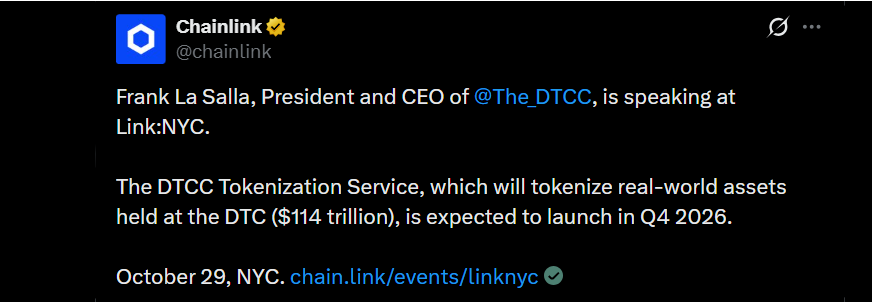
Source: X Offiical
The service targets a market worth $114 trillion, which is the total value of securities held at the Depository Trust Company (DTC), a DTCC subsidiary. It will convert some of those holdings into blockchain-based tokens, starting with Russell 1000 stocks, major index ETFs, and U.S. Treasuries.
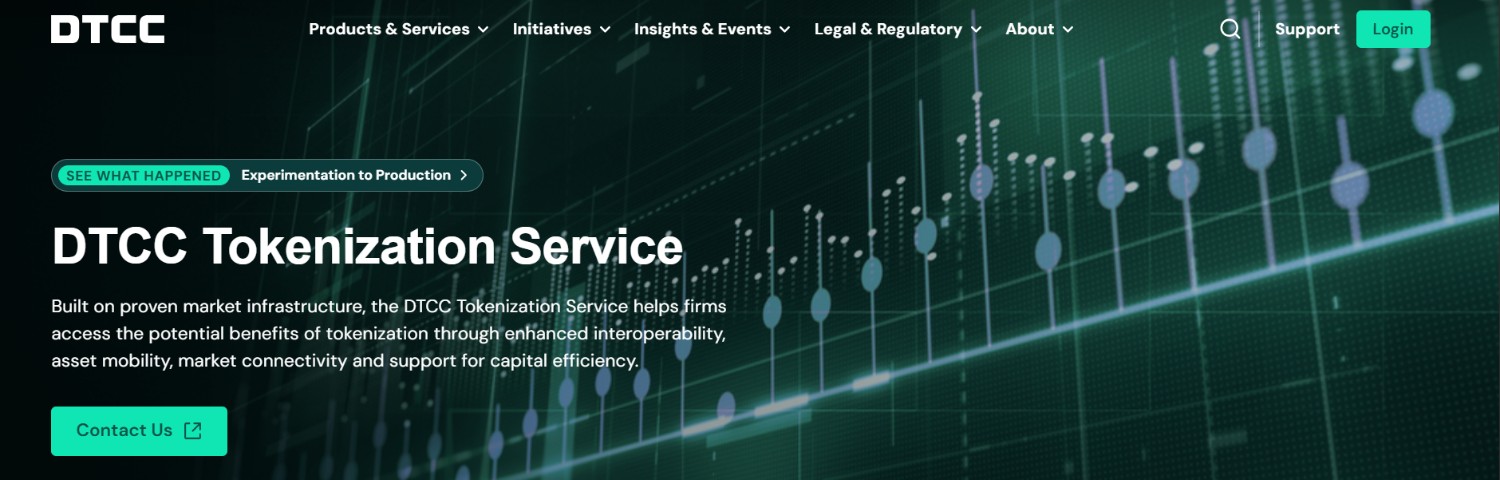
Source: Official Page
That timing is not a coincidence. The service is entering its final stretch before a fourth-quarter 2026 launch, and La Salla's talk gives the clearest public signal yet that DTCC is treating this as a near-term reality rather than a distant experiment.
How the DTCC Tokenization Service Will Work for Investors and Banks
The idea is simple on paper. Firms that already hold securities at DTC can request a tokenized version of the same asset. DTCC then mints a digital twin of that security and sends it to an approved wallet.
Each token carries the same CUSIP number, the same ownership rights, and the same entitlements as the original security. Nothing about legal ownership changes. Only the format does.
Key features of the setup include:
Tokens can be converted back to traditional book-entry form at any time
The same CUSIP is used for both the traditional and tokenized version
Built-in controls allow minting, burning, pausing, and clawback for compliance
Transfers between approved wallets can happen 24 hours a day
The service runs on DTCC's ComposerX platform and is authorized under a December 2025 SEC No-Action Letter, which gives it a three-year window to operate.
Major Wall Street Firms Join the Tokenization Working Group Quickly
More than 100 firms have joined the working group behind this effort. That list includes BlackRock, Goldman Sachs, and JPMorgan, along with several other large banks, asset managers, and exchanges.
The group grew fast. It started with around 50 members and has since doubled in size, a sign that big institutions see real value in tokenized settlement.
In July, the group completed production trades using assets already held at DTC. More than 30 firms took part, covering use cases such as collateral pledges, securities lending, and Treasury repo settlement. Those trades gave DTCC the confidence to move toward a full commercial launch this quarter.
Chainlink Powers Collateral Management Across Multiple Blockchains
Chainlink is playing a supporting role in this rollout. It provides the runtime environment and data standards behind the Collateral AppChain, a system built to help firms manage collateral across different blockchain networks without friction.

Source: Official X Channel
This matters because tokenized assets are only useful if they can move smoothly between networks. Chainlink's tools aim to make that movement consistent and reliable, no matter which blockchain a firm prefers to use.
Frank La Salla, President and CEO of DTCC, will speak about the tokenization effort at the Link:NYC event on October 29 in New York. He has discussed similar topics at recent industry panels alongside executives from BlackRock and Vanguard.
What Comes Next for Tokenized Assets and Global Financial Markets
DTCC processed roughly $4.7 quadrillion in securities transactions in 2025. Even a small share of that volume moving onto tokenized rails would mark one of the largest shifts in market infrastructure in decades.
The near-term plan includes onboarding more participants, expanding supported networks, and adding more asset types once the October launch proves stable.
What stands out here is who is doing the building. This is not a crypto-native project trying to attract traditional finance. It is traditional finance's own infrastructure provider choosing to build the bridge itself, with the same custody, compliance, and investor protections that have anchored U.S. markets for decades.
Disclaimer: This article is for informational purposes only and does not constitute financial or investment advice. Crypto markets carry significant risk. Always do your own research before making any investment decisions.