Clarity Act News Today: The Global Crypto Rules You Need to Know


Clarity Act News Today: How Do US Crypto Rules Compare Globally?
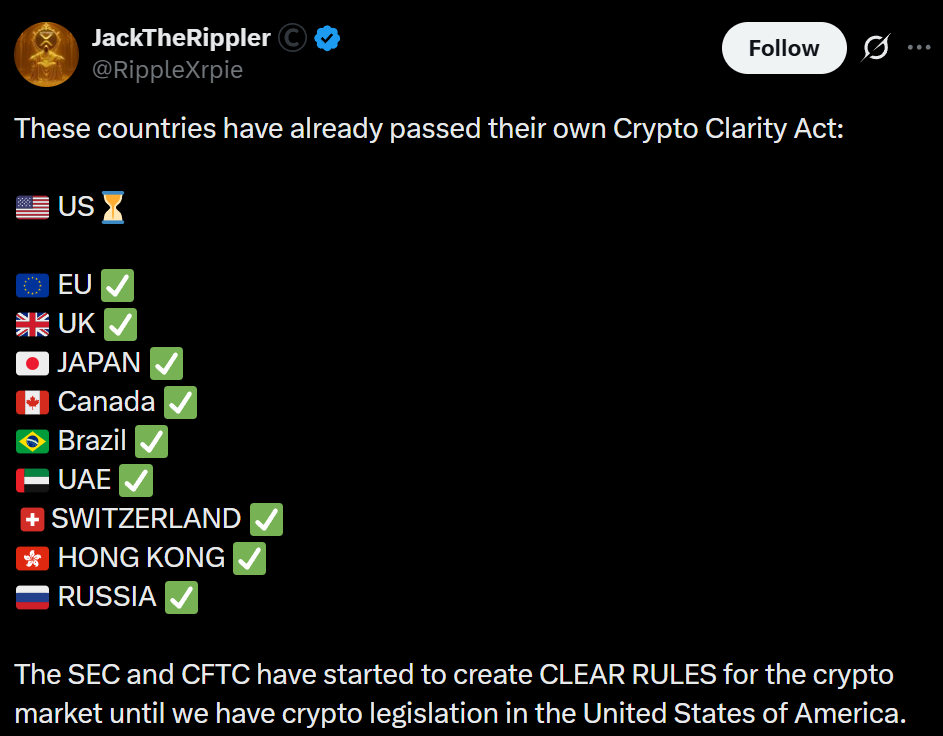
Here's the accurate version of a story making the rounds online. A recent post claimed multiple countries, including the US, have already passed their own "Crypto Clarity Act." That's not quite right on one key point: the US version is still stuck in Congress.
But the broader claim has real substance underneath it, several major economies genuinely have their own comprehensive crypto frameworks already active or nearly finalized.
This piece of Clarity Act news today breaks down what's actually true, country by country.
Where the US CLARITY Act Actually Stands
Despite the framing in recent social media posts, the US CLARITY Act has not passed into law.
It remains stuck in the Senate, needing 60 votes to overcome a filibuster, a threshold Republicans alone can't clear without Democratic support.
Treasury Secretary Scott Bessent , SEC Commissioner Paul Atkins, and Representative French Hill have all publicly urged the Senate to move faster, warning that continued delays risk pushing crypto innovation to jurisdictions like Abu Dhabi and Singapore.
The bill is meant to extend the framework the GENIUS Act established for stablecoins into a full market structure covering tokenized securities, exchanges, and blockchain settlement.
Russia's Framework Is Real and Dated
One country where the underlying claim genuinely checks out is Russia. The State Duma passed its "On Digital Currency and Digital Rights" law through second and third readings on July 21, 2026, with the bill formally clearing its first reading back in April with 327 of 340 votes in favor.
Key details of what this law actually does:
-
Classifies cryptocurrency as property under the Russian civil code, not as legal tender
-
Bans domestic crypto payments for everyday purchases but permits cross-border settlement
-
Puts the Bank of Russia in charge of licensing exchanges, brokers, and custodians
-
Sets a retail investment cap around $3,800
-
Main provisions take effect September 1, 2026, with stricter enforcement arriving in mid-2027
How the EU, UK, and Japan Compare
Beyond Russia, several other jurisdictions do have active or advancing frameworks, just not ones literally branded "Crypto Clarity Act":
| Region | Framework | Status |
| European Union | MiCA (Markets in Crypto-Assets) | Phased rollout, full enforcement by 2026 |
| United Kingdom | FCA crypto regime / Cryptoassets Regulations 2026 | Implementation ongoing, broader perimeter expected later |
| Japan | Amended Financial Instruments and Exchange Act + Payment Services Act | Further reclassification underway in 2026 |
Each of these represents years of regulatory groundwork.
MiCA in particular has been one of the most closely watched frameworks globally, since it applies uniformly across all EU member states rather than country by country.
Canada, Brazil, UAE, Switzerland, and Hong Kong
The remaining countries named in the original claim each have their own licensing regimes or comprehensive frameworks at varying stages of maturity.
Canada, Brazil, the UAE, Switzerland, and Hong Kong have all built out licensing structures for exchanges and digital asset service providers, some more mature than others, but none of them are literally called a "Clarity Act" either.
The common thread across all of them is the same underlying goal the US bill is trying to achieve: clear rules for custody, trading, and market structure instead of relying on enforcement actions to define the boundaries after the fact.
Why the US Framing Matters So Much Right Now
This is really the heart of today's Clarity Act news. While other major economies have moved from proposal to actual law, the US remains the one major holdout still negotiating basic market structure legislation.
Sacks and Atkins have both pushed publicly for Congress to act, with Atkins specifically noting that the SEC and CFTC are structuring their own rulemaking so they're ready the moment Congress passes something.
That's a notable admission; regulators are essentially waiting on lawmakers rather than the other way around.
Conclusion
The core claim behind this round of Clarity Act news today gets one big detail wrong: the US hasn't passed its own version yet, and it remains genuinely uncertain whether it will clear the Senate this year.
But the broader picture is accurate: Russia, the EU, the UK, and Japan all have real, dated regulatory frameworks either fully active or actively rolling out, while Canada, Brazil, the UAE, Switzerland, and Hong Kong continue building out their own systems.
The real story here isn't that everyone already has clarity; it's that the US is visibly behind several other major economies on this specific front.
Disclaimer
This article is for educational and informational purposes only and should not be considered financial or investment advice. Always conduct your own research before making investment decisions.










