Chainlink Crypto News: LINK Reserve Just Crossed $70 Million


Chainlink Crypto News: Why Is the LINK Reserve Growing So Fast?
Fresh Chainlink crypto news just landed straight from the network's own treasury dashboard.
The Chainlink Reserves added another $1.1 million worth of LINK today, pushing the total value of its holdings to roughly $70.5 million.
What makes this particularly notable isn't just the size; it's the consistency: not a single token has been sold from this reserves since it first launched.
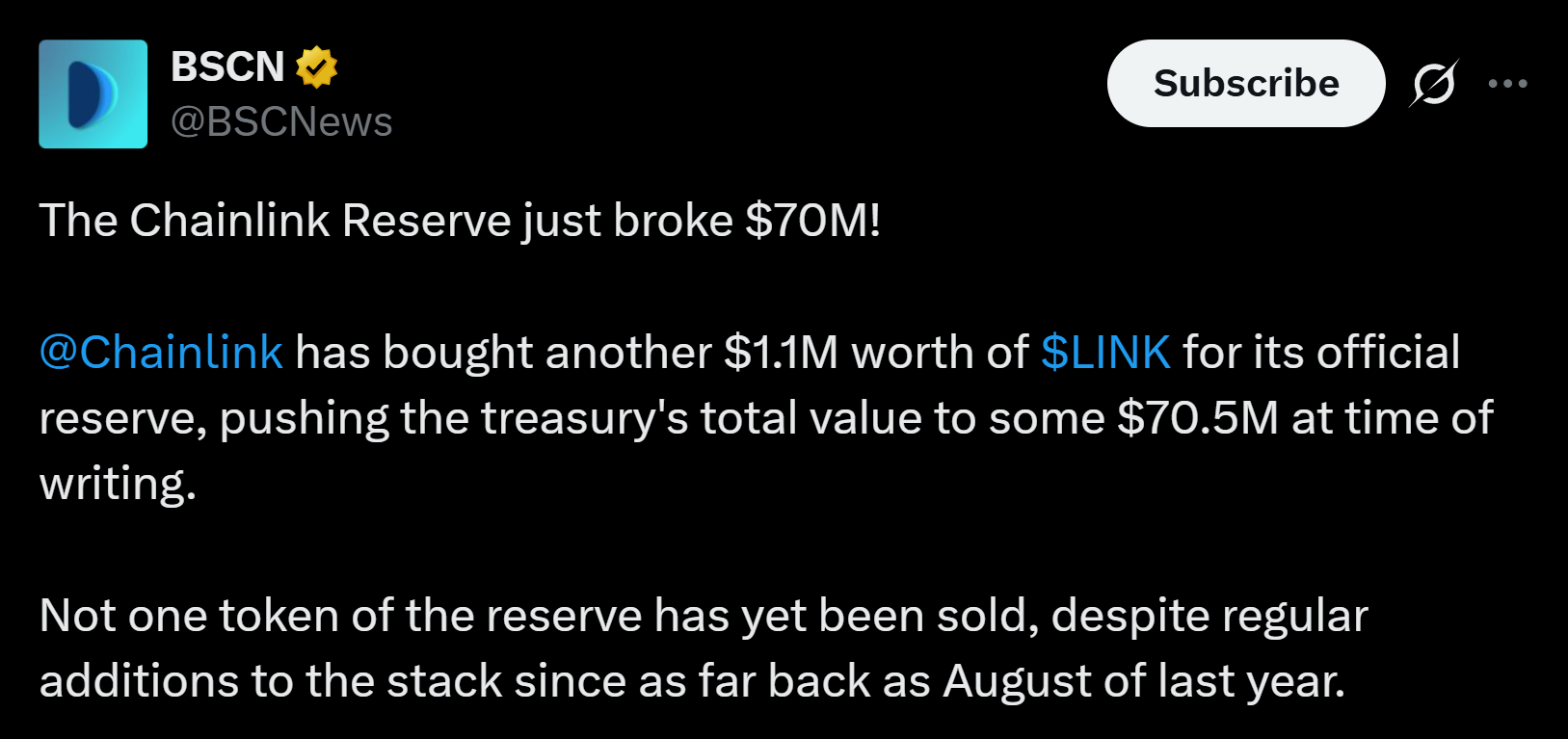
Source: BSCNews on X
What the Chainlink Reserve Actually Is
Per Chainlink's own reserve dashboard, the Chainlink Reserves is described as an upgrade to the Chainlink platform built specifically to create a strategic, on-chain reserves of LINK.
It launched on August 7, 2025, as part of a broader set of changes the network calls Economics 2.0.
Rather than relying on token emissions or inflation, the reserves is funded through something called Payment Abstraction, a system that automatically converts revenue, both from enterprise clients paying offchain and from on-chain decentralized app usage, directly into LINK tokens.
How Today's $1.1 Million Addition Fits the Bigger Pattern
This isn't a one-time event; it's the latest entry in a steady accumulation pattern that's been running for over a year now.
A look at the reserve's growth trajectory shows just how consistent this has been:
Milestone | Approximate Date |
Reserves launched (~70,000 LINK, ~$1M) | August 7, 2025 |
Crossed 1 million LINK | Early December 2025 |
Passed 1.4 million LINK | Early January 2026 |
Reached ~2.3 million LINK | Late February 2026 |
Climbed past 3.9 million LINK | Late May 2026 |
Surpassed 5.2 million LINK | Late July 2026 |
Total value crosses $70.5 million. | Today |
Early inflows into the reserve averaged around 80,000 to 90,000 LINK per week in late 2025.
By early 2026, that pace had climbed to between 125,000 and 137,000 LINK weekly, roughly a seven-fold increase in the revenue feeding the system since it first began.
Why No Tokens Have Ever Been Sold
One of the more distinctive design choices behind this reserve is built directly into its structure.
The smart contract holding these funds includes a multi-day timelock specifically designed to prevent withdrawals, and Chainlink has stated it doesn't expect any tokens to be pulled out for multiple years.
That's a meaningful detail in this round of Chainlink crypto news, since it means every dollar of enterprise and on-chain revenue converted into LINK effectively gets removed from circulating supply for the foreseeable future, rather than being available to sell at the first sign of profit.
What's Been Driving the Growth
The accumulation isn't happening in a vacuum; it's tied directly to real business activity.
A few developments that have contributed to the reserve's expansion include growing enterprise adoption of Chainlink's infrastructure, DTCC's approval of tokenization initiatives that route through Chainlink, UBS launching tokenized funds using the network, and Coinbase bridging billions in wrapped assets through Chainlink's infrastructure.
Because the reserve's funding mechanism directly ties enterprise and onchain revenue to LINK purchases, this kind of expanding institutional usage shows up almost directly as reserve growth over time.
What This Milestone Signals Going Forward
Crossing $70 million in reserve value is a clear signpost, but the more important story here might be the underlying trend rather than any single number.
A few reasons this pattern is worth watching:
The reserve's growth has been remarkably steady rather than driven by isolated spikes
Weekly inflow rates have scaled substantially as enterprise revenue sources have multiplied
Zero token sales since inception reflects a genuinely long-term holding structure, not just a marketing claim
Conclusion
This round of Chainlink crypto news marks a real milestone, with the Chainlink Reserve's holdings now valued at roughly $70.5 million after today's $1.1 million addition, all without a single token ever being sold since the program launched back in August 2025.
With weekly inflows continuing to scale alongside growing enterprise adoption, this reserve looks less like a short-term treasury experiment and more like a structural mechanism tying LINK's long-term value directly to the network's real-world usage.
Disclaimer
This article is for educational and informational purposes only and should not be considered financial or investment advice. Always conduct your own research before making investment decisions.