CLARITY Act News: What SEC and CFTC Doing After Crypto Bill Failure?


CLARITY Act News: Why Is Market Rallying After The Crypto Bill Failed?
This CLARITY Act News update starts with a surprise. The bill failed to advance in the Senate on Sept. 16, 2026, yet crypto markets rallied afterward.
Within days, the SEC and CFTC announced new steps on tokenized assets, market rules, and custody. That raises a clear question. Did the Senate setback slow crypto regulation, or did it push regulators to act faster?
At a Glance
-
The Senate did not advance the Crypto Bill 2026 on Sept. 16.
-
The SEC announced an Innovation Exemption for certain tokenized-stock trading.
-
The CFTC sent its crypto-market rules to the White House for review.
-
Bitwise CIO Matt Hougan says the industry gave up long-term certainty but got faster rules.
-
Agency action is not the same as a law passed by Congress.
Why Did Crypto Rally After CLARITY Act Senate Setback?
Bitwise CIO Matt Hougan's explanation of the rally. He argues the industry "sacrificed long-term certainty and got better rules, faster." In his view, the SEC and CFTC moved in with measures that were more favorable than the bill itself would have delivered.
This is his interpretation, not proven cause and effect. Many things can move crypto prices at once. Still, his view shows how some market watchers read the situation: the loss of legislation may have been offset by quicker agency action.

Source: X Post
What Is the SEC Doing After the CLARITY Act Failed?
SEC Chair Paul Atkins has said the agency is working to bring regulatory clarity to crypto. He has described the focus as supporting digital finance innovation and giving the market more certainty.
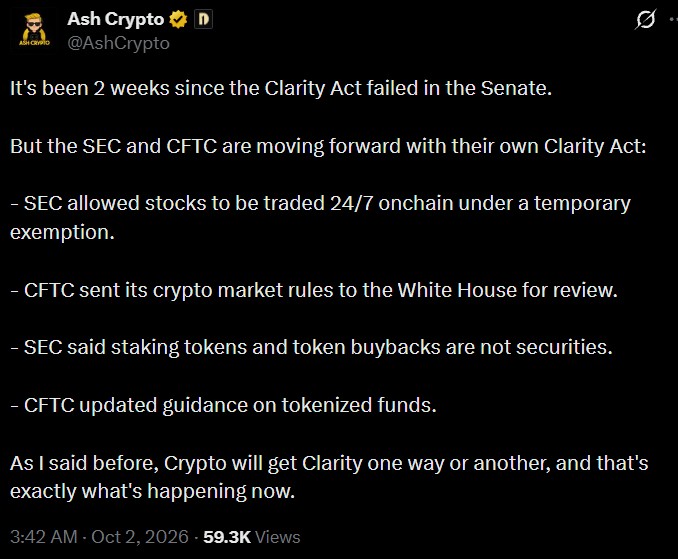
The clearest example is the Innovation Exemption announced on Sept. 17. It covers certain tokenized-stock trading. On Oct. 1, Reuters reported that the SEC proposed crypto-asset custody rules for investment advisers and funds. Together, these moves show the SEC acting through exemptions and proposed rules instead of waiting for Congress.

Source: Crypto Aman
What Is the CFTC Changing for Crypto Markets?
The CFTC sent its crypto-market rule proposal to the White House for review on Sept. 18, according to CoinDesk. That step usually comes before a rule is made public.
The agency also updated its guidance. On Sept. 24, it refreshed its FAQs to cover tokenized investments and blockchain recordkeeping. These changes give market participants more detail on how existing rules apply to newer products.
Source: Bitcoin Archive X
CLARITY Act vs SEC and CFTC Regulations: What Changes for Crypto Users?
The table below compares the two paths. Agency actions do not automatically provide the same statutory framework as an Act of Congress.
| Area | CLARITY Act | SEC/CFTC Approach |
| Legal framework | Congressional legislation | Existing agency authority |
| Regulatory certainty | Intended to create a broader statutory framework | Rules, interpretations, exemptions and guidance |
| Crypto market structure | Comprehensive framework | Agency-specific measures |
| Tokenized assets | Legislative treatment | |
| Banks | Proposed broader crypto permissions | Existing banking and regulatory framework remains relevant |
| Long-term durability | Would be established in statute | Can depend on agency rules and future policy |
Can Banks Expand Crypto Activities Without the CLARITY Act?
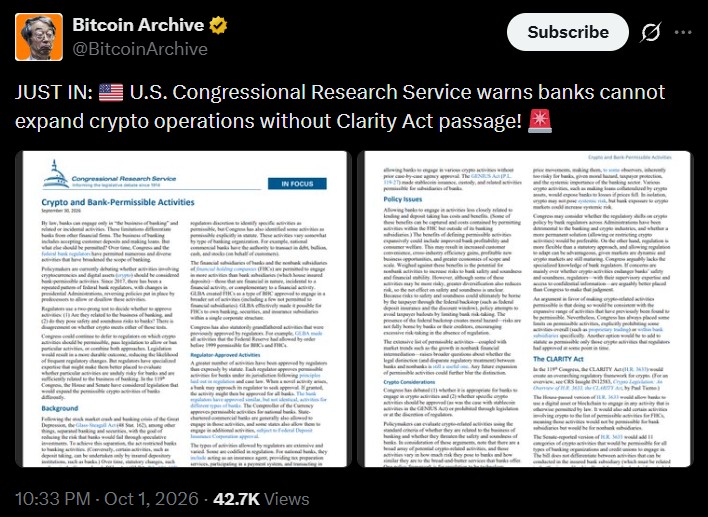
Some social media posts claim banks cannot expand crypto operations without the bill. That is too simple. The Congressional Research Service published an updated analysis on Sept. 30 covering which crypto activities banks may already carry out. The report also explains how the Senate-reported bill would have changed that framework.
The accurate takeaway is that banks already operate under existing rules, and those rules still matter. The bill would have proposed broader permissions. Without it, banks work within the current framework and any guidance regulators issue.
Source: Ash Crypto X Post
CLARITY Act News Timeline: What Happened and What Comes Next?
-
Sept. 16, 2026: The CLARITY Act fails to advance in the Senate.
-
Sept. 17: The Securities and Exchange Commission announces its Innovation Exemption for certain tokenized-stock trading.
-
Sept. 18: The CFTC sends crypto-market rules to the White House for review.
-
Sept. 24: The CFTC updates FAQs covering tokenized investments and blockchain recordkeeping.
-
Sept. 30: The CRS publishes an updated analysis of crypto and bank-permissible activities.
-
Oct. 1: The SEC proposes crypto-asset custody rules for investment advisers and funds.
-
Oct. 2: Market discussion focuses on whether both actions can provide practical clarity while Congress remains stalled.
What Does the CLARITY Act Failure Mean for Crypto Investors and Traders?
For readers following the news, a few items are worth watching.
-
First, track the final text of any SEC and CFTC regulations, since proposals can change.
-
Second, watch tokenized-market developments, because the Innovation Exemption is limited in scope.
-
Third, follow banking access, where the CRS analysis explains the current limits.
-
Finally, see whether Congress returns to market-structure legislation.
None of this predicts prices, and each item can change quickly.
Conclusion: Is U.S. Crypto Regulation Moving Forward Without Crypto Bill?
Regulation is moving, but through a different route. The SEC and CFTC are acting faster than Congress, and some market voices see that as a good trade. The cost, as Hougan notes, is long-term certainty.
The laws written by agencies can shift with future leadership, while a statute is harder to undo. The latest CLARITY Act News shows speed and durability pulling in different directions.
YMYL Disclaimer: This article is for information only and is not financial, legal, or investment advice. Regulatory developments can change quickly. Crypto assets are volatile, and you can lose money. Please verify details with official sources before making any financial decision.












