AIOZ Crypto Explained: What the AIOZ Blockchain Actually Does

Why AIOZ Crypto Matters in the DePIN Ecosystem
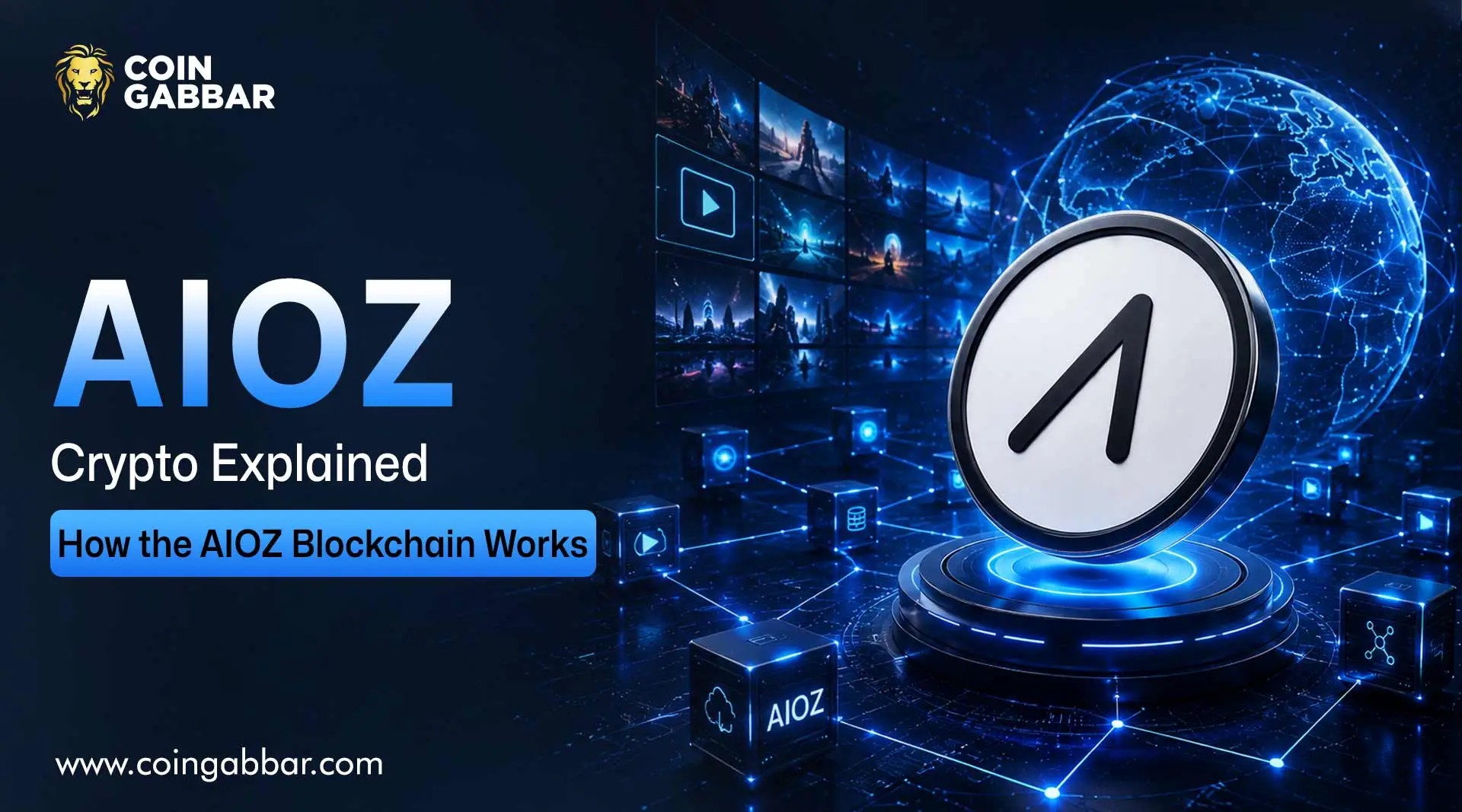
Most people run into AIOZ crypto while scrolling a top DePIN tokens list and wondering what the project actually does. Fair question. AIOZ isn't just another token chasing an AI narrative — it's tied to a working blockchain that pays real people for storage, streaming, and computing power they share from home.
This piece walks through what AIOZ-Network is, how the token's supply and burns work, and what to weigh before you buy. If you're new to crypto, stick around for the risk section near the end — it matters more than the price chart.
What Is AIOZ Network?
AIOZ Network describes itself as infrastructure for web-3 storage, decentralized AI computation, live streaming, and video on demand, all powered by everyday people running nodes. Instead of renting server space from a big cloud provider, apps built on AIOZ can pull storage, bandwidth, and compute from a global network of individual devices.
That's the core DePIN idea. You've probably used Web2 versions of this without thinking twice- YouTube for video, Dropbox for storage, AWS for computers. AIOZ's pitch is a decentralized version of all three, run by node operators who earn AIOZ-tokens for contributing.
The project launched its mainnet in December 2021, according to the project's own tokenomics documentation.
How Does the AIOZ Blockchain Work?
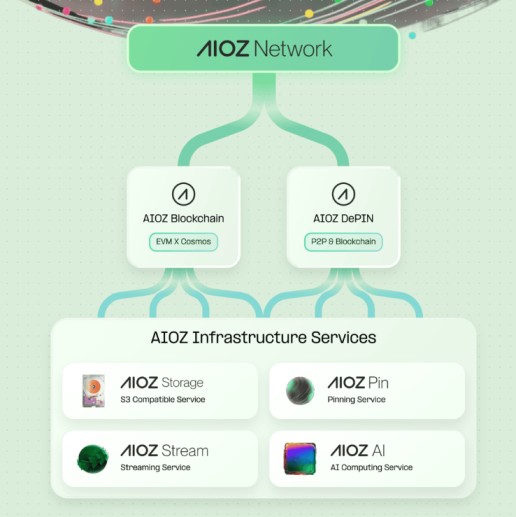
Here's where the "AIOZ blockchain" part gets specific. AIOZ-Network runs its own Layer-1 chain that combines the Cosmos SDK's Tendermint consensus engine with EVM compatibility. In simple terms, that means developers can write smart contracts in Solidity — the same language used on Ethereum — while the chain itself runs on Cosmos's faster, cheaper consensus system.
The network uses a delegated proof-of-stake model. Validators secure the chain, delegators stake it to back a validator, and both earn a share of network rewards. Bridges connect AIOZ to Ethereum and BNB Chain, plus Inter-Blockchain Communication links it to other Cosmos-based chains.
What Are AIOZ Network's Core Products?
The project groups its infrastructure into four products:
AIOZ-Storage — S3-compatible decentralized object storage, paid for in AIOZ tokens
AIOZ-Pin — IPFS pinning and file storage aimed at NFT and metaverse projects
AIOZ-AI — a marketplace where AI models run locally on node operators' devices, with node runners earning rewards for computing power
AIOZ-Stream — infrastructure for video hosting, transcoding, and decentralized CDN delivery
None of these are hypothetical roadmap items — the docs describe them as live infrastructure services, though the project itself acknowledges more native apps are still being built on top of them.
How Does AIOZ Crypto Tokenomics Work?
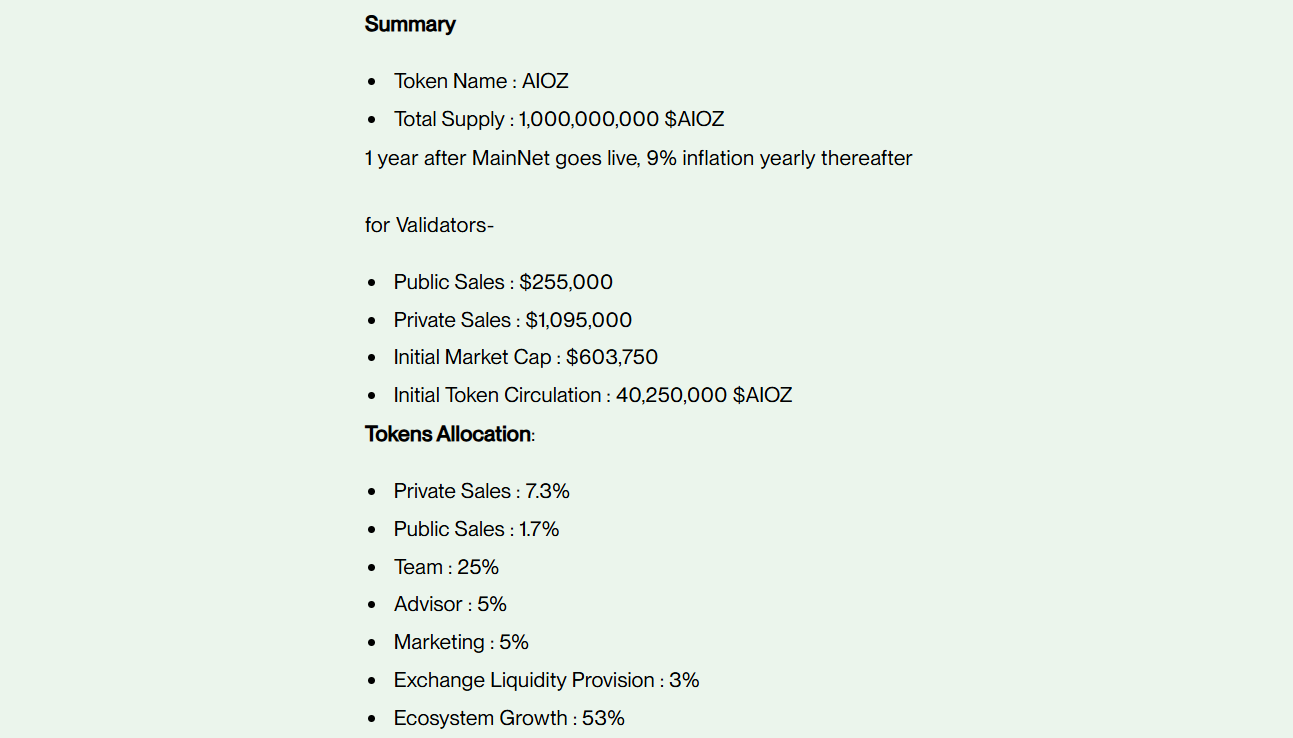
Inflation is scheduled to shrink. According to published tokenomics page, the network launched with a 9% annual inflation rate. Starting December 25, 2023, that rate was set to drop by 1% every year:
8% — December 2023
7% — December 2024
6% — December 2025
5% — December 2026 (target)
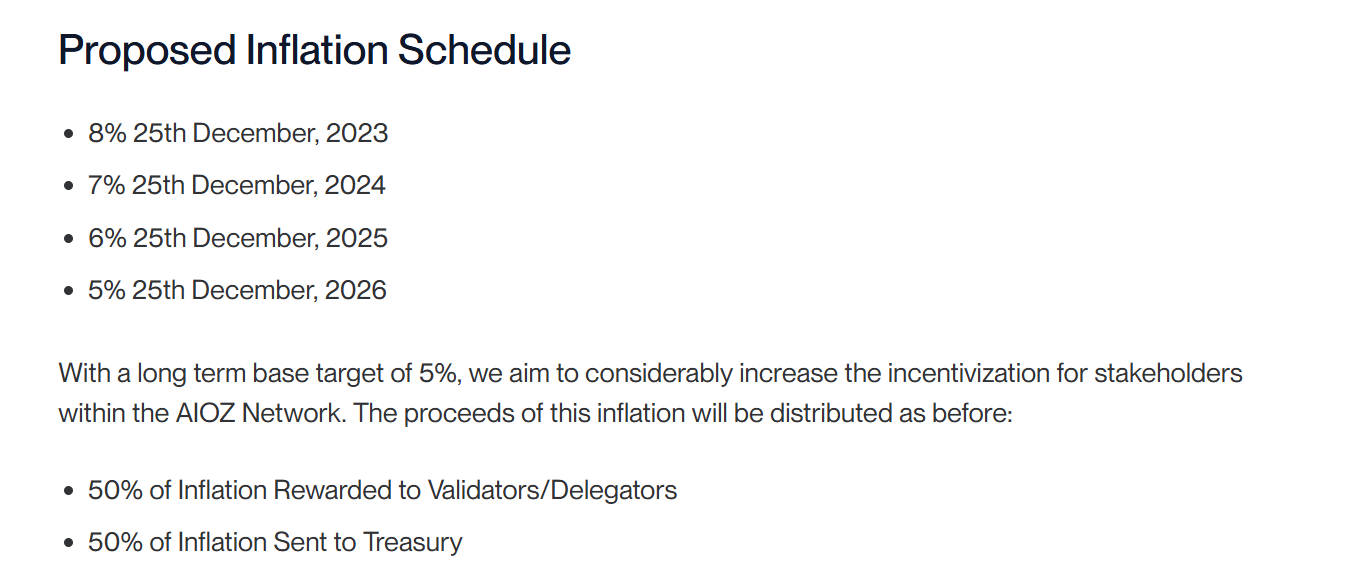
Half of all inflation rewards go to validators and delegators who stake the token. The other half goes to a network treasury earmarked for growing the four infrastructure products above — that's the project's stated plan, not a guarantee of how funds get spent.
Burns work against that inflation. The project says token burning happens in several places:
50% of all AIOZ-blockchain transaction fees
5% of all DePIN reward payouts
5% of infrastructure revenue
5% of native dApp revenue
Whether these burns meaningfully offset inflation over time depends on how much real usage the network generates — a variable, not a fixed number.
How to Buy and Stake AIOZ?
Pick an exchange. it is listed on several centralized exchanges, including KuCoin, Coinbase, and Kraken, per those platforms' own listing pages.
Get a compatible wallet. The project's tutorials cover Meta Mask, Keplr, and Ledger, since the chain supports both EVM and Cosmos-style wallets.
Bridge if needed. If you're moving AIOZ between Ethereum, BNB Chain, or Cosmos-based chains, use the official Gravity Bridge or IBC tools listed in AIOZ's- docs, never a random third-party bridge link.
Stake or delegate, if you want to earn a share of network inflation rewards, following the process on AIOZ's official staking guide.
AIOZ Crypto Risks and Due Diligence Checklist
Check This | Why It Matters |
Team and audit history | Confirm smart contract audits directly through-AIOZ's docs, not secondhand claims |
Real network usage | Node counts and data delivered matter more than marketing copy |
Token unlock schedule | Watch treasury and inflation-linked releases that can add sell pressure |
Exchange listing legitimacy | Only use exchanges you can verify independently |
Market cap vs FDV | Market cap reflects circulating supply only — it's not the same as total token value |
AIOZ Network Adoption and Market Position:
The stronger signal here is that it isn't a paper project — it has a functioning Layer-1 chain, live infrastructure products, and a multi-year track record dating to a December 2021 mainnet launch. That's more than plenty of DePIN tokens can claim.
The weaker signal is valuation. A market cap in the tens of millions, sitting roughly 97% below a 2021 peak, suggests the market hasn't rewarded AIOZ's product breadth the way it has rewarded narrower competitors in AI compute or decentralized storage.
Whether that's an opportunity or a warning depends on whether it has four-pillar approach — storage, AI, pinning, and streaming — turns into paying customers, or stays spread too thin to compete with specialists. Neither outcome is baked in yet.
Conclusion
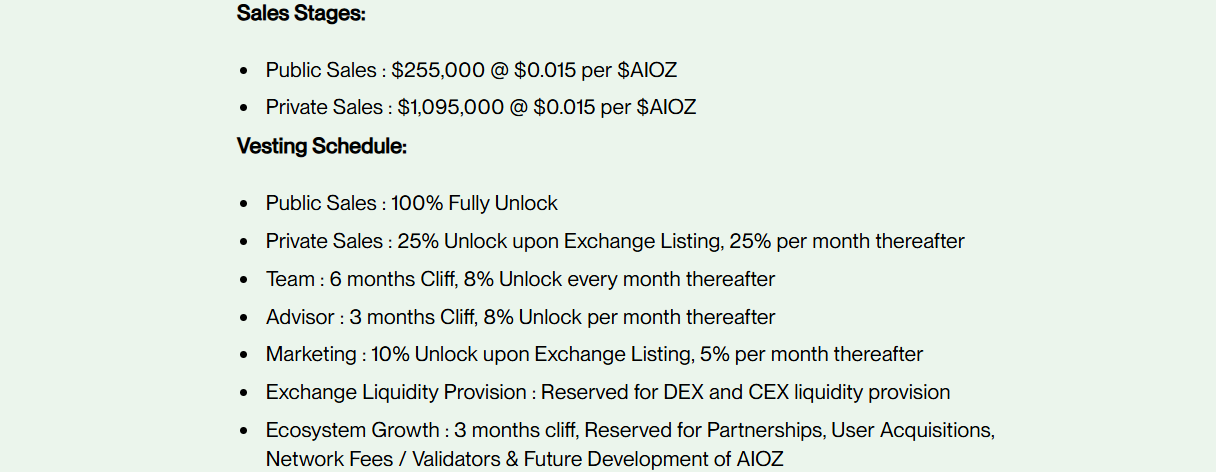
AIOZ-Network combines a Cosmos-EVM blockchain with a genuinely broad set of DePIN products — storage, AI compute, IPFS pinning, and video streaming — all paid for and rewarded in AIOZ-tokens. The tokenomics show a clear, published plan to taper inflation toward 5% by the end of 2026, backed by burn mechanisms tied to actual network usage.
None of that changes the fact that AIOZ-trades far below its 2021 high and sits outside the top 200 coins by market cap. Read the docs, check the explorer yourself, and size any position around what you can afford to lose.
Disclaimer:
This article is for informational and educational purposes only. It is not financial, investment, legal, or tax advice. Cryptocurrency markets is highly volatile and carry a real risk of partial or total loss. Prices, supply figures, and rankings cited here reflect data available at the time of writing and can change quickly. Always do your own research and consult a licensed financial advisor before making any investment decisions.