GXT Token Whitepaper v1.00 Is Now Officially Live


GXT Token Whitepaper: A New Standard of Transparency
New crypto exchanges often launch a token without ever publishing a clear, single document explaining how that token actually works. This leaves buyers guessing about supply limits, unlock schedules, and long-term utility.
GXT Exchange has published an official whitepaper aimed at addressing that gap.
On July 26, 2026, GXT Exchange announced that its official GXT token whitepaper version 1.00 is now live, giving the community one central reference for the token's full vision, tokenomics, roadmap, and product architecture.
In this guide, we break down what the GXT token whitepaper actually says, with a primary focus on the token itself rather than the exchange's broader platform features.
What Is the GXT Token Whitepaper
The GXT token whitepaper is the official document published on the GXT Exchange website that defines how the GXT token is created, allocated, mined, and used across the platform.
According to the document, it exists so the community has one authoritative source for supply and distribution details, instead of piecing this information together from scattered social posts.
The whitepaper was announced through the exchange's official X account, alongside hashtags covering its token, presale, and DeFi focus areas.
Why GXT Exchange Created This Whitepaper
According to the whitepaper, the document was written to formalize GXT's tokenomics before the project's Token Generation Event (TGE), the point at which GXT becomes a fully tradable asset.
Publishing supply caps, vesting terms, and unlock percentages ahead of time is meant to give presale buyers and mining participants a fixed reference point they can hold the project to.
The whitepaper also states that GXT is the native utility token of the GXT Exchange ecosystem, with a fixed, capped supply and no further minting planned beyond that cap.
GXT Token Supply and Total Allocation
GXT has a fixed total supply of 300,000,000 tokens, according to the whitepaper. The document describes GXT as non-inflationary, meaning the 300 million cap will not increase over time.
Of that total, 100,000,000 GXT (33.3%) is listed as circulating at TGE. The whitepaper calls this a "community-first" design, since the single largest allocation category is Community & Mining rather than team or investor holdings.
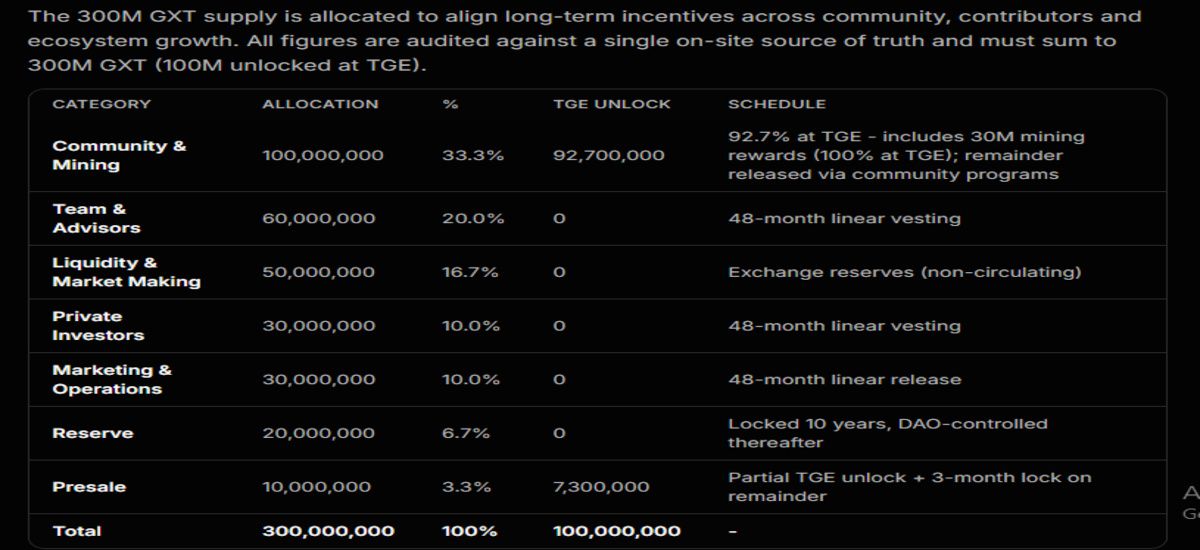
Source: Official Tokenomics Dashboard
Category | Allocation of token | % of Supply | TGE Unlock |
Community & Mining | 100,000,000 | 33.3% | 92,700,000 GXT (incl. 30M mining) |
Team & Advisors | 60,000,000 | 20.0% | 0% (48-month linear vesting) |
Liquidity & Market Making | 50,000,000 | 16.7% | 0% (non-circulating reserves) |
Private Investors | 30,000,000 | 10.0% | 0% (48-month linear vesting) |
Marketing & Operations | 30,000,000 | 10.0% | 0% (48-month linear release) |
Reserve | 20,000,000 | 6.7% | 0% (locked 10 years) |
Presale (Stages 1-3) | 10,000,000 | 3.3% | 7,300,000 GXT (remainder after 3-month lock) |
Total | 300,000,000 | 100% | 100,000,000 GXT |
GXT Token Utility: What the Token Is For
The whitepaper lists several use cases for GXT within the exchange ecosystem:
Trading fee discounts: Holders who pay fees directly in GXT get a lower rate than those paying in other assets, and this stacks on top of regular volume-based tiers.
Mining rewards users earn GXT through everyday platform activity like daily claims, referrals, and community tasks, not just by holding.
Launchpad access GXT opens the door to new token launches hosted on the exchange, giving holders early entry others don't get.
Staking, locking up GXT, lets holders earn passive returns instead of leaving tokens idle in a wallet.
VIP tier benefits: The more GXT someone holds or stakes, the higher perks they unlock, similar to loyalty tiers on other exchanges.
Affiliate and referral commissions bringing new users to the platform pay out in GXT, tying growth incentives directly to the token.
Premium service payments GXT covers upgraded features on the platform, including the upcoming GXT Pay Card.
This spread of utility is a key reason the whitepaper positions GXT as central to the exchange's ecosystem rather than a purely speculative asset.
GXT Mining Program Explained
Mining runs in three separate phases, starting June 25 and wrapping up August 1, 2026. Each phase releases 10,000,000 GXT, giving out 30,000,000 GXT across the full program.
So how do users actually earn rewards? Through regular platform activity, mainly daily claims, referrals, and community tasks. To keep the system fair, GXT Exchange checks devices and IP patterns and requires KYC, which helps cut down on people gaming the rewards with multiple fake accounts.
GXT Token Presale: Stages and Pricing
The presale unfolds in three stages on the GXT Launchpad, with 10,000,000 GXT available across all of them. Here's how the official roadmap breaks it down:
Stage | Supply of Token | Price | TGE Unlock | Status |
Stage 1 | 5,000,000 | $0.12 | 80% | Sold out |
Stage 2 | 3,000,000 | $0.15 | 70% | Live |
Stage 3 | 2,000,000 | $0.20 | 60% | Upcoming |
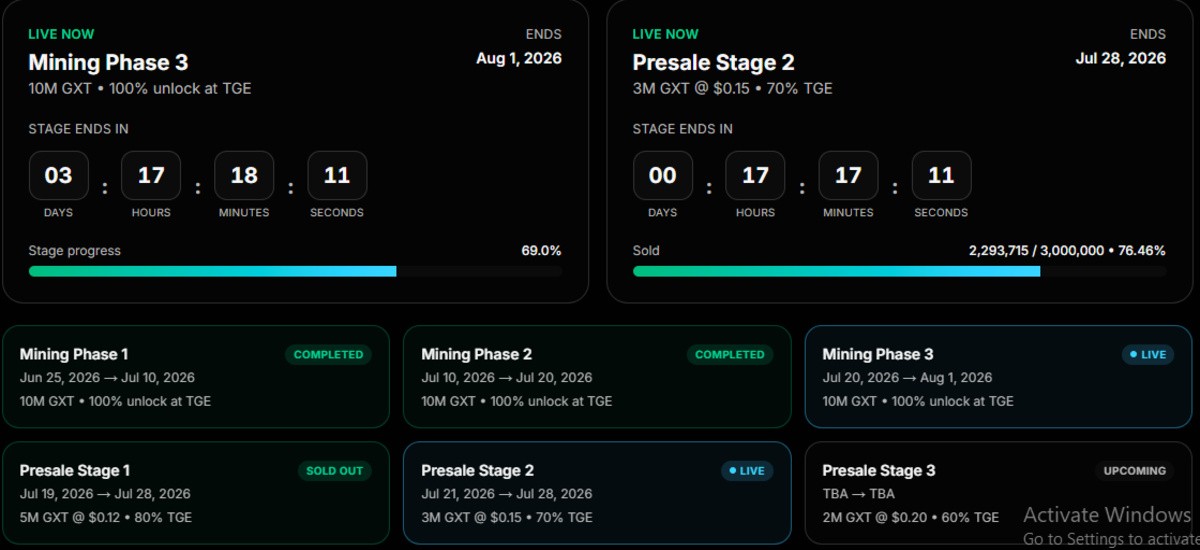
Source: Official Roadmap
Not everything unlocks right away. Whatever doesn't release at TGE stays locked for another three months before it's freed up.
And regardless of which stage someone buys into, KYC is mandatory before they can join.
GXT Token Roadmap and TGE Timeline
Once Stage 3 wraps, the plan is to move into the Token Generation Event, followed by listings on centralized exchanges. That said, the roadmap treats this as a target date rather than a hard promise.
Legal reviews, security checks, or operational delays could all push it back, and the whitepaper says as much.
Looking past TGE, GXT Exchange has laid out plans for governance rollout, wider fiat on- and off-ramps, more regional licensing, and eventually its own native blockchain.
Advantages of the GXT Token Model
Supply is capped for good, so there's no risk of the project quietly minting more tokens down the line
Mining and community rewards get the biggest slice of the pie, not insiders, which is a fairly community-friendly setup
Team and investor tokens sit under a 48-month vesting schedule, which slows down how fast insiders could dump on the market
GXT isn't a one-trick token. It touches fees, staking, governance, and payments
Note: Data in this article comes from the official GXT Exchange whitepaper and roadmap as of July 27, 2026, and may change if either document is updated.
Risks and Challenges to Consider
Because mining and presale unlocks make up most of the circulating supply at TGE, weak demand could translate into early sell pressure
The TGE date isn't locked in. Even the whitepaper flags that it might shift
Governance doesn't hand holders full control right away. It starts with non-binding votes before moving toward anything on-chain
Like most early-stage tokens, GXT's usefulness really comes down to whether the platform keeps growing
How to Verify the GXT Token Whitepaper
It only takes a few minutes to make sure a whitepaper is actually official, and it's worth doing before trusting any numbers in it. Here's a simple way to check.
Start with the domain. The whitepaper should open directly from gxtexchange.com. If a link looks slightly off, shortened, or comes from a different domain, treat it with suspicion.
Trace the announcement back to its source. GXT's whitepaper went live through the exchange's verified official X account, not through a fan page, reposted screenshot, or random group chat.
Line up the numbers. Total supply, allocation splits, and unlock dates these should all match between the whitepaper and the official roadmap. If two official pages tell different stories, that's worth pausing on.
Watch for vague supply or vesting details. A clearly capped supply and a defined vesting schedule are good signs. A whitepaper that dances around these specifics isn't.
Don't just assume security measures exist. KYC, audits, and proof of reserves should be stated outright somewhere in the document, not implied.
Treat every date as tentative. Presale timelines and TGE dates shift more often than not, even when they come from an official source, so plan around what's confirmed rather than what's projected.
Future Outlook
The roadmap points to a few things beyond TGE: broader governance rights, easier fiat access, and additional regional licenses through 2027.
Further out, there's talk of a native GXT blockchain and deeper ecosystem ties, though those remain plans rather than anything locked in yet.
Expert Opinion
This kind of setup isn't unique to Project. A lot of newer exchange tokens follow the same blueprint: unlock the mining and community pool fully but keep team, investor, and marketing shares vesting for years.
The effect is that more supply hits the market early through mining and presale, while insiders wait it out.
Whether this supports stable token performance after listing will depend on real demand at TGE and how closely the project follows its published unlock schedule.
Final Thoughts
The GXT token whitepaper gives the community a documented, fixed reference for supply, allocation, and utility ahead of TGE.
For anyone tracking GXT specifically, the fixed 300 million supply, the vesting terms on insider allocations, and the presale unlock schedule are the details worth watching most closely as the project moves toward listing.
Disclaimer: This article is for informational purposes only and does not constitute financial, investment, or trading advice. Cryptocurrency markets are volatile, and readers should conduct their own research before making any decisions involving digital assets.
Also read: