Top Crypto Exchanges by Assets: Centralized Exchange Rankings


Crypto Exchanges by Assets Based on Tracked Wallet Assets
Top crypto exchanges by assets rarely get compared side by side in one place, but the gap between the top names is worth seeing clearly. DeFiLlama tracks the on-chain data that exchanges have disclosed or been publicly identified with, and the resulting picture, first compiled on July 28, 2026, shows just how lopsided this market really is. This breakdown walks through what each exchange holds and what it means for anyone with funds on these platforms.
Centralized Exchanges by Total Assets in Tracked Wallets
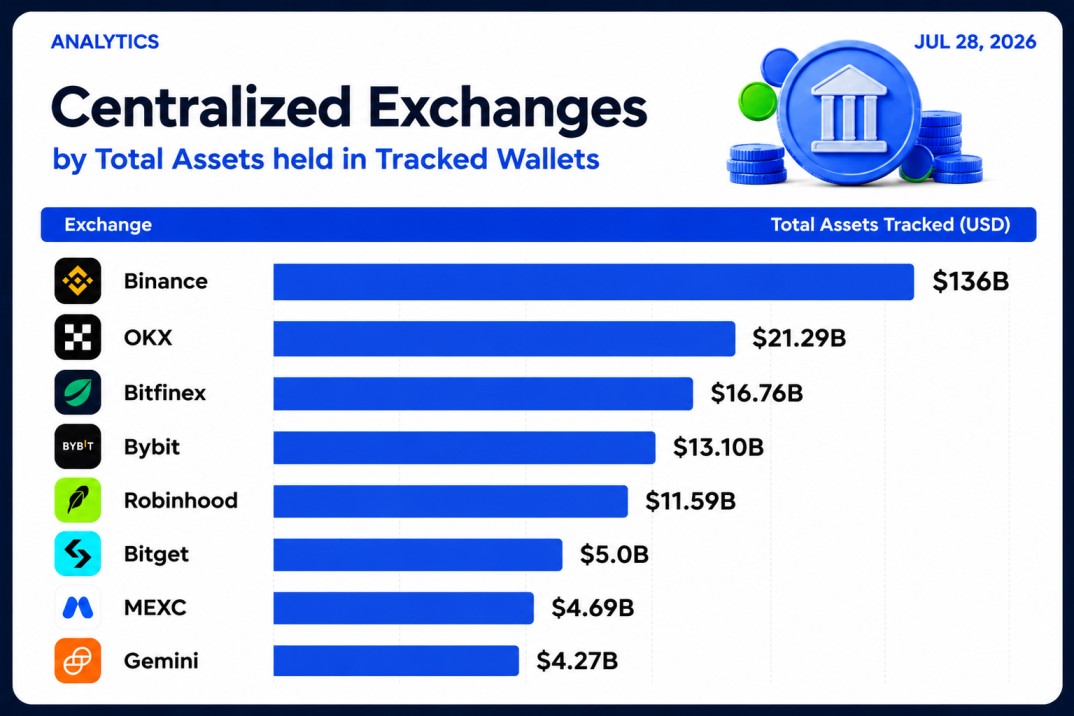
Here is what sits in those wallets right now, based on the top crypto exchanges by assets data DeFiLlama publishes for each platform's disclosed reserves:
| Exchange | Total Assets Tracked |
| Binance | $136B |
| OKX | $21.29B |
| Bitfinex | $16.76B |
| Bybit | $13.10B |
| Robinhood | $11.59B |
| Bitget | $5.0B |
| MEXC | $4.69B |
| Gemini | $4.27B |
Breaking Down Each Exchange's Top Crypto Exchanges By Assets
Before getting into individual platforms, it helps to understand why this gap exists at all. Reserve size on an exchange usually reflects a mix of three things: how long the platform has operated, how much trading volume it processes daily, and how much users trust it enough to leave funds parked rather than moving them to self-custody.
Exchanges that have survived multiple market cycles without a major solvency scare tend to accumulate deeper reserves simply because users feel comfortable leaving larger balances there over time.
The Dominant Player: Binance
Binance holds $136B, more than the other seven exchanges on this list combined at $77.4B. That works out to 64 percent of all tracked CEX assets sitting inside one platform, and roughly 6.4 times more than OKX, the next name down.
-
According to DeFiLlama's Binance tracker, the bulk of that balance sits in Bitcoin, Ethereum, and stablecoin reserves. For the wider market, this level of concentration means Binance's liquidity depth is genuinely difficult for any rival to match, which in turn keeps reinforcing its position at the very top of the industry.
-
For users, this scale generally means tighter spreads and faster order execution, though it also means a single platform holds an outsized share of industry risk if anything ever went wrong.
The Established Mid-Size Exchanges
OKX sits second with $21.29B, according to its DeFiLlama profile. Much of that reserve strength traces back to strong derivatives volume and a large user base concentrated across Asia.
-
The exchange has leaned into futures and options products, and that activity shows up directly in how much collateral sits parked in its tracked wallets at any given time.
-
For users, this depth mainly benefits active derivatives traders who need reliable collateral backing rather than casual spot buyers.
Bitfinex follows at $16.76B, per DeFiLlama data. It is one of the older platforms on this list, and a chunk of its balance reflects a heavy Bitcoin position built up over more than a decade of operation.
-
That long history gives it a different reserve profile than newer competitors, weighted more toward held assets than active trading collateral.
-
Long-time users benefit from that stability, though newer users may find the platform's interface and onboarding feel dated next to more modern exchanges.
Bybit ranks fourth at $13.10B, as shown on DeFiLlama. This figure matters partly because of context.
-
Bybit suffered a major security incident in 2025, and rebuilding reserves back to a figure this size signals user confidence returned faster than some expected after that event.
-
For current users, this recovery is a reasonably positive signal, though anyone who was on the platform during the incident likely still remembers the withdrawal delays that followed.
Robinhood rounds out this tier at $11.59B, confirmed by DeFiLlama's tracker.
-
This entry stands out the most on the whole list, since Robinhood is a retail brokerage, not a crypto-native exchange.
-
It already custodies more crypto than Bitget, MEXC, and Gemini combined, a sign that traditional finance platforms are pulling real volume away from exchanges built specifically for digital assets.
-
For users already inside Robinhood's ecosystem for stocks, this means one login now covers crypto too, though its coin selection remains far narrower than dedicated exchanges.
The Smaller Contenders
Bitget holds $5.0B, per DeFiLlama.
-
The platform has grown mostly by leaning into copy trading features and derivatives products aimed at newer traders who want to follow more experienced accounts rather than trade independently.
-
Newer traders benefit most here, though relying heavily on copy trading carries its own risk if the accounts being followed make poor calls.
MEXC sits close behind at $4.69B, according to its DeFiLlama page.
-
It has built its reputation around listing newer or smaller-cap tokens earlier than larger competitors, which tends to attract a more speculative trading base rather than long-term holders.
-
Users chasing early access to new tokens gravitate here, but that same early-listing focus means thinner liquidity and higher volatility on many of its pairs.
Gemini closes the list at $4.27B, as tracked by DeFiLlama.
-
Its smaller reserve size reflects a deliberately conservative, compliance-first approach rather than weaker demand, since Gemini has positioned itself around US regulatory alignment over raw growth.
-
Users who prioritize regulatory clarity and US oversight tend to prefer Gemini specifically for that reason, even at the cost of a smaller coin selection.
Together, this bottom tier holds less than Robinhood does on its own, a clear sign of how quickly asset concentration drops off once you move past the top few names.
User Impact
For everyday users, top crypto exchanges by assets data says more than just who is biggest. Deeper reserves generally mean tighter spreads, less slippage, and stronger withdrawal capacity during market stress.
That said, size alone is not a full safety signal. A large balance does not guarantee funds are backed one-to-one, so proof-of-reserve reporting and audit history still matter alongside raw totals. Diversifying holdings across more than one platform remains a reasonable habit either way.
A few practical takeaways from this data:
-
Larger reserve totals generally correlate with better execution on sizable trades, though this is not guaranteed for every trading pair
-
Sudden drops in a platform's tracked assets, especially sharp outflows over a short window, are worth watching as an early signal of stress
-
Smaller reserve totals do not automatically mean higher risk, since some platforms simply serve smaller user bases by design
-
Regulatory status and proof-of-reserve audits matter more for safety than raw asset size on its own
Conclusion
The Top Crypto Exchanges By Assets picture right now is dominated by one name. Binance alone accounts for nearly two-thirds of everything DeFiLlama tracks across these eight platforms, while Robinhood's rapid rise past several dedicated crypto exchanges shows how much the competitive landscape is still shifting underneath the surface.
OKX, Bitfinex, and Bybit continue holding meaningful ground in the middle tier, even as newer entrants and traditional finance platforms alike chip away at market share once assumed to belong exclusively to crypto-native exchanges.
Nothing about this market is evenly distributed, and based on how quickly these balances move month to month, it likely will not stay evenly distributed for long either.
Disclaimer
This article is for educational and informational purposes only and should not be considered financial or investment advice. Always do your own research before choosing any crypto exchange or making investment decisions.







.jpg)