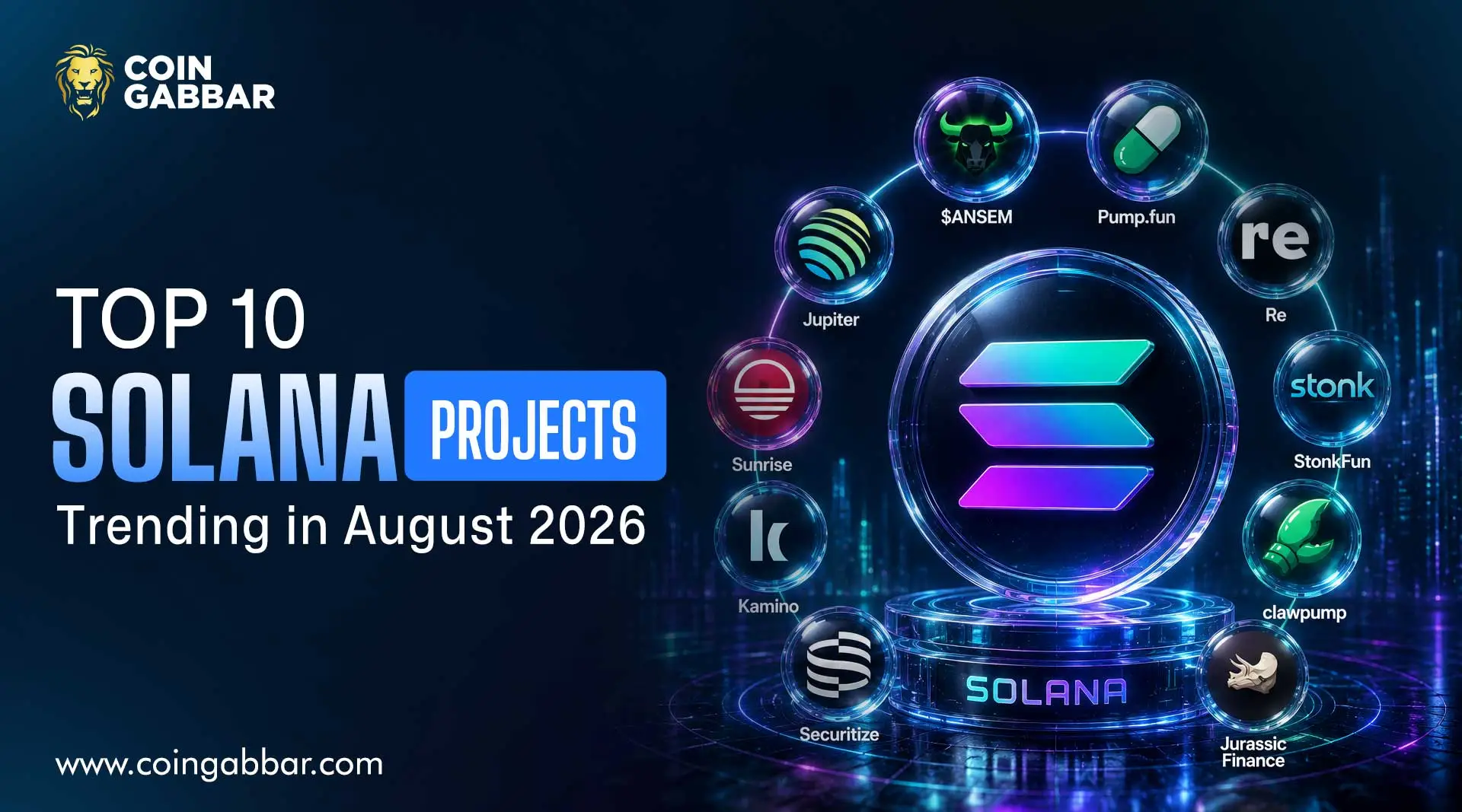
Top Solana Projects Trending in August: 10 Projects to Watch

Why Are These Solana Projects Trending?
Top Solana projects move fast. A protocol can dominate the timeline for a week, then fade into the next narrative by the following month.
This list skips one-week spikes driven by a single tweet. It covers projects with a real story behind their momentum right now, built as a reference point for where Solana's ecosystem is actually moving — not just where attention briefly landed.
Below are ten names worth knowing, each with its own reason for staying on trader and builder radars, spanning both memecoin culture and real-world asset infrastructure, sometimes inside the same protocol.
What Makes a Solana Project Worth Watching?
Not every trending project deserves attention. Real signals include:
A verified product launch or upgrade, not just a rumor
A dollar figure that comes from the project's own data or a credible outlet, not a screenshot
Institutional or exchange involvement that adds real users, not just liquidity
A story that explains why now, not just why hype
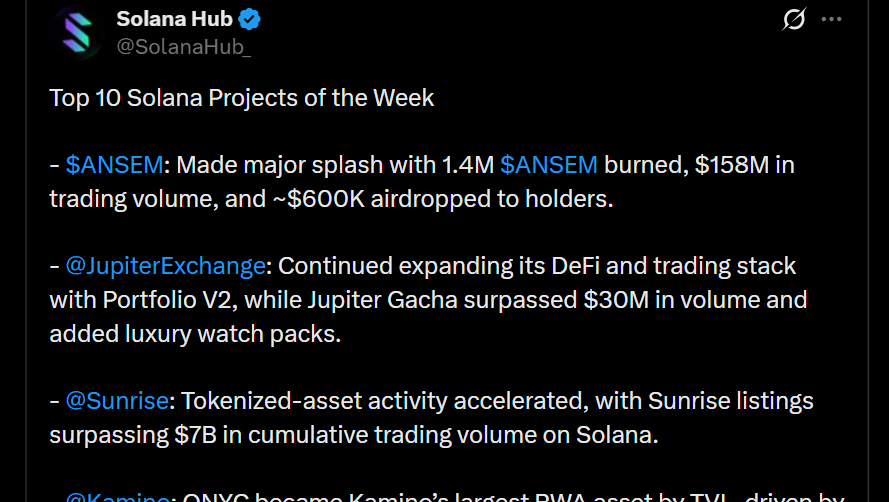
Source: Solana Hub X Post
Ansem ($ANSEM) — Major Burns and Holder Rewards
Price: ~$0.28 | Market cap: ~100M–245M
Ansem.io launched this week around an idea called z500, an on-chain index for new token launches built on top of Pump.fun. Teams that launch through the platform burn $ANSEM to unlock visibility tiers, and part of their supply is automatically airdropped to $ANSEM holders.
Features: within the first two hours of launch, teams had burned 500,000 $ANSEM and pushed close to $200,000 in airdrops to holders across more than a dozen coins, all tracked live on Solscan.
Why it's trending: the account behind it, known on X as Ansem, already has a track record of moving Solana memecoin markets with a single post, and z500 turns that reach into a standing mechanism instead of a one-off pump.
Risk: a large share of $ANSEM supply sits with early holders, so concentration risk is real, and the whole model depends on new projects continuing to launch through the platform rather than fading after the initial buzz.
Jupiter Exchange — Portfolio V2 Expands DeFi Management
Price: ~0.17–0.19 | Market cap: ~560M–640M
Jupiter shipped Portfolio v2 on August 17, and it changes what the tool actually does. The old Portfolio screen only showed positions across Solana DeFi. The new version lets users borrow, lend, swap, repay, and close positions directly from that same screen.
Features: coverage across more than 180 Solana protocols and 270-plus decoded transaction types, plus a direct hook into Jupiter's own Lend v2, which already holds close to $1.9 billion in deposits.
Why it's trending: this closes a gap that's followed DeFi dashboards for years — seeing a position isn't the same as being able to act on it. Jupiter built its user base on aggregation; this update turns that view into a control panel.
Risk: more surface area means more smart-contract risk, and active management tools tend to invite more frequent, higher-stakes user mistakes than a passive tracker ever did.
Sunrise — Growing Tokenized Asset Activity on Solana
Price: ~0.0085–0.01 | Market cap: ~54M–61M
Sunrise exists to solve one specific problem: a new token launching on another chain has no easy, liquid way onto Solana without fragmenting into multiple wrapped versions. Sunrise gives issuers a single canonical route instead.
Features: built on Wormhole's Native Token Transfers standard, giving external assets same-day liquidity across Solana venues like Jupiter and Raydium the moment they list.
Why it's trending: Sunrise was the rail that brought tokenized SpaceX shares onto Solana the same day SpaceX began trading on Nasdaq, and it keeps sitting at the center of how new tokenized listings actually arrive on the network.
Risk: as a gateway, Sunrise's usefulness depends entirely on adoption by issuers on other chains; if fewer big-name tokens choose to route through it, its relevance narrows quickly.
Kamino Finance — ONyc Brings RWA Yield to DeFi
Price: ~$0.020 | Market cap: ~95M–116M
Kamino remains Solana's largest money market, and its integration of ONyc, a reinsurance-backed yield token from OnRe, has become one of its most closely watched RWA markets. ONyc lets users post real-world reinsurance yield as collateral for lending, borrowing, or looping directly on Kamino.
Features: a base yield above 14%, combining roughly 8% from insurance premiums and 6% from stablecoin yield, with looping strategies pushing net returns past 20% APY for users comfortable with leverage.
Why it's trending: it marks one of the first times insurance-backed yield has been usable as on-chain DeFi collateral, and deposits into the OnRe market on Kamino have grown quickly as investors look for yield that isn't tied to crypto market swings.
Risk: looping amplifies both yield and liquidation risk, and reinsurance-backed assets still rely on off-chain NAV reporting that most retail users can't independently verify.
Securitize — Bringing High-Yield Funds Onchain
Price: ~$6.30 | Market cap: ~$983M
Securitize and Neuberger Berman launched HINC, the Neuberger Securitize High Income Tokenized Fund, on August 18. It's Neuberger's first time acting as subadvisor to a tokenized fund.
Features: the fund invests mainly in high-yield bonds, with additional exposure to collateralized loan obligations and leveraged loans, drawing on a fixed-income platform that oversees more than $230 billion in assets.
Why it's trending: this is a genuinely new asset class arriving on-chain. Most tokenized products so far have been Treasuries or money-market funds; HINC brings actively managed high-yield credit into the same wrapper, and Solana is one of only four networks carrying it at launch.
Risk: access to HINC stays restricted to accredited investors and qualified purchasers who complete Securitize's onboarding, so this isn't a retail product, even though the token technically sits on a public chain.
Pump.fun — $PUMP Buybacks Gain Momentum
Price: ~$0.003 | Market cap: ~$1.17B
Pump.fun remains one of the highest-revenue protocols in crypto, having passed $1 billion in cumulative platform revenue earlier this year. Its buyback-and-burn program, which commits half of protocol revenue to repurchasing and burning $PUMP, has been running for months.
Features: over $400 million spent on buybacks to date, burning well over 150 billion $PUMP tokens, funded entirely from bonding-curve and PumpSwap trading fees rather than external capital.
Why it's trending: the buyback math has recently turned favorable again as trading activity picked up, meaning the program is now retiring tokens at a lower average cost than during the leaner months earlier this year.
Risk: roughly 40% of total $PUMP supply is still locked and scheduled to unlock over time, and that overhang remains the single biggest swing factor for the token regardless of how buybacks perform.
Re ($RE) — PT-reUSD Looping Boosts Yield
Price: ~$0.52 | Market cap: ~$83M
Re, the tokenized reinsurance protocol behind reUSD, is having a moment on Pendle. Pendle's PT Looping incentive program added reUSD's principal token to its list of boosted pools this month.
Features: looping PT-reUSD stacks its fixed base yield with an extra 2% APY incentive paid in PENDLE, and at higher leverage multiples the combined return moves into the 20%-plus range.
Why it's trending: reUSD already sits on Kamino, where deposits count toward the same reinsurance-backed collateral pool driving ONyc's growth, so the Pendle incentive effectively adds a second yield layer on the same underlying real-world asset.
Risk: the 2% incentive boost is time-limited to the August 27 window, and looped positions carry standard leverage risk if reUSD's peg or NAV moves unexpectedly.
StonkFun — Connecting Memecoins With Tokenized Equities
Price: ~$0.0106 | Market cap: ~$10.6M
StonkFun lets anyone launch a token paired directly against tokenized equities like SPYX or NVDAX instead of the usual SOL or stablecoin pair. It's a genuinely different spin on the launchpad model that Pump.fun popularized.
Features: new tokens form markets quoted against real xStocks equities on Raydium, and 60% of platform trading revenue is used to buy back and burn the native STONK token.
Why it's trending: the pairing mechanic has pulled in early attention from traders and drawn support from Raydium, at a moment when Solana overall is leading every other chain in tokenized-equity holder growth. Platform revenue crossed $237,000 within its first two weeks live.
Risk: STONK itself carries no claim on the underlying stocks; the RWA exposure lives entirely in the xStocks pairing, and liquidity on a token this new can still be thin.
ClawPumpTech ($CLAW) — Bringing AI Agents to Solana
Price: ~$0.0031 | Market cap: ~$3.1M
ClawPump bills itself as the agentic gateway to Solana — a platform where autonomous AI agents can launch tokens gaslessly on Pump.fun and start earning trading fees immediately, no separate wallet funding required.
Features: agents keep up to 65% of trading fees from tokens they launch, plus access to an MCP server that bundles dozens of Solana DeFi tools — swap, lend, borrow — behind a single endpoint.
Why it's trending: this week's AnsemHack Clawrena brought agentic builders and traders together around a $320K prize pool paid in $ANSEM, cash, and compute, with ClawPump directing 10% of its own revenue share toward buybacks of both $CLAW and $ANSEM, tying two separate token economies together in one event.
Risk: the agent-token category is barely months old and mostly unproven; most agent-launched tokens carry tiny market caps and thin liquidity, and the buyback mechanism only holds up as long as ClawPump's own revenue does.
Jurassic Finance ($RAWR) — Tokenizing a Dinosaur Fossil
Price: ~$0.07 | Market cap: ~$1.7M
Jurassic Finance is doing something no other Solana project has tried: tokenizing a real dinosaur fossil. The specimen, a museum-grade Triceratops prorsus skull named Deaton with 60–65% of its original bone mass intact, is the project's first acquisition target.
Features: each fossil purchase is structured through a dedicated special purpose vehicle that issues one million SPL tokens, with 95% distributed to investors and the remainder held by the project's treasury; the fundraising target for Deaton was 660,000 USDC.
Why it's trending: it's the most literal expansion yet of real-world-asset tokenization beyond stocks and bonds into physical collectibles, and the announcement sent $RAWR up more than 89% within 24 hours.
Risk: authentication, storage, and insurance for a fossil this valuable all happen off-chain, so investors are trusting the project's legal structure and its off-chain partners as much as they're trusting the blockchain record.
Quick Comparison Table
Project | Token | Current Price | Market Cap |
Ansem | ANSEM | ~$0.28 | ~100M–245M* |
Jupiter | JUP | ~$0.18 | ~560M–640M* |
Sunrise / Wormhole | W | ~$0.009 | ~54M–61M* |
Kamino Finance | KMNO | ~$0.0206 | ~95M–116M* |
Securitize | SECZ | ~$6.29 | ~$983M |
Pump.fun | PUMP | ~$0.003 | ~$1.17B* |
Re | RE | ~$0.52 | ~$83M* |
StonkFun | STONK | ~$0.0106 | ~$10.6M* |
ClawPumpTech | CLAW | ~$0.0031 | ~$3.1M* |
Jurassic Finance | RAWR | ~$0.07 | ~$1.7M* |
Prices and market caps are as of the week of August 21, 2026, and move quickly — treat them as a snapshot, not a live quote.
How to Use This List
Want yield? Kamino's ONyc and Re's Pendle looping both clear 20% APY, but leverage cuts both ways here — check the risk line before sizing a position.
Want the picks-and-shovels play? Jupiter and Sunrise are the infrastructure underneath most of the other names on this list, not a single trade or narrative.
Tracking where institutions are actually going? Securitize's HINC launch is the cleanest read on traditional finance treating Solana as a real venue, not an experiment.
Here for the unusual stuff? Jurassic Finance and ClawPumpTech show how far Solana's experiments have stretched — from tokenized fossils to AI agents that launch and earn on their own.
Treat this list as a map of where attention and capital moved on Solana this week — the memecoin side and the institutional RWA side are increasingly the same ecosystem, sometimes the same protocol, and both are worth watching for different reasons.
Final Word
None of this is a buy signal. Ansem.io and StonkFun are days-old products riding hype cycles that could fade as fast as they were built. Securitize's HINC and Sunrise's asset gateway are backed by real institutional weight, but that doesn't make them low-risk. Kamino and Re's looping yields look attractive on paper and carry real liquidation exposure the moment markets move against a position.
The common thread across this week's top Solana projects is momentum, not certainty. Treat this list as a map of where attention and capital are moving on Solana right now, not as investment advice.
Disclaimer:
This blog is for informational purposes only and isn't financial advice. Crypto and tokenized RWA markets are volatile — verify current prices and contract addresses through official sources before investing.
Also read:






.webp)