Luxembourg Crypto Fraud Law Gives FIU New Powers From August 8

Luxembourg Crypto Fraud Law: What Bill 8722 Actually Changes
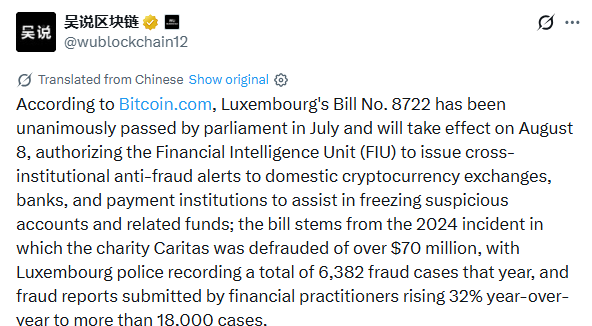
A new Luxembourg crypto fraud law takes effect tomorrow, August 8, 2026, giving the country's Financial Intelligence Unit unprecedented authority to issue real-time fraud alerts directly to cryptocurrency exchanges alongside traditional banks. Bill 8722 passed unanimously in Luxembourg's parliament in July and was published in the Journal officiel, the country's official gazette, on August 4.
 Source: X(formerly Twitter)
Luxembourg Crypto Fraud Law: What Bill 8722 Actually Does
Per the bill's provisions, Luxembourg's Financial Intelligence Unit (FIU) — known locally as the Cellule de Renseignement Financier — gains the right to proactively report suspicious account numbers to banks, payment institutions, and licensed crypto exchanges, allowing those firms to block fraudulent transactions before they finalize. Under the previous rules, banks could only freeze transactions within their own internal systems; once stolen funds moved to a different provider, including a crypto exchange, authorities had no statutory mechanism to notify the receiving institution to stop the transfer.
FIU Director Max Braun said the expanded alert system will make cashing out stolen funds more difficult for international scam syndicates, describing it as a new tool to help prevent CEO scam specifically. Alerts will be distributed through a secure, data-compliant IT system directly to authorized financial and crypto providers operating in Luxembourg. Braun led an informational training session with compliance officers on August 6, two days ahead of the law's entry into force.
Why Luxembourg Closed This Loophole Now
The legislation traces directly back to a 2024 "CEO fraud" scheme that saw the humanitarian charity Caritas lose just over $70 million after fraudsters impersonated executives to authorize transfers. Justice Minister Elisabeth Margue introduced the bill in March 2026 specifically in response to that case and to Luxembourg's broader fraud data: police recorded 6,382 scam cases in 2024, up nearly 4% year-over-year, while fraud and scam reports submitted by financial professionals to the FIU surged 32% to more than 18,000 cases over the same period.
The crypto-specific provision closes a gap that's become more consequential as Luxembourg has grown into a significant European hub for cryptocurrency platforms following recent EU regulatory changes. That growth has made digital asset wallet providers operating in the country an increasingly attractive target for criminals looking to quickly convert stolen cash into digital assets before authorities can intervene.
Luxembourg Crypto Fraud Law: Safeguards and What's Next
The law includes specific data-protection measures alongside its enforcement powers. Banks and crypto exchanges receiving an FIU alert are formally prohibited from tipping off the affected customer or any third party that their account has been flagged — a "no tipping off" rule designed to prevent fraudsters from being warned before funds can be frozen. Information received by professionals under the alert system must also be deleted within a defined retention period once its purpose has been served.
Braun was careful to temper expectations, calling the crypto-inclusive alert system a major step forward while cautioning it "will not solve the whole problem" of sophisticated corporate financial crime. The 75-member FIU operates under Luxembourg's public prosecutor's office and serves as the country's central authority for countering money laundering, terrorism financing, and broader financial crime.
Conclusion
The Luxembourg crypto fraud law marks one of the more direct legislative responses yet to the specific problem of stolen funds moving quickly into digital asset to evade recovery. By folding exchanges into the same real-time alert system banks already use, Bill 8722 aims to close a gap that a single $70 million financial crime case exposed clearly — though its actual effectiveness against more sophisticated schemes remains to be tested once the law takes effect August 8.
Disclaimer
This article is for informational purposes only and does not constitute legal advice. All details are based on Luxembourg's official Bill 8722 text, statements from FIU Director Max Braun, and publicly available reporting as of August 6, 2026. Always consult official Luxembourg government sources or a qualified legal professional for authoritative guidance on this legislation.