Bitcoin News Today: BIP 110 Explained, Saylor Slams It as a Bad Idea


Saylor pushes back on BIP 110 with a 110-point breakdown
In today's Bitcoin news, Michael Saylor has come out strongly against BIP 110, a proposed Bitcoin software change.
Saylor shared a long article on X. It lists 110 reasons why he thinks the plan is risky for BTC.
He said many Bitcoiners he respects support a Bitcoin protocol proposal 110. But he believes the fix could be worse than the problem it tries to solve.
What is BIP 110 and why does it matter?
BIP 110 stands for Bitcoin Improvement Proposal 110. It reached "Complete" status on June 25, 2026, under the BIP 3 process.
That status does not mean BTC has adopted it. It only means the authors finished their work and recommend it.
The proposal is called a "Reduced Data Temporary Softfork." It would run for about one year if activated.
What changes would it make?
The plan adds seven new rules to Bitcoin's consensus code. Here is a simple breakdown:
Rule | What It Does |
ScriptPubKey limit | Caps new scripts at 34 bytes, with an 83-byte exception for OP_RETURN |
Payload limit | Caps many pushed payloads and witness items at 256 bytes |
Witness versions | Blocks spending of undefined witness and Tapleaf versions |
Taproot annex | Removes the ability to use the Taproot annex |
Control block cap | Limits Taproot control blocks to 257 bytes |
OP_SUCCESSx | Rejects Tapscripts using these opcodes |
OP_IF / OP_NOTIF | Blocks execution of use in Tapscript |
Old transaction outputs made before activation are protected. This is called grandfathering.
Why does Saylor oppose the proposal?
Saylor's main point is about neutrality. He says BTC should not use consensus rules to judge what counts as a "good" or "bad" use of the network.
He argues the network cannot tell the difference between an image, a contract, or a proof. All of it is just data.
He also flagged the lower signaling threshold. A proposal proposes 55% miner support, compared to the usual 95% under BIP 9.
Saylor believes this lower bar increases the risk of a chain split. He said a divided network could hurt trust, liquidity, and custody systems.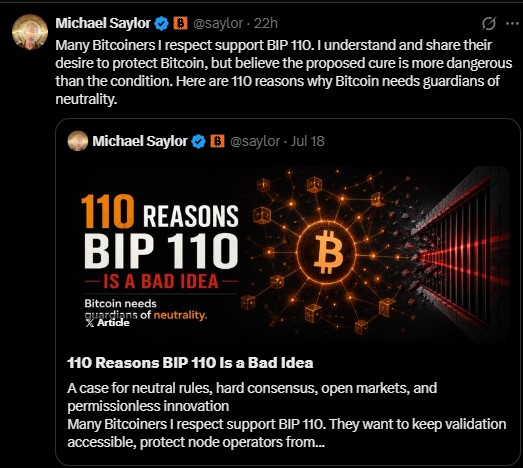
What does this mean for Bitcoin's future?
This debate is not new. BTC has faced arguments over block space and data storage for years.
Supporters of a Bitcoin protocol proposal want to protect node operators and keep fees low for payments. Saylor and others worry that changing consensus rules for this reason sets a risky precedent.
The outcome will depend on whether miners, node operators, and the wider community find common ground. Right now, there is no clear timeline for adoption.
This story is developing, and more Bitcoin news updates are expected as the debate continues.
Disclaimer
This article is for informational purposes only and does not constitute financial, investment, or legal advice. Cryptocurrency markets are highly volatile and involve significant risk. Always do your own research and consult a licensed financial advisor before making investment decisions.






