Revolut US Market Gets a Major Banking Green Light

Revolut US Market Eyes 2027 Launch After Major OCC Approval
Revolut US Market ambitions took a major step forward this week after the Office of the Comptroller of the Currency granted conditional approval for the fintech giant to charter a national bank in the United States.
The decision marks one of the clearest signals yet that the company plans to operate as a full-fledged national institution rather than relying solely on partner banks for its American customers.
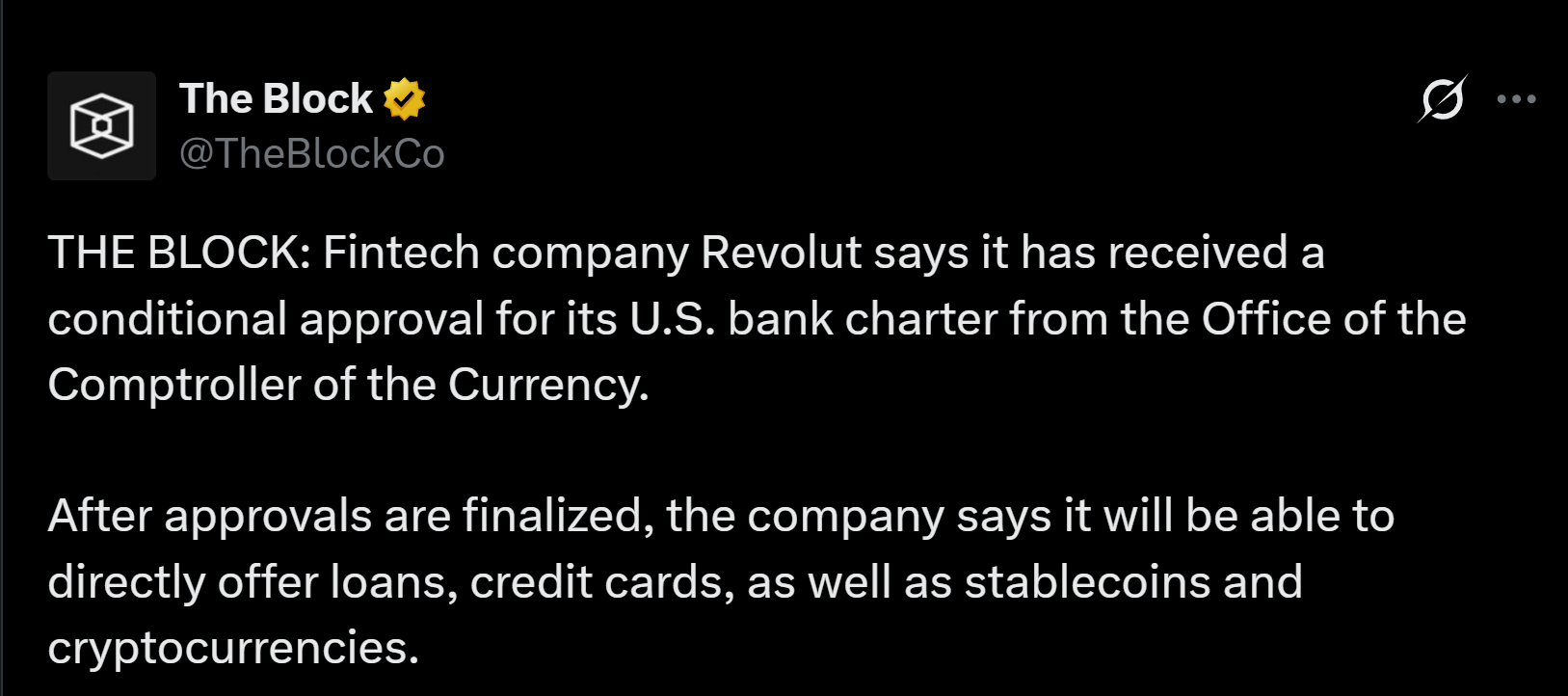
Source: The Block
What The OCC Actually Approved
According to the official Corporate Decision #1390, the OCC granted preliminary conditional approval for Revolut Bank US, National Association, to be headquartered in Stamford, Connecticut, with no physical branches.
The regulator also approved a related waiver request covering residency requirements for the entity's board of directors.
This clearance is preliminary and conditional only—meaning final authorization to actually open will not be granted until the entity satisfies a lengthy list of preopening requirements.
Notably, this initial green light does not cover the company's proposed retail foreign exchange business, which will require a separate written non-objection from the OCC before it can launch.
How The New Entity Will Be Structured And Owned
Under the approved structure, the new institution will operate as a wholly owned subsidiary of Revolut Holdings US Inc., a Delaware corporation, which is itself fully owned by UK-based Revolut Group Holdings Ltd.
Both the US holding company and its UK parent have applied separately to the Federal Reserve to become holding companies, while a deposit insurance application with the FDIC remains under active review.
This layered corporate setup is fairly standard for foreign-owned entities pursuing a US national bank charter and reflects the multiple regulators that still need to sign off before Revolut US Market plans can move to final approval.
What Products The New Institution Plans To Offer
Once every approval is finalized, the company says it will be able to directly offer American customers loans, credit cards, FDIC-insured deposits, and access to stablecoins and cryptocurrencies.
The OCC filing confirms the entity plans to offer digital asset custody services in a nonfiduciary capacity through its UK-regulated affiliate, though total digital asset revenue is projected to stay under 2% of overall revenue during its first three years.
It will not hold any digital assets on its own balance sheet, and any company-branded stablecoin activity will run through a third-party issuer, with its role limited to marketing and customer access.
Key conditions attached to this stage include:
-
A minimum tier 1 leverage ratio of at least 10% for the first three years
-
Sixty days' advance notice required before any significant change to the business plan
-
OCC no-objection required before naming senior executives or new board members
-
Initial paid-in capital of no less than $95 million
Approval Snapshot
| Detail | Information |
| Approving regulator | Office of the Comptroller of the Currency |
| Proposed name | Revolut Bank US, National Association |
| Proposed headquarters | Stamford, Connecticut |
| Application filed | March 10, 2026 |
| Minimum required capital | $95 million |
| Minimum tier 1 leverage ratio | 10% for the first three years |
| Planned launch window | First half of 2027 |
Why This Fits Into The Company's Broader Global Expansion
Company leadership framed the approval as a foundational milestone rather than a finished product.
Founder and CEO Nik Storonsky said the conditional approval gives the company a foundation to build in the world's largest financial market, while American CEO Cetin Duransoy credited the OCC for being diligent and expedient throughout the review process.
This Revolut US Market milestone also builds on a broader wave of licensing activity—the company has secured a Mexican banking license, advanced regulatory work across Brazil, Colombia, Peru, and Argentina, and separately obtained banking licenses in France, Australia, and the UK, along with a payments license in the UAE this year alone.
The company says it remains on track to reach 100 million customers globally by mid-2027.
Conclusion
This conditional charter approval pushes Revolut US Market plans meaningfully closer to reality, though genuine operations remain contingent on still-pending sign-off from the Federal Reserve and FDIC, alongside final OCC approval.
With a 2027 launch target now publicly confirmed and stablecoin and cryptocurrency access explicitly part of the roadmap, this decision represents a significant regulatory milestone for a fintech company aiming to become a fully chartered institution on American soil.
Disclaimer
This content covers financial markets and is for general information only. It is not financial, investment, trading, or legal advice. Crypto assets are volatile and can lose value fast. Always do your own research. Speak with a licensed financial advisor before making investment decisions.
Also read:






