World Liberty Financial News: WLFI Gets OCC Bank Approval


World Liberty Financial News: WLFI Moves Toward OCC Trust Bank Charter
The biggest piece of World Liberty Financial News this week is that the U.S. Office of the Comptroller of the Currency has given a conditional green light to a new national trust bank tied to the project.
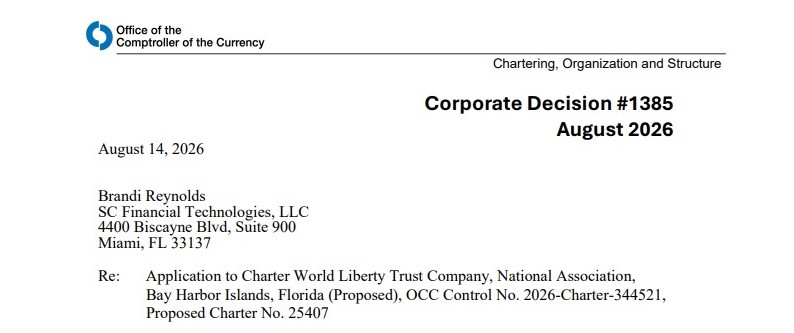
Per the OCC's official decision letter, dated August 14, 2026, the agency has granted preliminary conditional approval to World Liberty Trust Company, National Association—clearing the first major hurdle toward a bank that could eventually hold the reserves backing WLFI's USD1 stablecoin.
It's not a final OCC approval yet, but it's a real step forward, and it lands at a moment when national trust bank charters tied to crypto are moving through federal regulators faster than usual.
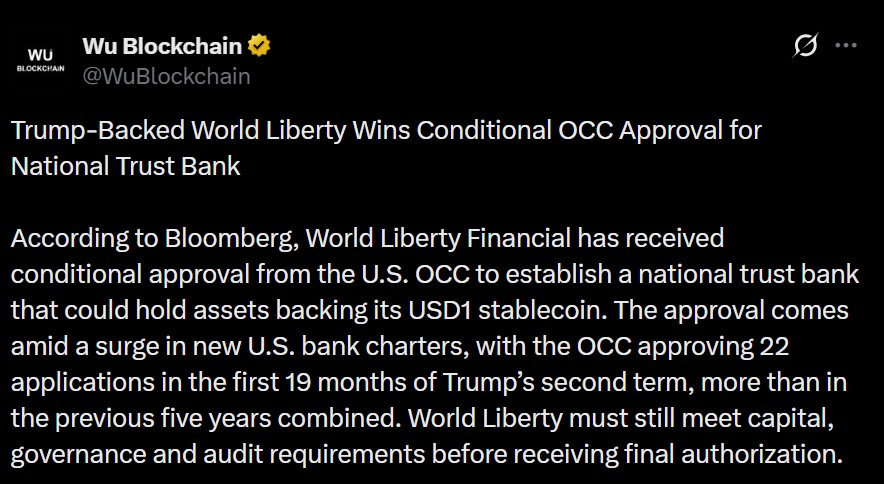
Source: Information cover by WuBlockchain
What the OCC Actually Approved
The decision letter states the new bank would be based in Bay Harbor Islands, Florida, and operate as a wholly owned subsidiary of WLTC Holdings LLC.
It's structured as a trust company rather than a traditional banks, which matters because the entity won't take deposits or need FDIC insurance.
Its planned activities include:
-
Issuing and redeeming USD1, taking over that role from BitGo, which currently handles it
-
Offering digital asset custody services as a fiduciary, mainly for USD1 holders and other institutional clients
-
Letting custody customers convert other approved stablecoins into USD¹
This is really the core of the World Liberty story—the banks exist mainly to give USD 1 a more formal, regulated home under an OCC charter.
Why the OCC Signed Off
The letter explains that federal law has allowed the OCC to charter trust-focused national banks since 1978, and the agency has leaned on that authority for several similar crypto-linked charters recently.
It also points to the GENIUS Act, a federal law that specifically recognizes uninsured national banks as eligible stablecoin issuers, as part of the legal basis for this OCC approval.
The letter is clear that stablecoins issued this way are not banks deposit and won't carry FDIC insurance.
Conditions the Trust Bank Still Has to Meet
This approval comes with real strings attached, and the entity can't open its doors until it satisfies them. Some of the bigger requirements:
| Requirement | Detail |
| Minimum capital | At least $20 million in tier 1 capital |
| Liquid assets | At least half of that capital held in easily accessible liquid assets |
| Operating buffer | 180 days of operating expenses set aside |
| Legal compliance | Must adjust or exit any activity that doesn't fit the GENIUS Act |
| Structure | Cannot become a "bank" under the Bank Holding Company Act |
| Timeline | Capital must be raised within 12 months, and the banks must open within 18 months, or approval expires |
Pushback From Public Comments
Part of what makes this World Liberty Financial news notable is how contested the application was before it got approved.
The decision letter says the OCC received seven public comments, raising concerns ranging from potential conflicts of interest involving the family behind the venture and foreign investors to worries about deposit-insurance confusion to calls for a national-security review of overseas backers.
The agency addressed each point directly, stating that career staff—not political appointees—handled the review, that outside investors had signed passivity commitments limiting their influence, and that concerns tied to the broader WLFI token and its holding company fell outside the scope of this particular banking application.
What Comes Next for World Liberty
This is only a preliminary conditional approval, not a final one. Before the trust company can actually start operating, it still needs to raise the required capital, put governance and compliance policies in place, pass an OCC pre-opening review, and get sign-off on its leadership team.
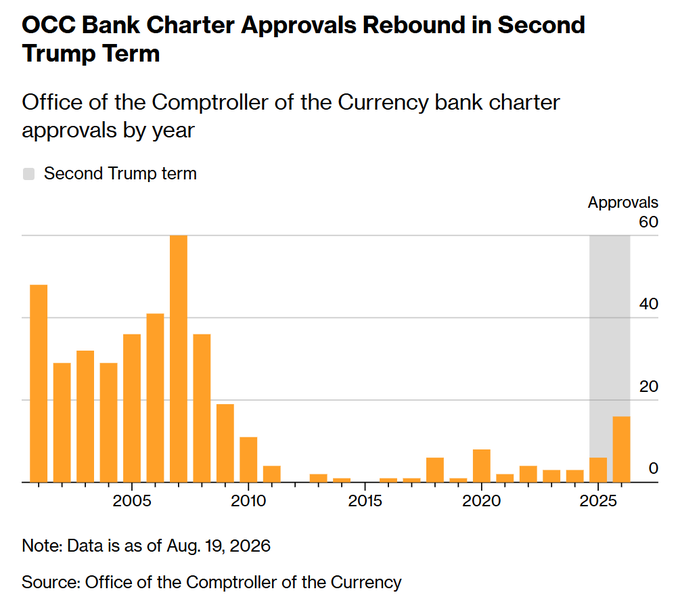
This piece of World Liberty Financial News also lands amid a much bigger trend: the OCC has approved 22 new bank charters in the first 19 months of the current administration, more than the previous five years combined, showing how quickly crypto-linked trust charters are moving through U.S. regulators right now.
Conclusion
World Liberty has cleared a significant regulatory milestone with this national trust bank approval, but the path to an actual operating institution is still ahead of it.
The OCC's conditional sign-off sets clear capital, compliance, and timeline requirements the project must meet, all while sitting inside a broader wave of new crypto-friendly charters moving through federal regulators this year.
Disclaimer
This article is for educational and informational purposes only and should not be considered financial or investment advice. Always conduct your own research before making investment decisions.
Also read:









