Trump Quantum Executive Order Pushes Crypto Deadline to 2031
 Yash Shelke

Trump Quantum Executive Order: What Both Orders Actually Do
What happens to Bitcoin the day someone finally builds a computer that can crack its encryption?
President Trump signed two executive orders on June 22, 2026, in the Oval Office, surrounded by tech leaders including IBM CEO Arvind Krishna and Google's president. The Trump quantum executive order package does two things simultaneously: it races to build the most powerful computer the US government has ever fielded, and it forces federal systems off the encryption standards that this technology could eventually break.
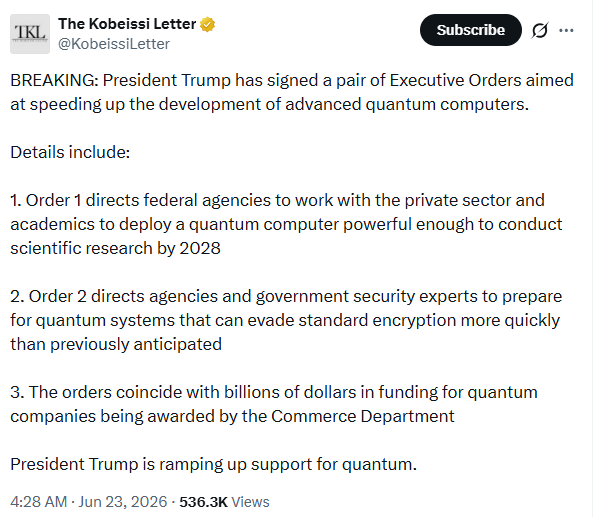 Source: X(formerly Twitter)
For crypto holders specifically, the second order matters more than most coverage has explained. It moves the deadline for adopting quantum-resistant encryption from 2035 to December 2031 — a four-year acceleration that puts a hard date on a threat the crypto industry has debated for years.
Trump Quantum Executive Order: What Both Orders Actually Do
The Trump quantum executive order package consists of two formally separate documents: "Ushering in the Next Frontier of Quantum Innovation" and "Securing the Nation Against Advanced Cryptographic Attacks."
The first order establishes a new national effort called QC-ADDS — the Quantum Computer for Application Development and Discovery Science. Its goal: deliver a this technology capable of scientifically relevant calculations to a Department of Energy facility by 2028. Energy Secretary Chris Wright called the impact "tremendous." The order also directs agencies to deploy quantum-enabled sensors and networks within five years, expand apprenticeship and workforce training programs, strengthen domestic supply chains for specialzed materials, and tighten counterintelligence protections against foreign espionage targeting quantum research.
The second order is the one with the encryption deadline. It directs federal agencies to migrate to post-quantum cryptography by December 2031, with NIST required to complete a pilot migration of federal systems by the end of 2027. Critical infrastructure and high-impact systems must update key-establishment and digital-signature methods to quantum-resistant standards by 2030 and 2031 respectively. The Cybersecurity and Infrastructure Security Agency will help private-sector critical infrastructure operators make the same shift.
The timing connects to real money already in motion. The Commerce Department announced $2 billion in equity stakes across nine quantum computing companies last month, including a new IBM venture — funding that arrived just weeks before this Trump quantum executive order signing.
Trump Quantum Executive Order and the Bitcoin Q-Day Risk
Here's why crypto holders specifically should read past the headline.
Researchers call the moment a future computer becomes powerful enough to reverse-engineer a private key from a public address "Q-Day." Once that threshold is crossed, an attacker could theoretically drain any wallet whose public key has been exposed on-chain — which describes the majority of Bitcoin addresses with any transaction history at all.
Coinbase's own advisory council has warned that roughly 7 million BTC could eventually be vulnerable under this scenario — a figure representing tens of billions of dollars in exposed holdings at current prices. The Trump executive order doesn't create this risk; it responds to a threat researchers have warned about for years, formalizing a federal response timeline that the broader industry will likely be measured against.
Google set its own internal post-quantum migration deadline for 2029 back in March 2026 — meaning the federal government's 2031 target now sits behind at least one major tech company's self-imposed schedule. QuSecure's Garfield Jones called the order an "unambiguous signal," adding bluntly: "Agencies and contractors that haven't started a cryptographic inventory are already behind. The organizations that move now will have options. The ones that wait will find themselves managing a crisis."
The deeper concern security researchers flag is "harvest now, decrypt later" — the practice of adversaries collecting encrypted data today with the expectation that future computers will be able to read it years from now. For Bitcoin, that means publicly exposed transaction data collected today could theoretically become decryptable once Q-Day arrives, regardless of when that happens.
Trump Quantum Executive Order Outlook: What Comes Next
No firm date exists for Q-Day itself. Most expert estimates place the risk sometime in the 2030s, though estimates vary considerably, and a senior White House official confirmed no specific companies are being prioritized under either order.
Three things to watch following the Trump quantum executive order signing, based on public sources and assumption basis only — no guaranteed outcomes:
Whether Bitcoin's own protocol begins a parallel migration conversation. Unlike federal agencies, Bitcoin has no central authority that can mandate a cryptographic upgrade — any shift would require broad community and developer consensus.
Whether other major exchanges follow Google's lead with self-imposed deadlines. Coinbase has already flagged the exposure publicly; a formal migration timeline from a major exchange would be the next logical signal.
Whether the China competition angle accelerates the timeline further. Officials have repeatedly framed leadership as a national security race, which historically tends to pull deadlines earlier rather than later.
All projections are speculative and based on public analyst sources only.
Conclusion
The Trump quantum executive order signing puts a real federal deadline — December 2031 — on a threat crypto researchers have debated abstractly for years. Bitcoin isn't breakable today. But 7 million exposed BTC and a four-year accelerated federal timeline mean the conversation about Q-Day just moved from theoretical to scheduled. Watch whether exchanges and protocols start setting their own dates next.
YMYL Disclaimer
This article is for informational purposes only and does not constitute financial, investment, or cybersecurity advice. The Bitcoin Q-Day risk discussed has no firm timeline and estimates vary among experts. Digital asset investments carry significant risk including total loss of capital. Always conduct independent research before making any investment decision.


1 month ago
Today’s online world is flooded with scam advertisements, mostly lurking in comments across websites and blogs. Thousands of innocent people have fallen prey, losing vast sums of money to clever scammers. Common scams include: Fake Bank Loan Offers Cryptocurrency & Forex Trading Schemes Fake Lotteries & Jackpots Romance & Dating Frauds …and many more. But here’s the crucial question: Can you recover the money stolen by these scammers? The answer is YES, and here’s how you can do it. The solution involves hiring a skilled hacker who can help retrieve your lost funds. Yes, that’s right we’re talking about professionals who specialize in tracking down scammers and recovering your money. Today might just be your lucky day! Who Are We? We are TREK Tech Corp, a team of expert hackers dedicated to helping victims reclaim their stolen funds. After extensive research, we found that over $3 billion USD is lost each year to online scams — and we’re here to turn the tide. How Do We Work? Our process begins by hacking into the scammer’s device — be it a phone or a computer — to uncover crucial details about their operations. Many scammers don’t keep money in banks; instead, they stash funds in Bitcoin wallets or other untraceable accounts. Once we gather enough intel, we craft a plan to recover your money and return it to you. Reach Out to Us Getting in touch is simple — just send us an email at: trektechcorp1@gmail.com If you or someone you know has been scammed, don’t wait. Contact us now. Your safety and confidentiality are guaranteed. We Also Offer Legitimate Hacking Services: Phone & Device Hacking/Cloning Email Hacking & Password Recovery Social Media Account Hacking & Recovery Deleted File Retrieval Mobile Tracking Virus Removal & System Security And more. Remember: If you’ve been scammed, help is just an email away. Reach out today!

1 month ago
At Zeus Crypto Recovery Services, we understand that recovering digital assets requires precision, discretion, and a methodical process. Our team works closely with clients to organize technical evidence, analyze blockchain activity, and provide clear, professional guidance throughout each stage of the engagement. We prioritize transparency by setting realistic expectations and communicating openly about the investigative process and possible outcomes. Whether your cryptocurrency has been affected by unauthorized wallet access, fraudulent investment schemes, phishing attacks, exchange-related disputes, or mistaken transfers, Zeus Crypto Recovery Services provides experienced support rooted in technical expertise and ethical standards. Our objective is to equip clients with the knowledge, documentation, and investigative insight needed to pursue every viable recovery avenue. Our commitment extends beyond investigations. We help clients strengthen their digital security posture through practical recommendations designed to reduce future risks and protect valuable crypto holdings. Why People's Choose Zeus Crypto Recovery Services * Specialized blockchain investigation expertise * Comprehensive digital asset tracing and analysis * Confidential handling of every client engagement * Transparent communication and realistic case assessments * Professional support tailored to individual recovery needs * Commitment to integrity, accountability, and client trust Zeus Crypto Recovery Services is dedicated to helping clients move from uncertainty to informed action through professional blockchain investigations, responsible recovery strategies, and unwavering commitment to excellence in the evolving world of digital asset Reach out now to recover your digital assets. WhatsApp /Call : +447353848036 Website https://zeusrecoveryservices.com






