New York Sues Polymarket Over Gambling Claims: What Happens Next


New York Sues Polymarket over claims the prediction-market platform is operating an illegal gambling business without a state license.
Hours later, Polymarket sued New York back, arguing that its federally regulated exchange cannot be controlled by state gambling laws.
The two lawsuits put a larger question before the courts: who has the power to regulate prediction markets, state gambling authorities or federal regulators?
Here is what New York alleges, how Polymarket is fighting back, and what has not been decided yet.
Polymarket vs. New York: What Happened?
Date | Event |
July 9, 2025 | CFTC designated QCX LLC d/b/a Polymarket US as a contract market |
July 2026 | New York sued Kalshi |
September 24, 2026 | New York sued Polymarket |
September 24, 2026 | Polymarket filed its federal lawsuit against New York |
Next | Courts consider jurisdiction and the competing state/federal arguments |
What We Know vs. What We Don't Know
What is known:
New York filed a lawsuit against Polymarket US.
Polymarket filed a separate federal lawsuit against New York.
QCX LLC d/b/a Polymarket US has federal designated-contract-market status.
New York alleges violations of state gambling laws.
Polymarket disputes New York's authority to regulate its exchange.
What is not yet proven:
A court has not ruled that Polymarket operated illegal gambling in New York.
A court has not ruled that federal law completely prevents New York regulation.
New York's requested penalties have not been awarded.
No final ruling has determined which side's legal theory prevails.
What Did New York's Lawsuit Against Polymarket Say?
Attorney General Letitia James filed the case on Thursday, September 24, 2026, in a Manhattan state court.
Her office says Polymarket operates in violation of the state's gambling laws, including not being licensed by the New York State Gambling Commission.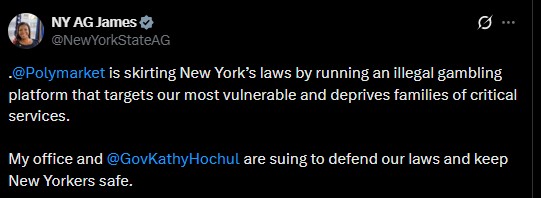
The lawsuit also points to a report from the state's addiction services office. It found users between 18 and 24 are at "high risk" of addiction to gambling.
James said in her statement, "By skirting New York's laws, Polymarket is targeting the most vulnerable and depriving New York families of critical services and support."
Governor Kathy Hochul also backed the case, saying she will "always stand up for New Yorkers when bad corporate actors prey on consumers and threaten tax dollars that fund schools and critical public services."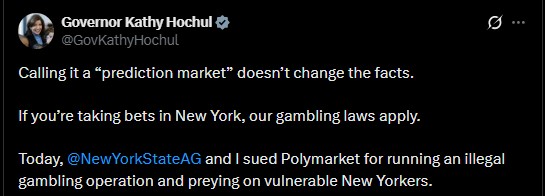
What Is Polymarket Accused of Doing, Exactly?
The state's investigation dug into real trades on the platform. A few examples stand out in the filing.
A New York-based account reportedly spent $3.01, including fees, on 6.39 contracts predicting the Mets would beat the Atlanta Braves. After the Mets won, the account got paid out.
The petition also describes a $1 transaction involving 94 contracts tied to which contestant would be eliminated from "Big Brother."
State officials also flagged that Polymarket offered a market on the winner of this year's New York gubernatorial election.
New York law bans wagering on games involving New York college teams and bans all sports betting for anyone under 21. That is the legal line the state says Polymarket crossed.
Is Polymarket Actually Federally Regulated?
Yes. The company behind Polymarket US is QCX LLC, and it holds real federal status.
CFTC records show QCX LLC d/b/a Polymarket US was designated as a Contract Market on July 9, 2025, after Polymarket bought the CFTC-licensed exchange QCEX for $112 million.
That federal designation is the core of Polymarket's legal defense. The company argues its event contracts fall under federal commodities law, not state gambling law.
Federal registration alone does not settle the case, though. Whether it blocks New York's gambling claims is exactly what the courts now have to decide.
What Does Polymarket Say in Its Defense?
Polymarket did not stay quiet. Hours after the state filed its case, the company sued New York back in federal court.
Chief Legal Officer Neal Kumar called the case a "copy/paste recycled lawsuit" and said Polymarket had tried to talk with the state first.
"We didn't run to preemptively sue the state; we chose to engage with them directly on the substance and address their concerns," Kumar said. "They preferred the media hit."
Kumar also said, "Polymarket was founded in a tiny NYC apartment and now has more than 350 employees here... We believe in New York and we're staying here."
Why Did Polymarket Sue New York Back?
Polymarket did two things on the same day. First, it moved to shift the state's case into federal court. Second, it filed its own separate lawsuit.
That second suit names Letitia James and officials at the New York State Gaming Commission directly. The goal is to stop the state from regulating a market Polymarket says only the CFTC can oversee.
This is part of a bigger pattern. States and the CFTC under the Trump administration disagree over who gets to police prediction markets, and that fight is now playing out across multiple courtrooms.
What Happens If New York Proves Its Allegations?
If a court eventually sides with New York, here is what could follow, depending on the court's specific findings.
If the Court Rules for New York | Potential Outcome |
Court finds unlawful gambling activity | Polymarket could be ordered to stop the disputed activity |
Court awards penalties | Polymarket could face financial penalties |
Court orders forfeiture | Money covered by the order could be forfeited |
Court grants an injunction | Certain future activity could be restricted |
The state wants three times the amount of any gains Polymarket made, plus $100,000 for every attempt or offer of sports wagering or mobile sports wagering in New York.
The suit also asks the court to order Polymarket to forfeit money, distribute restitution, and pay fines.
What Happens If Polymarket Wins Instead?
If Polymarket convinces the court that federal law controls here, the outcome flips completely.
New York's gambling laws would not apply to Polymarket's contracts. The state would lose its main legal tool against the platform.
This would also set a strong precedent. It could shield Polymarket, and possibly rival Kalshi, from similar lawsuits in other states going forward.
What Has NOT Been Proven Yet?
Right now, nothing in this case has been decided by a court. A few specifics are worth spelling out beyond the basics above.
Whether Polymarket's specific contracts legally count as "gambling" under New York's statute is still an open legal question, not a settled fact.
The scope of federal preemption, meaning how far CFTC oversight reaches into state law, has not been tested in this particular case.
No fines, forfeitures, or restitution have been ordered. Those figures are what New York is asking for, not what has been granted.
Whether large numbers of under-21 users placed real-money bets is not fully established beyond the specific examples named in the filing.
Both lawsuits were only just filed. This case will likely take months, possibly longer, to move through the courts.
Is This The First Time New York Sued a Prediction Market?
No. New York sued Polymarket's rival Kalshi back in July 2026, nearly two months before this case.
The state also filed similar petitions in April against Coinbase Financial Markets and Gemini Titan.
Polymarket has grown fast in that same window. One estimate puts the platform on pace to facilitate more than $70 billion in trading in 2026, more than triple its 2025 volume.
So this case is not just about one company. It is about who gets to control a fast-growing industry: the states or federal regulators.
What Happens Next in the Polymarket Case?
The legal fight will likely focus first on jurisdiction, federal preemption, and how New York's gambling law is defined.
The case could end up deciding how much power states have over exchanges that already hold federal regulatory status.
Until a judge rules, treating Polymarket as already found guilty of illegal gambling would be inaccurate. This is an ongoing dispute, not a finished case.
Disclaimer
This article is for informational purposes only and does not constitute legal, financial, or investment advice. Prediction markets and crypto-related platforms carry regulatory and financial risk. Laws around gambling and prediction markets vary by state and are subject to change. Always do your own research and consult a licensed professional before making financial decisions or using any trading platform.