Japan Prediction Market Regulation: What Kalshi and Polymarket Face?


Japan Prediction Market and Gambling Laws: Kalshi and Polymarket Visit
This is the latest development in Prediction Market News Today: a parliamentary group inside Japan's ruling party is preparing to formally discuss how the country should treat platforms that let users trade on the outcome of real-world events, from elections to Bitcoin price levels.
The move follows growing global attention on prediction markets and comes as regulators in Japan try to work out where these products fit within existing gambling law.
At a Glance
Japan's ruling Liberal Democratic Party (LDP) will add prediction markets to the agenda of its Digital Advanced Finance Parliamentary League.
The group is still in an early, pre-legislative stage and plans to gather input from Japanese and U.S. firms.
Executives from Kalshi and Polymarket are reportedly planning a visit to Japan soon.
Japan's Financial Services Agency (FSA) has said no dedicated law currently governs prediction markets, and warned the activity could be treated as gambling under Penal Code Article 185.
No formal regulatory framework has been announced; market access in Japan remains unresolved.
Japan LDP Lawmakers Add Prediction Markets to Discussion Agenda
The Digital Advanced Finance Parliamentary League, an LDP-affiliated group formed in 2023 out of an earlier commodity-futures caucus, plans to bring prediction markets into its policy discussions.
Party sources say this is not yet formal institutional design or draft legislation. The core question lawmakers want to examine is where prediction markets sit relative to Japan's existing gambling regulations, since betting on outcomes for personal gain could potentially fall under criminal gambling statutes.
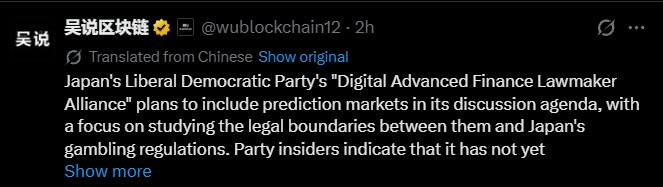
Source: Wu Blockchain
What the LDP Group Plans to Study
Area | Current Situation |
LDP lawmakers | Planning discussions on prediction markets |
Formal framework | Not yet being designed |
Main legal issue | Possible overlap with gambling laws |
No specific prediction-market law under its jurisdiction | |
Industry input | Views expected from Japanese and U.S. companies |
Major platforms | Kalshi and Polymarket |
Market access | Legal status in Japan remains a key hurdle |
The League intends to consult companies in both markets before moving toward any concrete policy proposal, and members say the near-term goal is simply to map out the issues rather than draft rules.
Kalshi and Polymarket Executives Plan Japan Visit
Party officials say executives from U.S. platforms Kalshi and Polymarket are planning to travel to Japan in the near future. Polymarket already has a Japanese-language site, though actual buying and selling on the platform is currently restricted for users in Japan. Their visit is expected to be part of the information-gathering process lawmakers described, not a signal of regulatory approval.
Japan FSA Warns Prediction Markets Could Raise Gambling Concerns
The issue reached the Diet earlier this year. At an April 21 House of Councillors Financial Affairs Committee session, Toshiyuki Inoue, Director-General of the FSA's Planning and Markets Bureau, said the agency has no specific law overseeing prediction markets.
He added that because such transactions could be interpreted as gambling, they require extremely cautious handling. Under Article 185 of Japan's Penal Code, a scheme where individuals stake their own money and win or lose based on an outcome could potentially qualify as illegal gambling, meaning any prediction-market business would need legal clarity before entering the market.
Why Prediction Markets Are Drawing Attention
Prediction markets let participants take positions on future events such as elections, economic data, sports outcomes, and crypto prices, profiting if their view is correct and losing if it is wrong.
Platforms like Kalshi and Polymarket have seen rapid volume growth in the U.S. and are increasingly cited alongside traditional polling as a gauge of expectations, though they are not a guaranteed predictor of outcomes.
Regulatory scrutiny has followed the growth: in the U.S., New York's Attorney General sued Coinbase and Gemini in April, arguing their prediction-market offerings amount to illegal gambling under state law.
Conclusion
Japan crypto market debate is only beginning. The LDP group's next step is expected to be interviews with major domestic and U.S. companies to identify the legal and regulatory questions that need answers. Until then, no formal framework exists, and whether platforms like Kalshi and Polymarket can legally operate in Japan remains an open question.
Disclaimer: This article is for informational purposes only and does not constitute financial, legal, investment, or trading advice. Cryptocurrency and prediction market products are volatile and carry regulatory and financial risk. Readers should conduct their own research and consult a qualified professional before making any financial decisions.