Pi Network Price Prediction: Protocol 28 Upgrade Adds Fuel to PI Setup


Pi Network has faced plenty of skepticism from traders questioning whether its price could stage a real recovery.
A major network upgrade landing this week is giving some of that skepticism a reason to pause.
Pi Network launched in 2019 as a mobile mining project, letting users earn PI tokens through a smartphone app ahead of the network's eventual mainnet rollout.
It built one of the largest community bases in crypto during its early years, and the Pi Network Coin continues to draw attention as its ecosystem matures.
As of September 25, 2026, PI trades near $0.086, down 2.2% over the past 24 hours.
This Pi Network price prediction looks at whether the Protocol 28 upgrade and the current price setup can support a move higher from here.
Pi Network's market capitalization stands at $967.083 million, with a fully diluted valuation of $1.488 billion.
Circulating supply sits at 11.243 billion PI against a total supply of 17.297 billion and a maximum supply of 100 billion.
Live $PI Market Data
Metric | Value |
Price | $0.086 |
24h Change | -2.2% |
24h Range | $0.08567 - $0.08851 |
Market Cap | $967.083M |
Source: market data taken from CoinGecko, as of Sep 25, 2026. Figures may vary slightly across other tracking websites.
Pi Network News Analysis
Pi Network News this week centers on a major protocol upgrade. According to Pi Update, a Pi Network-focused news account, the project has moved its testnet to Protocol 28 following the successful Protocol 27 Mainnet rollout.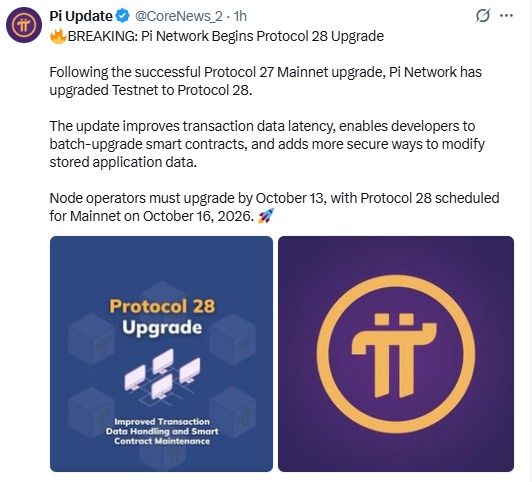
Source: Data Taken From @CoreNews_2, X Account, as of Sep 25, 2026
The upgrade is designed to improve transaction data latency, allow developers to batch-upgrade smart contracts, and add more secure methods for modifying stored application data.
Node operators have until October 13 to upgrade, with Protocol 28 scheduled to reach Mainnet on October 16, 2026.
This kind of infrastructure update often feeds into broader Pi Coin News coverage and can shape sentiment heading into the rollout date.
Technical Analysis
Pi Network technical analysis on the hourly chart shows $PI trading inside a falling wedge pattern. Price is currently sitting near the lower boundary of that wedge, close to the converging trendlines. 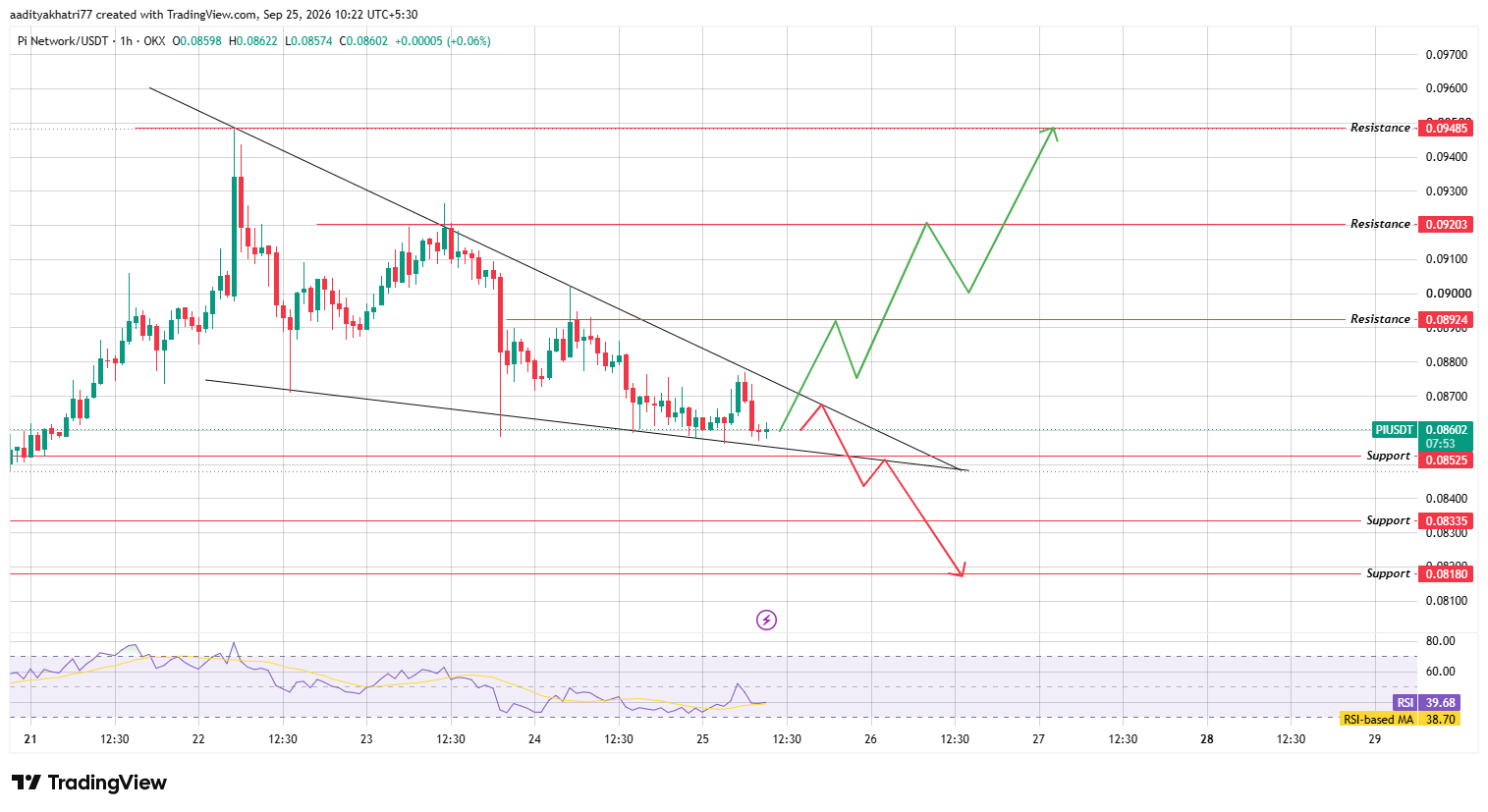
Source: Chart taken from TradingView, as of Sep 25, 2026
A bounce from this zone followed by a break of the wedge's upper trendline would signal a shift toward higher levels.
The Relative Strength Index reads 39.68, just above its moving average of 38.70, reflecting weak but stabilizing momentum.
Can PI Break the Wedge Toward Resistance?
If $PI bounces from current levels and breaks above the wedge's upper trendline, the setup points toward the first resistance zone at $0.08924.
A confirmed move above this level could extend gains toward $0.09203 and further toward $0.09485 if buying pressure builds through the Protocol 28 rollout window.
These levels mark the key zones this Pi Network Forecast is watching for signs of a sustained recovery.
What Happens If Pi Network Gets Rejected From the Wedge?
If $PI gets rejected from the trendline and fails to hold current levels, the token faces a test of support at $0.08525.
Losing that level would expose $PI to a decline toward $0.08335, with a deeper slide toward $0.08180 possible if selling pressure accelerates.
This scenario would shift the near-term Pi Network Outlook toward a more cautious stance.
Pi Coin Support and Resistance Levels
Support | Resistance |
$0.08525 | $0.08924 |
$0.08335 | $0.09203 |
$0.08180 | $0.09485 |
Bull, Base, and Bear Scenarios
Scenario | Setup | Level |
Bull | Bounce from wedge support, break of upper trendline | $0.08924 - $0.09485 |
Base | Continued consolidation inside the wedge | $0.08525 - $0.08924 |
Bear | Rejection from trendline, breakdown of support | $0.08335 - $0.08180 |
Pi Network vs Bitcoin
Pi Network's price action has shown a looser correlation with Bitcoin compared to more established altcoins, largely due to its distinct community-driven adoption cycle.
Even so, broader risk sentiment tied to Bitcoin's trend still filters into Pi Coin trading, particularly during periods of heightened market-wide volatility.
A stable or rising Bitcoin market would likely support a more favorable backdrop for this Pi Network Price Prediction 2026 outlook.
Expert Opinion
Analysts covering Pi Network technical analysis generally note that wedge patterns forming after a sustained decline often resolve in the direction of the prior trend once broken, making the upcoming trendline test an important signal.
Several also point out that scheduled network upgrades, such as Protocol 28, can act as short-term catalysts regardless of their immediate effect on token utility.
Disclaimer: This article is for informational purposes only and does not constitute financial advice. Cryptocurrency markets are highly volatile, and prices can fall well below the levels discussed here. The price levels above are based on technical analysis and are not guaranteed outcomes. Readers should conduct their own research and consult a licensed financial advisor before making any investment decisions.