Bedrock Price Forecast: Why Is $BR Token Up 70% Today Suddenly


Something shifted overnight in a corner of the restaking market most traders had stopped watching. Vault deposits filled fast, shorts got trapped, and one small-cap name became the loudest ticker on trading screens. What happened next raises a real question about whether this move has legs.
BR Coin Wakes Up: What Actually Pushed Bedrock Into the Spotlight
The Bedrock price forecast starts simple: BR jumped roughly 70% in 24 hours, tied to two things at once. A restaking vault was filled almost to capacity, and short sellers got run over.
Here's the thing: neither event alone usually moves a token this hard.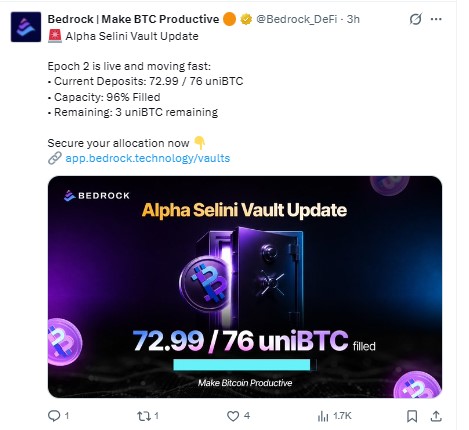
Bedrock runs Bitcoin restaking vaults under the "Make BTC Productive" banner, and its Alpha Selini Vault update showed deposits at 72.99 of 76 uniBTC, 96% filled, with three uniBTC of room left. That scarcity framing pulled in fast money.
And fast money it was. Liquidation data shows shorts absorbing far more damage than longs across the last day.
Bedrock Price Forecast: Latest Market Data
As of 05:20 UTC on August 13, 2026, BR trades near $0.2164 to $0.2184, up about 70% on the day, per CoinMarketCap data. Market cap sits near $65.28M against a fully diluted value of $216.57M since only 301.66 million of the one billion in supply circulates.
Volume exploded too, up nearly 474% to $11.03M, pushing volume-to-market-cap to 16.81%. Liquidity stays thin against that FDV gap.
Turns out, exchange flow backs the move. Binance carried $149.03M of recent volume, with Bybit, Bitget, MEXC, and Gate filling the rest, per CoinGlass tracking. That kind of sudden exchange listing spike usually shows before wider coverage catches on.
Bedrock Daily Chart Analysis: Technical Structure
The daily BRUSDT chart on MEXC shows a descending channel breakout, a clean one. Price spent months grinding inside a descending channel near $0.10 to $0.23, then broke above it on a green candle that dwarfs everything around it.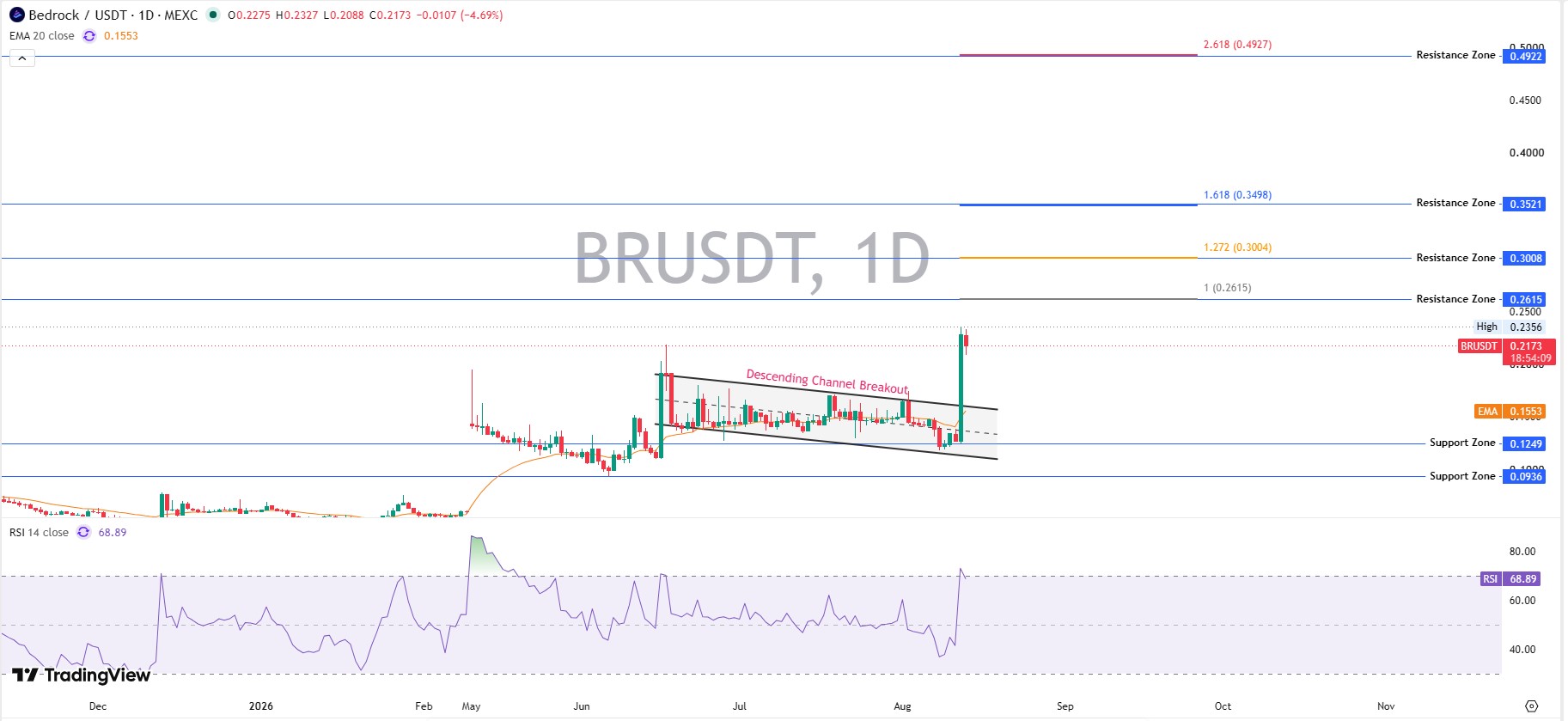
RSI sits at 68.89. Not overbought yet, but close. The 20-period EMA trails far below at $0.1553, showing how stretched this move is.
Resistance stacks using Fibonacci extensions: $0.2615 first, then $0.3008, $0.3521, and a stretch target near $0.4922. Support rests at $0.1249, with a deeper floor at $0.0936 if momentum fails.
We pulled up the chart on TradingView, and the first thing that stood out was thin volume on pullbacks, usually a sign of weak hands, not real accumulation.
But breakouts in thin history can fade fast too.
Bedrock Tokenomics and Whale Concentration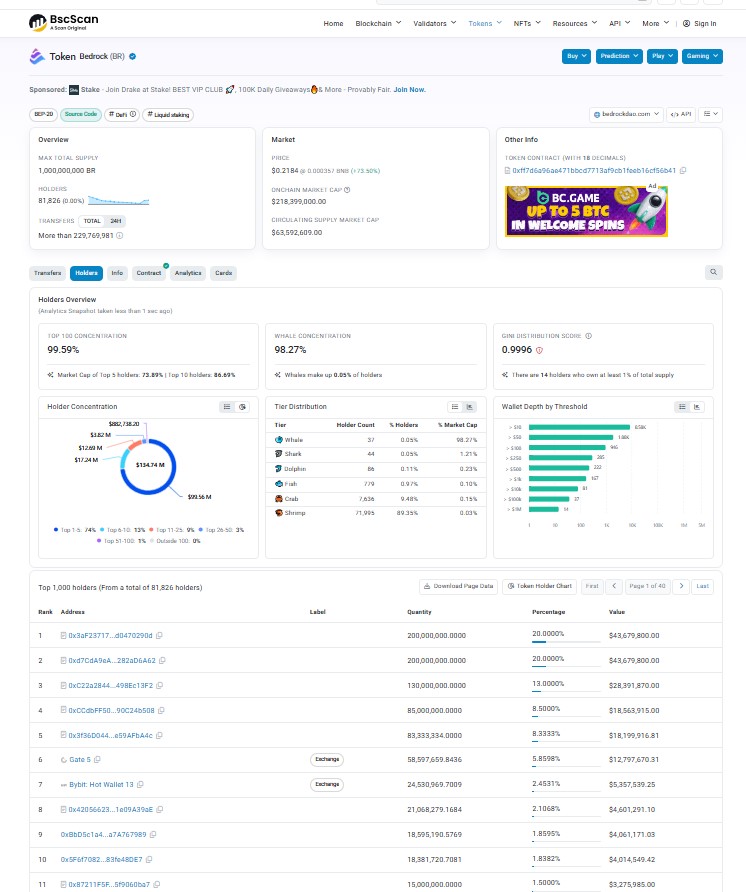
This part matters more than most Bedrock price prediction pieces admit. BscScan data puts top 100 wallet concentration at 99.59%, with whales alone holding 98.27%. The Gini score reads 0.9996, about as concentrated as a token gets.
Here's the thing: a score that close to 1.0 means ownership sits almost entirely with a tiny slice of addresses, not spread across the base.
Break the holder base into tiers, and the picture gets sharper. Whale wallets, just 37 of them, control 98.27% of the supply between them. Shark wallets, 44 in total, hold another 1.21%. Everyone else, dolphins, fish, crabs, and shrimp combined, splits what's left, well under 1% of BR in total.
The top five addresses alone carry over 73% of circulating market cap. One wallet holds 20% outright. Another holds the same. A third sits at 13%.
That's not a typo, and it's not unusual for a token this early into its restaking rollout, but it does change how this Bedrock price forecast should get read.
Fourteen wallets hold at least 1% of supply each, a small group with outsized control.
And control like that cuts both ways. On the way up, concentrated wallets can hold price steady by simply not selling, which may explain part of why this breakout held together. On the way down, the same wallets can dump size that retail liquidity cannot absorb.
Holder count has still grown to 88.87K addresses, showing real retail interest, even with whales this dominant.
Turns out, some of those top holders are flagged as exchange wallets rather than private treasuries, per the BscScan breakdown, which softens the picture slightly since exchange balances often represent many users pooled together, not one actor.
Concentration this steep means a handful of wallets can swing price hard either way. Worth watching before adding size here.
Bedrock as a Restaking Altcoin: Where BR Fits the Bigger Trend
Bedrock is not a memecoin chasing hype for its own sake. It's a Bitcoin restaking altcoin competing for yield capital alongside other liquid restaking projects, and that shapes how this rally should get read.
Restaking narratives move in waves tied to broader BTC and ETH price prediction sentiment, since capital rotates into yield plays when majors consolidate. Bedrock's all-time high sits at $0.2572 from April 2026, only about 15% above current levels.
Watching BTC itself matters here too, and anyone tracking a Bitcoin price prediction alongside this move will notice the correlation is not accidental.
Bedrock Price Forecast: Bear, Base and Bull Scenarios
Case | Target | Probability | Key Level | Invalidation |
Bear | $0.135 | 25% | Loses $0.1249 support | Daily close below $0.12 |
Base | $0.21-$0.26 | 45% | Holds above EMA20 | Falls back under $0.155 |
Bull | $0.35 | 30% | Clears $0.3008 resistance | Fails at $0.26 twice |
None of this is guaranteed, and this one especially isn't, given the concentration numbers above.
Key Risks to This Bedrock Price Forecast
Whale concentration above 98% remains the single biggest risk. A coordinated exit from a few wallets could crush this rally in hours.
Volatility this sharp invites a retest of broken structure. Readers tracking similar setups can bookmark the crypto airdrops and coin events calendar, since vault capacity events like this tend to repeat.
Disclaimer: None of this is personal investment advice. Do your own research and size positions around the risks above, not just the upside.