Bitcoin Price Prediction: Will BTC Hold $62K Support Before CPI?


Is Bitcoin about to lose its key support level?
Bitcoin is sitting at a nervous spot on the chart today. The coin recently got turned away at the top of its trading channel, and traders are now watching whether it can hold above $61,700.
BTC trades near $62,670 at the time of writing, down slightly on the day. The mood across the market feels cautious, with big whales buying quietly while everyone else waits on today's inflation report.
Let's discuss the Bitcoin Price Prediction.
What does the BTC chart show right now?
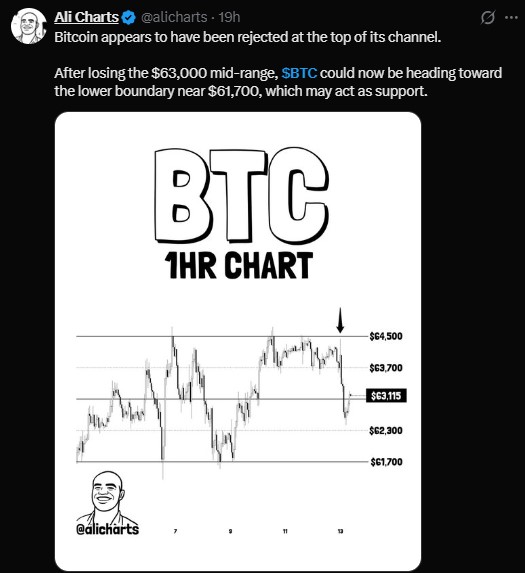
On the 1-hour chart, $BTC lost the $63,000 mid-range after getting rejected near $64,500. That rejection sent the price down toward $63,115 before slipping further.
Chart watchers now see $61,700 as the next line in the sand. If that level breaks, sellers could get more room to push prices lower.
If it holds, it may bounce back toward the middle of its channel.
Level | Price | Role |
Resistance | $64,500 | Recent rejection point |
Mid-range | $63,000 | Lost support, now resistance |
Key support | $61,700 | Lower channel boundary |
Are big holders buying or selling Bitcoin?
This is where the story gets interesting. Data from Glassnode shows Bitcoin's Accumulation Trend Score has stayed close to 1 since June.
That score measures whether large holders are adding to their bags, and a reading near 1 means they mostly are.
Separate data from Santiment backs this up. Wallets holding between 10 and 10,000 BTC added roughly 11,000 BTC over the past week.
This group has historically moved in step with price, so more buying from them is a hopeful sign for bulls.
Smaller retail wallets are also still buying dips, based on the same supply data. That means both whales and regular holders are leaning toward accumulation rather than selling, even with the price stuck in a choppy range.
Why did $424 million in $BTC leave exchanges?
A large outflow of about $424.66 million in BTC was recorded yesterday. Outflows like this usually mean coins are moving off exchanges into private wallets or cold storage, which traders often read as a sign of long-term holding rather than an intent to sell.
At the same time, separate wallet-tracking data flagged the U.S. government moves $288 million in seized $BTC, ether to Coinbase Prime
Movements tied to government wallets tend to draw extra attention, since large transfers can hint at future distribution even without a confirmed sale.
Is Wall Street actually adopting BTC?
A new Bitcoin Banking Adoption Index puts overall bank adoption at 32%. The index tracks how major banks handle Bitcoin trading, custody, and related products.
Fidelity leads the pack at 71%, followed by BNY at 46% and Goldman Sachs at 45%. Names like JPMorgan Chase, Morgan Stanley, and Citigroup all sit in the low-to-mid 40s.
Bank | Country | Adoption Score |
Fidelity | USA | 71% |
BNY | USA | 46% |
Goldman Sachs | USA | 45% |
JPMorgan Chase | USA | 43% |
Morgan Stanley | USA | 43% |
Citigroup | USA | 43% |
Wells Fargo | USA | 38% |
Executives behind the index called adoption "accelerating, but still early." That framing matters, because it suggests most large banks have only begun building out Bitcoin trading and custody services rather than fully embracing them.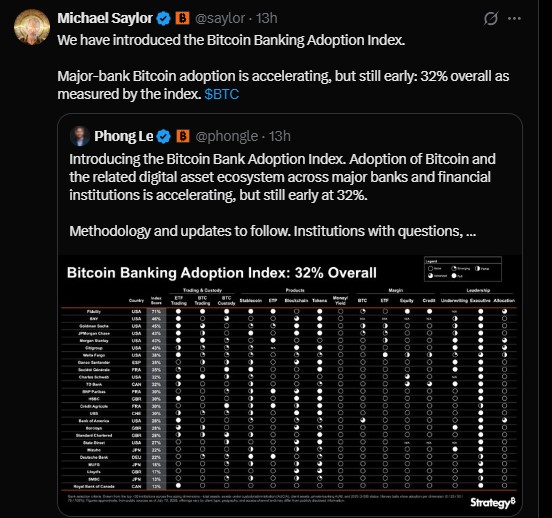
Are companies still buying Bitcoin?
Corporate buying hasn't slowed down. One major holder reported increasing its cash reserve by $450 million while holding roughly 843,775 BTC in reserves, alongside $3.0 billion in cash.
That kind of balance sheet strategy has become a talking point for how traditional companies treat Bitcoin as a treasury asset.
What is today's CPI report and why does it matter for $BTC?
The U.S. Consumer Price Index for June lands today, and it's arguably the single biggest catalyst on the calendar this week.
A Federal Reserve governor has already warned that a hot inflation print could bring rate hikes back into play sooner than expected.
Higher rates tend to hurt assets like $BTC that don't pay any yield, since safer options like bonds become more attractive.
A soft CPI reading, on the other hand, could ease pressure on the Fed and give risk assets like BTC some breathing room.
Given the setup, today's data release could decide whether Bitcoin holds its $61,700 support or breaks lower toward the next zone. Traders should expect a volatile few hours after the number drops.
Disclaimer
This article is for informational purposes only and does not constitute financial advice. Cryptocurrency markets are highly volatile, and prices can change quickly based on news and macroeconomic events. Always do your own research and speak with a licensed financial advisor before making investment decisions. Past performance is not indicative of future results.