XRP Price Drops to Its Lowest Since 2024 as Institutions Keep Buying

XRP is having a rough week. The token slid from near $1.82 to just above $1.00, its lowest daily close since November 2024.
But while retail traders watch the red candles, a different story is playing out behind the scenes. Big banks and funds are still adding exposure to the asset, even as the price falls.
This Ripple price prediction looks at the filings, the on-chain data, and the chart to see what might come next.
What is the XRP price today?
The altcoin is trading close to $1.00 to $1.02 as of August 13, 2026. That is roughly 69% below its January 2025 peak near $3.30.
The 24-hour range has stayed tight, between $1.00 and $1.03. Trading volume sits near $900 million to $1 billion a day.
Why are big banks still buying XRP ETFs?
New 13F filings with the SEC show a pattern. Several major banks disclosed fresh ETF positions this quarter.
JPMorgan Chase reported holding shares in both the Bitwise XRP ETF and the Grayscale XRP Trust ETF. Bank of Montreal also disclosed exposure to the cryptocurrency in its latest 13F-HR filing.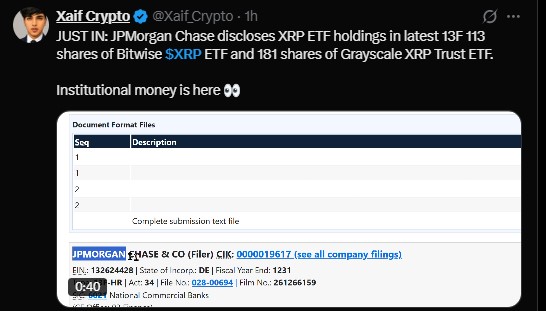
Neither position is huge in dollar terms. But the filings matter because they show the digital asset moving into mainstream portfolio reports, next to stocks and bonds.
Militia Capital, a hedge fund with over $3 billion in assets, went further. Public filings show the fund raised its Bitwise XRP ETF stake by about 11%, taking its position to roughly 35,320 shares.
Institution | XRP ETF Position | Filing Type |
JPMorgan Chase | 113 shares Bitwise XRP ETF, 181 shares Grayscale XRP Trust ETF | 13F |
Bank of Montreal (BMO) | XRP ETF exposure disclosed | 13F-HR |
Militia Capital | ~35,320 Bitwise XRP ETF shares (+11% QoQ) | 13F |
21Shares XRP ETF | Assets down roughly $135 million, about $13 million in realized redemption losses | Fund flow data |
Why did the Bitwise XRP ETF holdings grow as the price fell?
This is the part most headlines miss. While the price fell from about $1.82 to $1.04, the Bitwise fund's actual token holdings did not shrink. They grew.
Reported fund data shows the ETF went from holding around 131.2 million coins to about 286.8 million coins over six months. That is a net increase of roughly 155.6 million tokens.
In plain terms, the fund bought more coins while the price dropped. That is usually read as accumulation, not panic selling.
Not every fund followed the same path. The 21Shares ETF reportedly saw its assets shrink by close to $135 million, with about $13 million in losses locked in through redemptions. That is more than half the fund's value gone in a short stretch.
So the picture is mixed. Some funds are buying weakness. Others are seeing client money walk out the door.
What do on-chain signals say about XRP right now?
Network data adds another layer. The NVT ratio, which compares network value to transaction volume, recently dropped about 4.13% to 276.5.
A falling NVT ratio can mean transaction activity is growing faster than the market cap, which some traders view as a healthy sign for actual usage.
Active address data tells a split story. Daily active addresses jumped to around 20,500 before pulling back toward 14,000. Santiment data shows August active addresses averaging around 35,700 a day, up about a third from July's 26,400 average.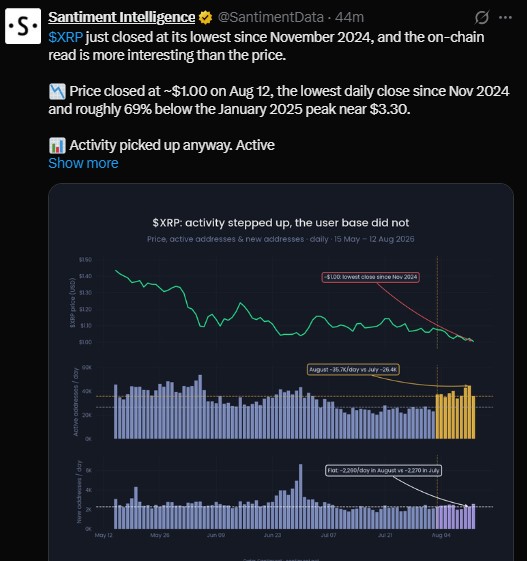
But new addresses have not grown. New wallets sat near 2,260 a day in August, almost flat compared to July's 2,270. Existing holders are moving coins around more. New users are not really showing up.
Separately, a wallet tracker flagged a transfer of 50 million coins, worth about $50.5 million, from Ripple to an unknown wallet. Large transfers like this happen often and do not always signal a sale.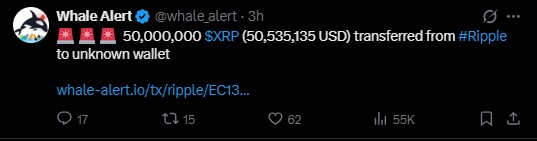
How does UK banking friction fit into this?
Away from the charts, UK lawmakers are asking banks to explain why roughly 40% of transfers to UK crypto exchanges get blocked or delayed. One firm reportedly lost close to £1 billion in rejected transactions.
Parliament wants answers before the Financial Conduct Authority's new crypto rules even start. It is a reminder that banking plumbing, not just price, still shapes how easily people can move into crypto.
What is the SEC's new crypto framework about?
The SEC holds an open meeting this Friday, August 14, to vote on proposing "Regulation Crypto," a tailored offering regime for certain crypto investment contracts. It is the first major rulemaking of this kind under Chair Paul Atkins.
This comes as the CLARITY Act, the broader market structure bill, remains stalled in the Senate. Analysts see Friday's vote as the SEC moving ahead with rules on its own, rather than waiting on Congress.
It is worth noting that this is a proposal vote, not a final rule. A public comment period would follow before anything takes effect.
XRP price prediction: what could happen next?
On the daily chart, the altcoin is forming a descending triangle, with lower highs pressing against support near $1.00. The RSI sits around 37, showing weak momentum but not yet deeply oversold.
If the $1.00 level breaks on strong volume, the pattern points toward a possible move toward $0.90 to $0.92.
If the altcoin holds $1.00 and reclaims the descending trendline, the first upside targets sit around $1.10 to $1.15, with $1.20 to $1.25 as a further target.
This is a technical read of the chart, not a guaranteed outcome. Institutional buying and regulatory news could both shift sentiment quickly in either direction.
For now, the token sits at a level many traders are watching closely, with data pointing to both quiet accumulation and real uncertainty at the same time.
Disclaimer
This article is for informational purposes only and does not constitute financial, investment, legal, or trading advice. Cryptocurrency markets are highly volatile and carry significant risk, including the potential loss of your entire investment. Past performance and on-chain data do not guarantee future results. Always do your own research and consult a licensed financial advisor before making investment decisions.
Also read: