How to Stake BDAG Tokens: Mainnet Rewards Guide for 2026

How to Stake BDAG on BlockDAG Mainnet: Wallets, APY and Epoch Rewards?
If you want to learn how to stake BDAG, the process is now live on BlockDAG mainnet and is built to be simple.
You connect a wallet, choose the amount of BDAG, confirm the transaction, and then track rewards on-chain. The bigger point, though, is not just how to click through the platform. It is understanding the lock rules, reward timing, wallet needs, and the risks before you commit funds.
With Phase 3 staking now live on BlockDAG mainnet, BDAG holders can lock tokens, join active pools, and start earning epoch-based rewards through the official staking platform.
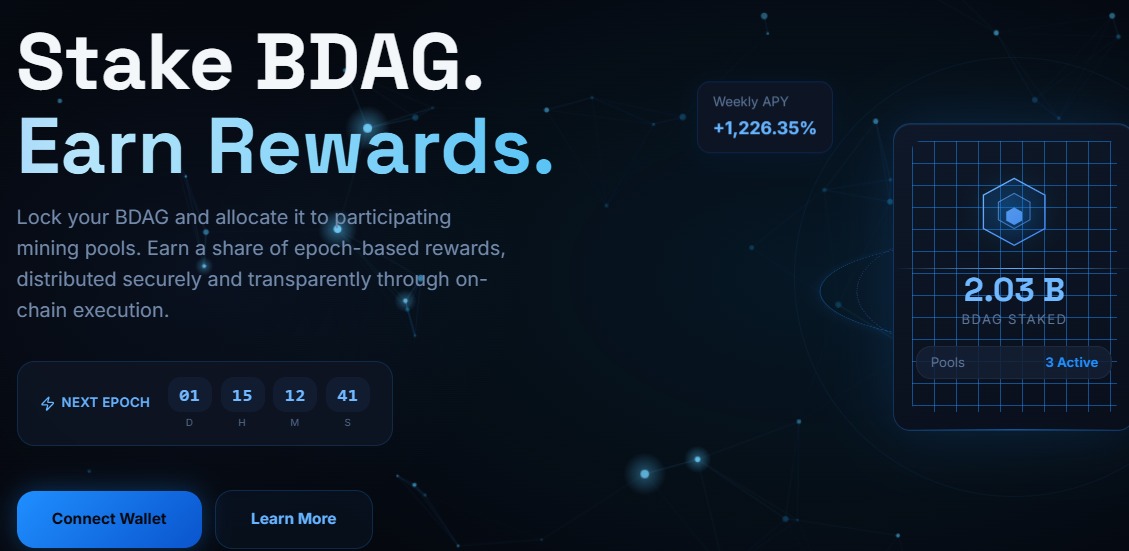
Source: BlockDAG Website
This guide explains how to stake BDAG. It keeps the process simple, clear, and focused on what matters.
What BlockDAG Staking Actually Does?
Before you start how to stake BDAG, it helps to know what staking means on this network.
BlockDAG still runs on Proof-of-Work, so miners continue to validate transactions and produce blocks.
Staking does not replace mining. Instead, it adds a second participation layer for BDAG holders.
Holders can lock BDAG tokens into the staking contract and earn a proportional share of epoch-based rewards.
Rewards are distributed on-chain through smart contract logic.
The staking page also says users can lock BDAG, allocate it to participating mining pools, and earn rewards transparently through on-chain execution.
That matters because how to stake BDAG is really about joining a live reward system, not a test feature. The staking is already operational on BDAG mainnet, with active pools and real-time reward calculation.
Wallets You Can Use
A big part of how to stake BDAG is wallet readiness. It supports several non-custodial wallet options, including:
WalletConnect
MetaMask
Trust Wallet
Binance Wallet
SafePal
So if you are preparing for how to stake BDAG, you need a compatible wallet that you control directly. The platform shows a “Connect Wallet” button as the first step.
Keep your BDAG in that wallet before you begin. A custodial exchange wallet is usually not the right setup for direct contract interaction.
Step-by-Step: How to Stake BDAG?
Here is the clean tutorial for how to stake BDAG.
Step 1: Open the official BlockDAG staking dashboard
Go to the official BlockDAG staking page and make sure you are on the real site. Since you will be signing wallet transactions, checking the correct domain matters.
Step 2: Connect your wallet
Click Connect Wallet. There are several supported options, including MetaMask, Trust Wallet, Binance Wallet, SafePal, and WalletConnect. Pick the wallet that holds your BDAG.
Step 3: Go to the staking section
Staking in three simple actions: Connect Wallet, Start Staking, and Track Earnings. This is the core path for how to stake BDAG.
Step 4: Enter the amount you want to stake
The minimum stake is any BDAG amount. Rewards are proportional to your stake, the dashboard says “More Stake More Rewards.”
Step 5: Confirm the staking transaction
Approve the transaction in your wallet. Once confirmed on-chain, your BDAG moves into the staking contract. The staking is non-custodial and controlled by transparent smart contract logic.
Step 6: Let rewards start accumulating
The staking timeline says reward accumulation begins immediately after activation. That means once you complete how to stake BDAG, your position becomes active from Day 0.
Step 7: Track earnings and claim when eligible
The dashboard includes a Track Earnings step, and the timeline shows that rewards become claimable only after a set period. You can monitor your staked balance, epoch progress, and claim status directly on the platform.
Lock Period, Claim Timing, and Unstaking Rules
This is one of the most important parts of how to stake BDAG because staking is not instant-access yield.
The official timeline works like this:
Day 0: stake becomes active
Week 1 to Week 3: rewards accrue, but remain non-claimable
Week 4 and after: rewards become claimable through a manual transaction
The staking timeline is with activation at Day 0, a reward accumulation period across the next weeks, an unbonding phase, and rewards claimable from Week 4+.
If you choose to unstake, a 3-week cooldown begins immediately. During that cooldown, your principal stays locked. Rewards continue to accrue, but they cannot be claimed during that time. Adding more BDAG during the cooldown resets the timer.
Another key rule: if you request unstaking during an active 7-day epoch, the withdrawal does not happen instantly. It is processed only after that epoch ends. This preserves fair reward calculation for all participants.
APY Expectations and Epoch-Based Rewards
If you are checking how to stake BDAG, the reward display needs careful reading. The staking page shows two different signals.
One section says staking APY is around 8% to 10% annually, while another live dashboard tile shows Weekly APY +1,226.35%.
These numbers should not be read as equal or fixed returns.
The safer interpretation is that the 8% to 10% annual figure looks like the general guidance, while the much higher weekly figure appears to be a live dashboard metric tied to current pool conditions, epoch calculations, or a temporary interface estimate.
Since BlockDAG staking uses epoch-based rewards, returns can shift based on how many users are staking, how rewards are allocated in that epoch, and your share of the total staked BDAG.
A portion of block rewards is distributed to the staking pool and then shared proportionally among active stakers during each epoch.
The interface also shows Epoch #7, which supports that the reward system is running in live cycles rather than as one fixed static APY.
So when learning how to stake BDAG, the key point is not to rely on one headline percentage alone.
Check the live dashboard, understand that epoch conditions can change, and treat any displayed APY as variable rather than guaranteed.
Risk Model and Security Design
BlockDAG staking has:
no slashing
no validator penalties
no third-party custody transfer
That makes how to stake BDAG easier for beginners to understand. Your tokens stay locked in the smart contract until you decide to unstake under the platform rules. All staking actions, reward calculations, claim events, and unstake requests are recorded on-chain.
More simple facts:
Risk level: No slashing
Minimum stake: Any BDAG amount
Weekly payouts: rewards are calculated and distributed every 7 days automatically
These details help make how to stake BDAG more transparent than vague staking pages that do not explain the mechanics.
What to Check Before You Stake
Before you finish how to stake BDAG, check five things:
you are on the official BlockDAG website
your wallet is compatible and funded with BlockDAG coins
you understand the 4-week claim timing
you understand the 3-week unstaking cooldown
you verify the current APY on the live dashboard
That last step matters most. Reward expectations can shift, and crypto prices can move sharply even if token rewards keep accruing.
Final Thoughts
Learning how to stake BDAG is fairly straightforward. The platform flow is simple, the wallet support is broad, and the contract logic is explained in plain terms. You connect a supported wallet, stake any amount of BDAG, let rewards accrue from Day 0, and claim once the claim window opens after four weeks.
YMYL Disclaimer: This content is for informational purposes only and is not financial advice. Always verify live BlockDAG staking terms, rewards, and risks before locking your BDAG tokens.