Top DeFi Tokens August 2026: Ranked List for traders

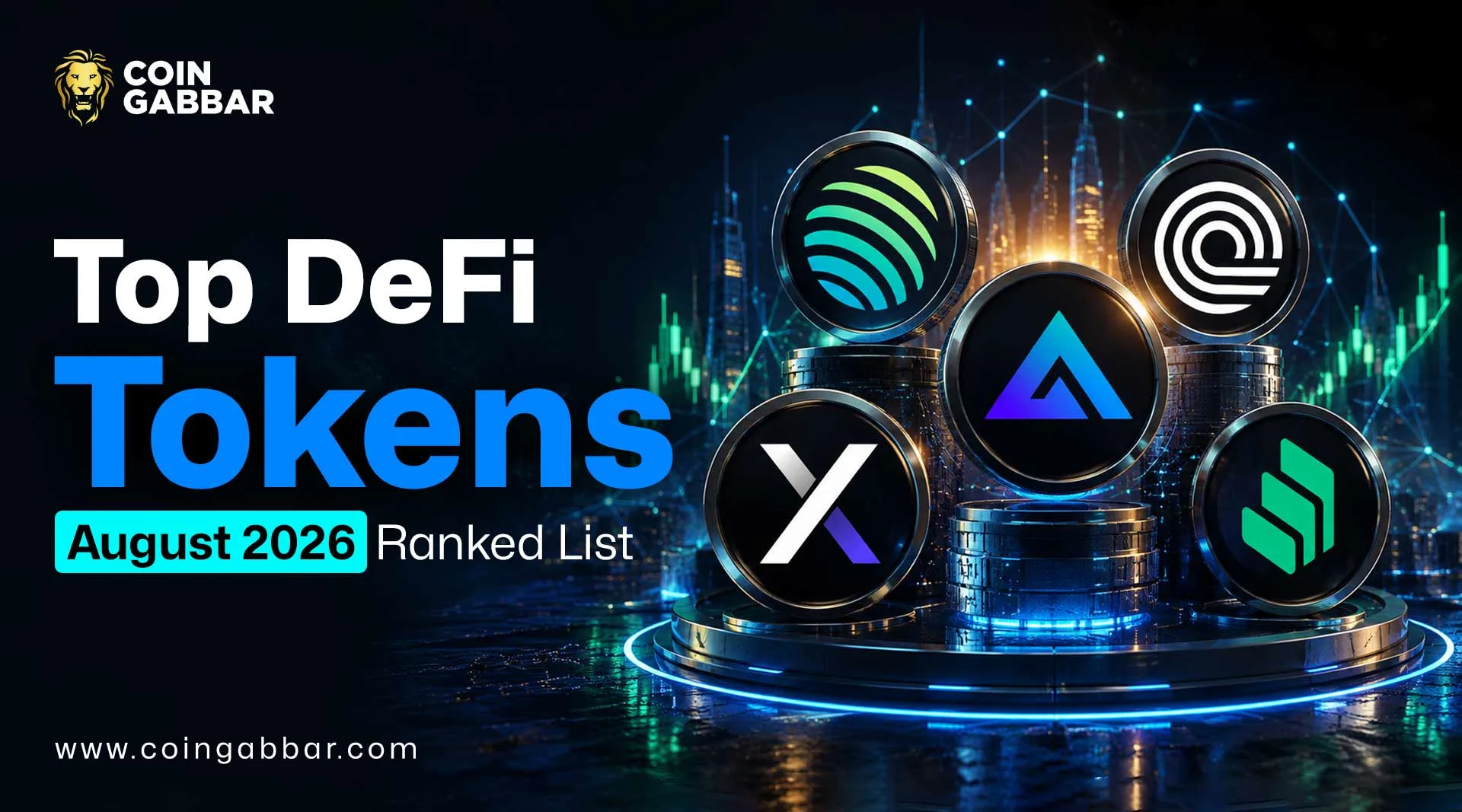
Top DeFi Tokens August 2026: Ranked List
DeFi's total value locked has swung hard in 2026. Some months bring fresh capital. Other months bring exits. That makes it harder to spot which projects are building versus which are just riding hype.
This list of top DeFi tokens august 2026 is built around one goal: show real usage, not just price charts.
Every pick comes from official project data, not rumours are not telling you what to buy. Its showing you what to research, including a genuine weakness for every project.
How it Selected These Picks
It did not rank tokens by price alone, since price moves too fast to matter for a monthly list. Instead, checked signals that hold up over time:
Real product usage — meaningful trading volume or deposits, not just token incentives
Revenue and fee flow—does the protocol generate fees, and where do they go
Tokenomics clarity—Is the supply Vesting schedule public, with unlocks disclosed in advance
Audit history—has the code been reviewed by outside security firms
Competitive position—is the project gaining ground or losing it to rivals
This gives a shortlist grounded in facts, not marketing copy. None of these projects are without risk. Call out a genuine weakness for each one below.
The Shortlist at a Glance
Here are the five projects covered in this top DeFi tokens august 2026 list:
Jupiter (JUP) — Solana's leading DEX aggregator and lending entrant
Ondo Finance (ONDO) — Real-world asset tokenization platform
GMX — Decentralized perpetuals exchange on Arbitrum and Avalanche
dYdX (DYDX) — Standalone Layer 1 chain built for perpetual futures
Compound (COMP) — One of DeFi's original lending protocols
Each one sits in a different DeFi niche. That spread matters whether you are a beginner or an experienced trader.
Pick 1: Jupiter (JUP)—Overview, Strengths, and Risks
Jupiter started as a swap aggregator on Solana and now routes the large majority of retail liquidity across the network. In 2026 it expanded into lending through Jupiter Lend, built with the Ethereum-based protocol Fluid.
What it does: Jupiter finds the best price for a token swap across many Solana DEXs in one transaction. It also runs a perpetuals platform and a lending market.
Token Utility: As per CoinMarketCap JUP is the governance token of the Jupiter ecosystem, enabling community governance while supporting Solana's leading DEX aggregator and DeFi products.
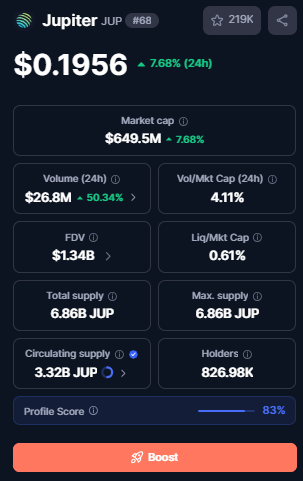
Metric | Value |
Current Price | $0.1956 |
Market Cap | $649.5M |
24H Volume | $26.8M |
FDV | $1.34B |
Total Supply | 6.86B JUP |
Max Supply | 6.86B JUP |
Circulating Supply | 3.32B JUP |
Strengths:
Deep integration across almost every major Solana protocol
Diversifying beyond swaps into lending and perpetuals
Active governance with community votes on new listings
Genuine weakness: JUP holders do not automatically capture protocol revenue the way some governance tokens do.
Utility centers on governance and staking rather than a direct fee switch, so price often lags product growth. Scheduled unlocks have also added short-term selling pressure.
JUP is a decent fit if you already use Solana and want exposure to its DeFi layer specifically.
Pick 2: Ondo Finance (ONDO) — Overview, Strengths and Risks
Ondo Finance brings real-world assets on-chain, including tokenized US Treasuries, money market funds, and now equities.
What it does: Ondo's OUSG product gives institutional users exposure to short-term Treasuries on-chain. USDY offers a similar yield-bearing product for retail and offshore users, and the platform has expanded into tokenized stocks.
Token Utility: As per CoinMarketCap ONDO is the governance token of the Ondo Finance ecosystem, supporting community governance for its real-world asset (RWA) tokenization platform.
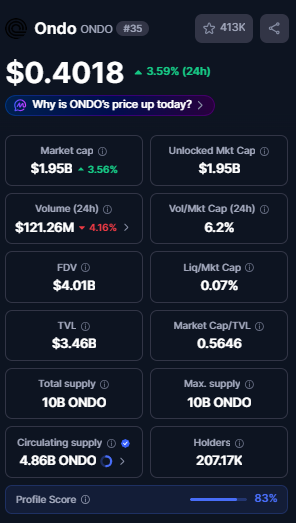
Metric | Value |
Current Price | $0.4018 |
Market Cap | $1.95B |
24H Volume | $121.26M |
FDV | $4.01B |
TVL | $3.46B |
Total Supply | 10B ONDO |
Max Supply | 10B ONDO |
Circulating Supply | 4.86B ONDO |
Strengths:
Clear compliance-first design using regulated broker-dealers
Tokenized asset volume has grown steadily even during weak price action
Backing from major institutional partnerships
Genuine weakness: ONDO token holders currently capture zero direct cash flow from platform fees. Management fees go to the corporate entity, not to the token. Until a fee-switch mechanism activates, price and protocol growth can move in opposite directions, which has already happened this year.
This pick suits readers who want long-term exposure to the tokenized real-world asset trend rather than a short-term trade.
Pick 3: GMX—Overview, Strengths and Risks
The GMX is one of the longest-running decentralized perpetual exchanges, predating the order-book model used by newer rivals, and still processes meaningful volume on Arbitrum and Avalanche.
What it does: GMX lets traders open leveraged spot and perpetual positions against shared liquidity pools called GM and GLV, rather than a traditional order book.
Token Utility: As per CoinMarketCap GMX is the native utility and governance token of the GMX ecosystem, supporting staking, governance, and fee-sharing for decentralized perpetual trading.
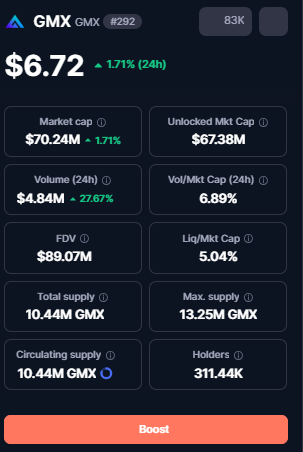
Metric | Value |
Current Price | $6.72 |
Market Cap | $70.24M |
24H Volume | $4.84M |
FDV | $89.07M |
Total Supply | 10.44M GMX |
Max Supply | 13.25M GMX |
Circulating Supply | 10.44M GMX |
Strengths:
Real fee-backed buyback mechanism tied directly to trading activity
Long operating history with no major protocol-level exploit
High staking participation, which limits circulating supply pressure
Genuine weakness: GMX has lost meaningful trading volume share to faster-growing rivals in the perpetuals space. Trading volume has fallen sharply in recent periods even as TVL held steady, a gap worth watching before assuming the buyback mechanism alone can support the price.
Pick 4: dYdX (DYDX) — Overview, Strengths and Risks
The dYdX rebuilt itself as its own Cosmos-based Layer 1 blockchain dedicated to perpetual futures trading, rather than staying an app on Ethereum.
What it does: The dYdX Chain supports over 180 markets with up to 100x leverage. DYDX holders can stake to help secure the network and earn a share of trading fees.
Token Utility: As per CoinMarketCap DYDX powers the dYdX ecosystem by enabling governance, staking, and network security across its decentralized perpetual trading platform.
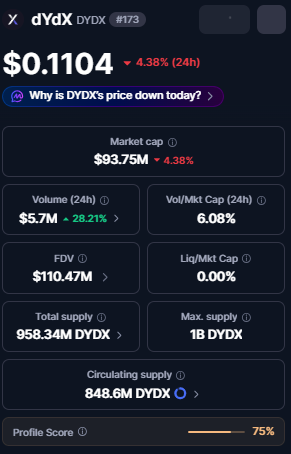
Metric | Value |
Current Price | $0.1104 |
Market Cap | $93.75M |
24H Volume | $5.7M |
FDV | $110.47M |
Total Supply | 958.34M DYDX |
Max Supply | 1B DYDX |
Circulating Supply | 848.6M DYDX |
Strengths:
100% of trading fees on V4 go to DYDX stakers
Full ownership of its own chain gives more control over upgrades
Long track record in the derivatives niche
Genuine weakness: dYdX has struggled against newer order-book competitors that captured much larger trading volume and market cap in 2026. The token trades far below its all-time high, and daily volumes are a small fraction of what leading rivals process.
Pick 5: Compound (COMP) — Overview, Strengths and Risks
Compound helped invent the algorithmic lending model most of DeFi still uses today and remains a functioning, audited protocol even as newer competitors have pulled ahead.
What it does: Users deposit assets like USDC or ETH to earn interest or use deposits as collateral to borrow. Compound III (Comet) uses isolated single-asset markets to limit risk from any one collateral type.
Token Utility: As per CoinMarketCap COMP is the governance token of the Compound protocol, allowing holders to vote on protocol upgrades while supporting one of DeFi's longest-running lending platforms.
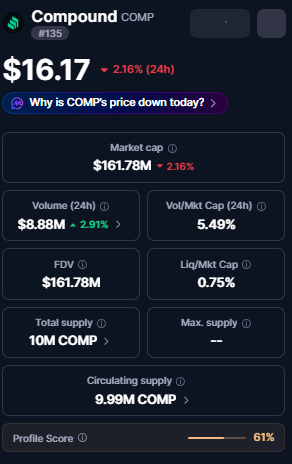
Metric | Value |
Current Price | $16.17 |
Market Cap | $161.78M |
24H Volume | $8.88M |
FDV | $161.78M |
Total Supply | 10M COMP |
Circulating Supply | 9.99M COMP |
Strengths:
One of the most audited and battle-tested codebases in DeFi
Isolated market design reduces cross-asset contagion risk
Renewed risk-management partnership through 2026 for safer expansion
Genuine weakness: Compound's total value locked sits far behind newer rivals like Aave, Morpho, and Fluid, and that gap has widened rather than closed. Growth has been slow, and the protocol has ceded its position as DeFi lending's default choice.
Honourable Mentions
A few more projects came close to making this shortlist but were left out for narrower reasons:
SushiSwap (SUSHI): A multi-chain DEX with a long history, though liquidity has thinned compared to its earlier years.
1inch: A DEX aggregator with strong tooling, but less differentiated from newer aggregators like Jupiter.
Spark: A fast-growing lending protocol tied to the Sky ecosystem, worth watching as it matures.
If you are building your own DeFi shortlist, these are reasonable names to research further.
Comparison Table: Key Metrics Side by Side
Token | Category | Approx. Market Cap | Fee-to-Token Link | Genuine Risk |
Jupiter (JUP) | DEX aggregator + lending | Mid-cap | Indirect (governance/staking) | Weak direct value capture |
Ondo (ONDO) | RWA tokenization | Mid-cap | None yet (fee switch pending) | Price lags protocol growth |
GMX | Perpetuals DEX | Small-cap | Direct (buyback from fees) | Falling trading volume |
dYdX (DYDX) | Perpetuals L1 chain | Small-cap | Direct (fees to stakers) | Losing share to rivals |
Compound (COMP) | Lending | Small-cap | Governance only | Slower growth than peers |
This table is a starting point for side-by-side research, not a final verdict. Market caps shift daily, so check a live tracker before acting on any figure.
Who Each Pick Suits
Jupiter (JUP): Active Solana users wanting broad DeFi exposure in one token
Ondo (ONDO): Readers interested in real-world assets with a longer time horizon
GMX: Readers who want direct fee-based utility and perps-sector volatility
dYdX (DYDX): Readers tracking the derivatives space and a turnaround story
Compound (COMP): Risk-averse readers who prioritize track record over growth speed
None of these fits are guarantees. They simply show where each token's profile lines up best today.
Risks and What Could Go Wrong
Every token on this list carries sector-wide risks worth naming plainly:
Smart contract risk — even audited protocols can have undiscovered bugs
Token unlock pressure — scheduled unlocks can add sudden sell pressure regardless of fundamentals
Regulatory uncertainty — rules around derivatives and tokenized securities are still developing
Liquidity risk — thinner on-chain liquidity can mean higher slippage during stress
Competitive displacement—a protocol's position today does not guarantee its position in six months
Position sizing matters more than picking the "best" token. Spreading research and any allocation across several projects is a common way to manage this kind of drawdown risk.
Glossary
TVL (Total Value Locked): Dollar value of assets deposited in a protocol's smart contracts
Market Capitalisation: Token price multiplied by circulating supply
FDV (Fully Diluted Valuation): Token price multiplied by maximum possible supply
Tokenomics: The rules governing a token's supply, distribution, and utility
Fee Switch: A mechanism that redirects protocol revenue to token holders
Perpetual Futures: A derivatives contract with no expiry date
Liquidity Provider (LP): A user who deposits assets into a pool to earn fees
Governance Token: A token that grants voting rights over protocol decisions
Final Thoughts
This top DeFi tokens august 2026 shortlist was built on product usage, fee flow, tokenomics clarity, audit history, and competitive position. It was not built on price momentum alone.
A shortlist like this is a starting point for research. It is not a buy list, and none of these picks are guaranteed outcomes. Markets shift monthly, and every token here carries real, named risks alongside its strengths.
Disclaimer: This article is for educational and informational purposes only and should not be considered financial or investment advice. Always conduct your own research before making investment decisions.





.jpg)