Kalshi Sixth Circuit Case and Coinbase Prediction Market News Update


Prediction Market News: Kalshi Sixth Circuit Case and Coinbase
Two stories landed under the same prediction market news banner this week, and they're worth reading together. One played out in a federal courtroom. The other showed up on an earnings call.
Put side by side, they paint a picture of an industry scaling faster than the law can keep up with. If you're following market regulation or just curious about prediction market industry growth 2026, both are worth understanding.
Kalshi's Day in the Sixth Circuit
First up in today's Crypto News Today: a Kalshi sports betting lawsuit now sitting with the U.S. Court of Appeals for the Sixth Circuit.
As per the report from bloomberg Kalshi vs state gambling laws fight is a fairly simple question with a not-so-simple answer.
Does the Commodity Exchange Act (CEA) hand the CFTC exclusive control over sports-related contracts? Or can individual states still enforce their own gambling rules on top of that?
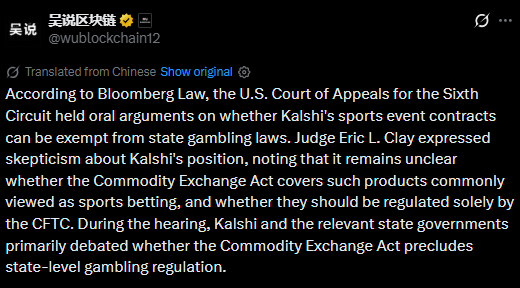
Judges in Cincinnati sat through more than 50 minutes of oral arguments on July 30. Judge Eric L. Clay pushed back on Kalshi's counsel, pointing out that it's still unclear whether products widely viewed as sports gambling actually fall under the Commodity Exchange Act, let alone whether the CFTC should be the only body regulating them.
As reported by Wu Blockchain on X, citing Bloomberg Law, the Sixth Circuit heard arguments on whether the Commodity Exchange Act preempts state gambling laws for Kalshi's sports event contracts.
Other members of the panel weren't much easier on Kalshi either, pressing the company on what really separates its sports event contracts from a standard sports bet.
Why does this hearing matter beyond one case? Because there's already a circuit split brewing. An Ohio court sided against Kalshi's preemption argument, while a Tennessee court came down the opposite way.
That contradiction is exactly what pushed this dispute up to the Sixth Circuit in the first place. It's also why the question "is Kalshi legal in the US" doesn't have one tidy nationwide answer just yet.
Whatever the court decides here could set the tone for sports event contracts legal news and the broader CFTC Kalshi sports betting ruling conversation for a while.
Coinbase's Numbers Tell a Different Story
The second thread in today's Crypto News is Coinbase's freshly released Q2 2026 earnings report. Total revenue came in at $1.22 billion, missing Wall Street's expectations, alongside a GAAP net loss of $359.5 million.
Metric | Q2 2026 Result |
Total revenue | $1.22 billion |
Transaction revenue | $599 million |
Subscription & services revenue | $555 million |
Crypto trading volume market share | 10.3% (record) |
Prediction markets revenue growth | +106% QoQ |
Average USDC held | $20 billion |
Source: Coinbase Investor Relations: Second Quarter 2026 Earnings.
Not everything in the report was gloomy, though. Coinbase's crypto trading volume market share hit a record 10.3%, up from 9.1% the quarter before, its third straight quarter of gains, and the company kept its streak of 14 consecutive quarters of positive adjusted EBITDA going.
According to Coinbase's Q2 2026 Shareholder Letter, as summarized by Wu Blockchain's official X post, prediction market revenue increased 106% quarter over quarter.
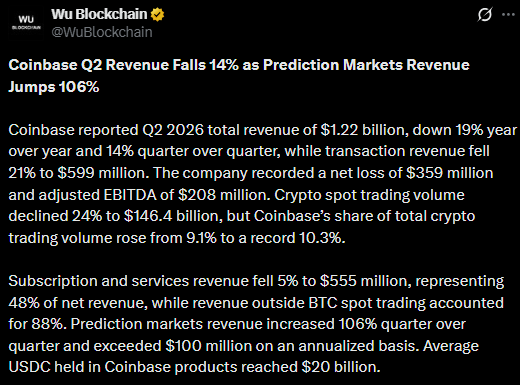
But the number that really stood out for Coinbase prediction markets revenue growth was this one: contracts and revenue in that segment more than doubled quarter over quarter, crossing the $100 million mark on an annualized basis.
Stablecoin revenue landed at $292 million on record USDC balances, and trailing twelve-month crypto derivatives volume stayed north of $4.2 trillion.
Here's the twist. Coinbase's own prediction markets business runs through a revenue-sharing arrangement with Kalshi, which ties this Coinbase quarterly earnings prediction markets update directly back to what's happening in that Cincinnati courtroom.
Connecting the Dots
On the growth side: Coinbase's figures make it obvious that demand for prediction markets is real, not hype.
On the risk side: the Sixth Circuit case makes it just as obvious that the legal foundation underneath that demand is still shaky.
The overlap: because Coinbase shares economics with Kalshi, an unfavorable outcome in the Kalshi Ohio-Tennessee court ruling saga wouldn't stay contained to Kalshi alone.
Where This Leaves Things
Taken together, both stories capture where prediction market news today actually stands. A prediction market platform model is scaling quickly through exchanges like Coinbase, even while courts are still working out whether sports betting vs derivatives classification gets decided at the federal level, the state level, or somewhere messier in between.
Until the Sixth Circuit rules, CFTC jurisdiction over sports event contracts stays an open question, and it's one of the threads worth watching in crypto industry news for the rest of the year.
Disclaimer: This article is for educational and informational purposes only and should not be considered financial or investment advice. Always conduct your own research before making investment decisions.


1 month ago
I responded to an advertisement involving a Dutch model, and shortly afterward I was contacted by Mark Grams, who claimed to be a professional investment adviser. After six weeks of building trust with me, he convinced me to convert both my investment and my father's portfolio into crypto. In total, I transferred €1.6 million worth of crypto to what I believed was a legitimate investment platform. When I later asked to access my funds, I was told that my account had been blocked and that I needed to transfer more money to unlock it. That was when I realized I had been scammed. After filing a police report with little progress, I hired a legal team, who then contacted Morphohack Cyber Service via email (MORPHOHACK@CYBERSERVICES.COM). They used blockchain analysis to trace the stolen crypto, and the trail led to several crypto exchanges, including HTX. However, Morphohack was able to recover all the crypto that had been funnelled through their network. Recovering my funds also helped uncover a broader network of alleged crypto-related crimes. After I lost my funds, I felt like the ground beneath me was about to explode, Morphohack brought me back to life with their professional help. I highly recommend Morphohack and their incredibly helpful team.