Pi Network Price Prediction: $PI Could Blast Higher After Key Breakout


Pi Network started back in 2019 as a mobile mining app, letting users earn $PI coins just by tapping a button daily, no heavy hardware needed.
That approach built one of crypto's largest communities before the coin even had a real market price. Mainnet finally opened up in 2025, and $PI now trades at $0.08758, down 2.5% over the past day.
With a max supply capped at 100B tokens and only around 11% currently circulating, most of the supply is still locked up and set to unlock over time.
This PI network price prediction looks at where $PI stands today, built on that backdrop of a huge early community and a long supply runway still ahead.
$PI Live Market Data
$Pi Network is currently trading at $0.08758, down 2.5% on the day. The 24-hour range has moved between $0.08651 and $0.09007, a fairly wide swing for a single day. 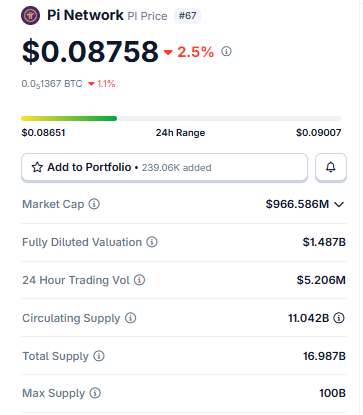
Source: $PI market cap data taken from Coingecko, data as of Aug 11, 2026. Figures may vary slightly across other tracking websites.
Market cap sits at $966.586M, with a fully diluted valuation of $1.487B.
Circulating supply stands at 11.042B PI against a total supply of 16.987B and a hard cap of 100B tokens. 24-hour trading volume came in at $5.206M.
Pi Network News Today
A crypto analyst recently pointed out that $Pi Network has processed over 526 million verification tasks since 2021, with most of that work handled by community validators instead of a third-party vendor. 
Source: Data Taken From @BenX_HQ, X Account.
That heavy reliance on the community, according to the analyst, is a big reason mainnet migration took so long to roll out.
An AI screening layer added in late 2025 reportedly cut the human review queue roughly in half, speeding things up.
This kind of infrastructure detail matters for a $Pi network price prediction because faster, community-driven verification could support long-term network credibility even as short-term price action stays choppy.
Key Takeaways
-
$PI trades near $0.08758, down 2.5% over the past 24 hours.
-
On the 1H chart, price sits at the upper boundary of a descending channel; a breakout here could flip momentum bullish.
-
The 4H chart shows a symmetrical triangle nearing its apex; the price is compressing before a bigger move.
-
Market cap stands around $966.586M, with a circulating supply of 11.042B out of a 100B max supply.
-
This pi network price prediction hinges heavily on how price reacts at these converging technical levels.
Technical Analysis
Hourly Chart Analysis for PI Network Price Prediction
On the 1H chart, $PI is inside the descending channel and has reached its upper boundary right now.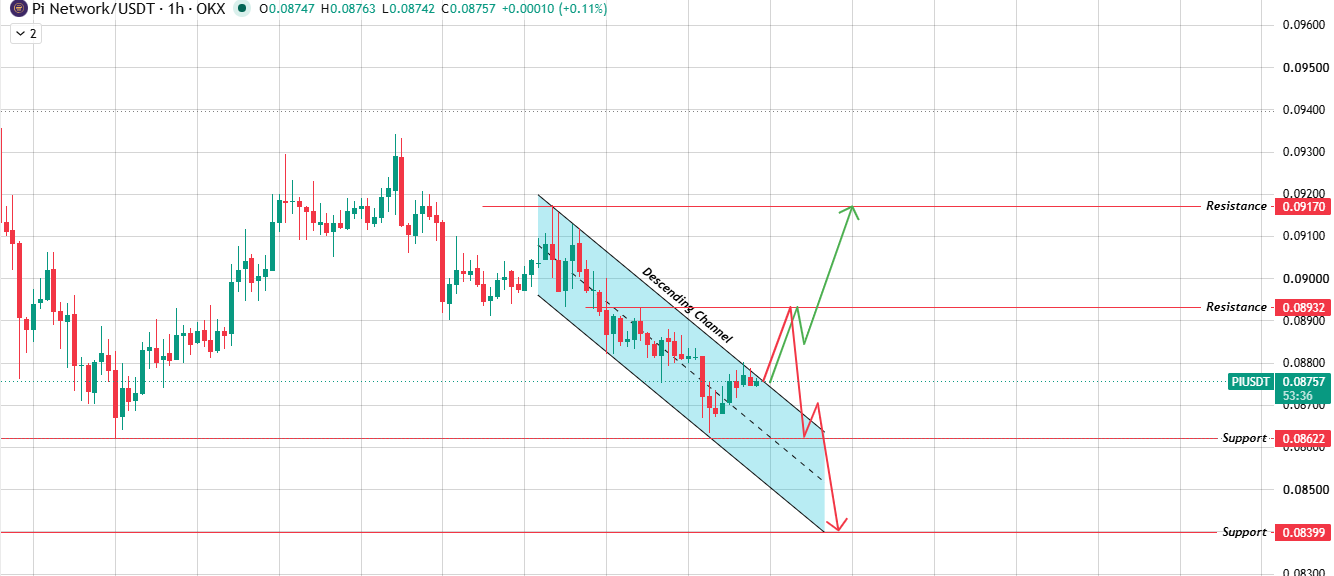
Source: Hourly Chart Taken From TradingView.
A break above this level, backed by volume, could push the price toward $0.08932 and then $0.09170.
If buyers can't hold that breakout and price gets rejected instead, expect a pullback toward support at $0.08622, with $0.08399 as the next level down if selling continues.
4-Hour Chart Analysis for PI Network Price Prediction
The 4H timeframe tells a similar story through a symmetrical triangle that's nearly at its apex. 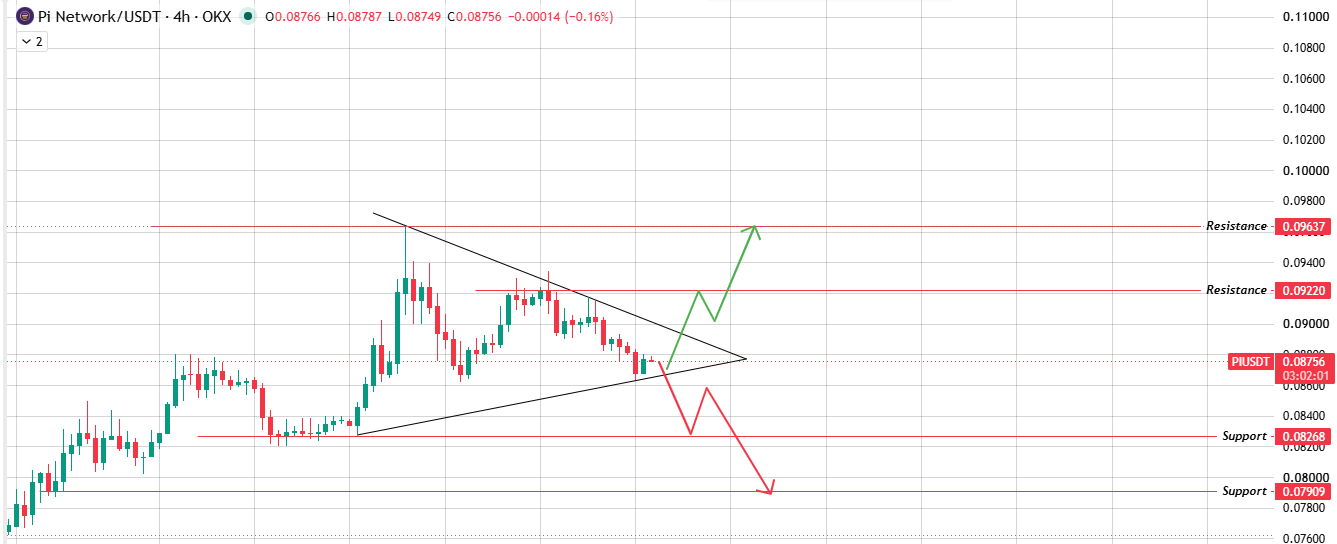
Source: 4-Hour Chart Taken From TradingView.
A break above the upper trendline levels is $0.09220, then $0.09637 if momentum holds.
A break below the lower trendline flips the setup bearish, opening a path to $0.08268 and then $0.07909.
Both charts are converging at almost the same moment, which makes the next few candles important for this Pi network price prediction.
Bull / Base / Bear Case
Glossary
Descending Channel: A price structure where value moves lower between two parallel downward-sloping lines.
Symmetrical Triangle: Two converging trendlines that squeeze price into a tighter range before a breakout.
Support Zone: A price area where buying interest has historically stopped further declines.
Resistance Level: A price ceiling where selling pressure tends to stall upward moves.
Max Supply: The absolute upper limit of coins that will ever exist for a given cryptocurrency.
Methodology
Levels used in this pi network price prediction come directly from TradingView chart data on the 1H and 4H timeframes. No price levels are extrapolated beyond what appears on the charts.
Disclaimer: This article is for informational purposes only and should not be treated as financial advice. Cryptocurrency markets are highly volatile, and prices can change quickly. Always do your own research and consult a financial advisor before making investment decisions.