Sherwood Protocol Price Prediction: WOOD Rips to a New All-Time High


Sherwood Protocol Price Prediction: WOOD Hits Fresh All-Time High
WOOD is trading at $0.0274, up 85.3% over the past seven days, after printing a fresh all-time high of $0.02871 today, July 22, 2026. The move follows a breakout from a multi-day consolidation range and coincides with renewed attention around agentic AI and blockchain infrastructure, including a widely discussed Franklin Templeton report on the theme.WOOD remains a thinly traded, DEX-only token, with a market cap near $27 million and TVL of roughly $421,000, so liquidity risk is central to this story.Below: the key support and resistance levels, the supply structure, and the parts of this narrative worth understanding before treating today's high as a floor.
KEY TAKEAWAYS
-
Direction: Short-term momentum is bullish; WOOD is trading at a fresh all-time high inside an ascending channel. Long-term direction depends on whether the agentic AI narrative keeps pulling in fresh volume once the newness wears off.
-
Why it moved: A breakout from a multi-day consolidation zone, combined with a widely shared thesis from Franklin Templeton on agentic AI and blockchain and Sherwood's own pitch as the verification layer for AI agents managing money.
-
Near-term range: Roughly $0.0207 to $0.0288 while the ascending channel holds.
-
Invalidation: A close back below the $0.0207 support zone breaks the channel and undercuts the bullish case.
Coin Overview
| Metric | Value (as of Jul 22, 2026) |
|---|---|
| Name / Ticker | Sherwood Protocol / WOOD |
| Blockchain | Robinhood Chain |
| Contract Address | 0xF8BC08092C06dB6148114DCf82AF881F1085f92b |
| Price | $0.0274 (+1.64% intraday, +85.3% 7d) |
| Market Cap | $27.6M to $28.7M |
| Fully Diluted Valuation (FDV) | $27.6M to $28.7M (fully circulating) |
| TVL | $421.1K |
| 24h Volume | $1.9M to $2.7M |
| Circulating Supply | 1B WOOD |
| Total Supply | 1B WOOD |
| Holders | 10,449 |
| Transfers | 78,954 |
| All-Time High | $0.02871 (hit today, Jul 22, 2026) |
| All-Time Low | $0.01249 (Jul 17, 2026, up 129.8% from here) |
Data pulled from Robinhood Chain explorer records and market data as of Jul 22, 2026. WOOD is not traded on any of the leading crypto exchange rankings yet, so treat volume figures as DEX-only for now.
Here's the thing worth flagging early. Explorer data shows WOOD's total and reported circulating supply are the same number, one billion tokens, both fully out. That removes one common source of overhang, a scheduled unlock or vesting cliff diluting holders later. It does not rule out concentrated allocations sitting in team, treasury, multisig, or OTC wallets that were never subject to vesting in the first place. Investors should still review wallet distribution and project documentation for allocation details before treating supply as fully decentralized.
WOOD Technical Analysis: What's Actually Driving This Move
Technical Analysis: What's Actually Driving This MoveMethodology: Technical analysis uses the WOOD/WETH pair on Robinhood Chain, based on 1-hour and weekly candles captured on July 22, 2026 (UTC), sourced from the token's primary Uniswap V2 pool. Levels will shift as more trading history accumulates.
On the 1-hour WOOD chart data, price spent roughly two days boxed inside a tight consolidation zone between $0.0125 and $0.0207.. And then it broke out, climbing into a clean ascending channel that has held for the last day and a half.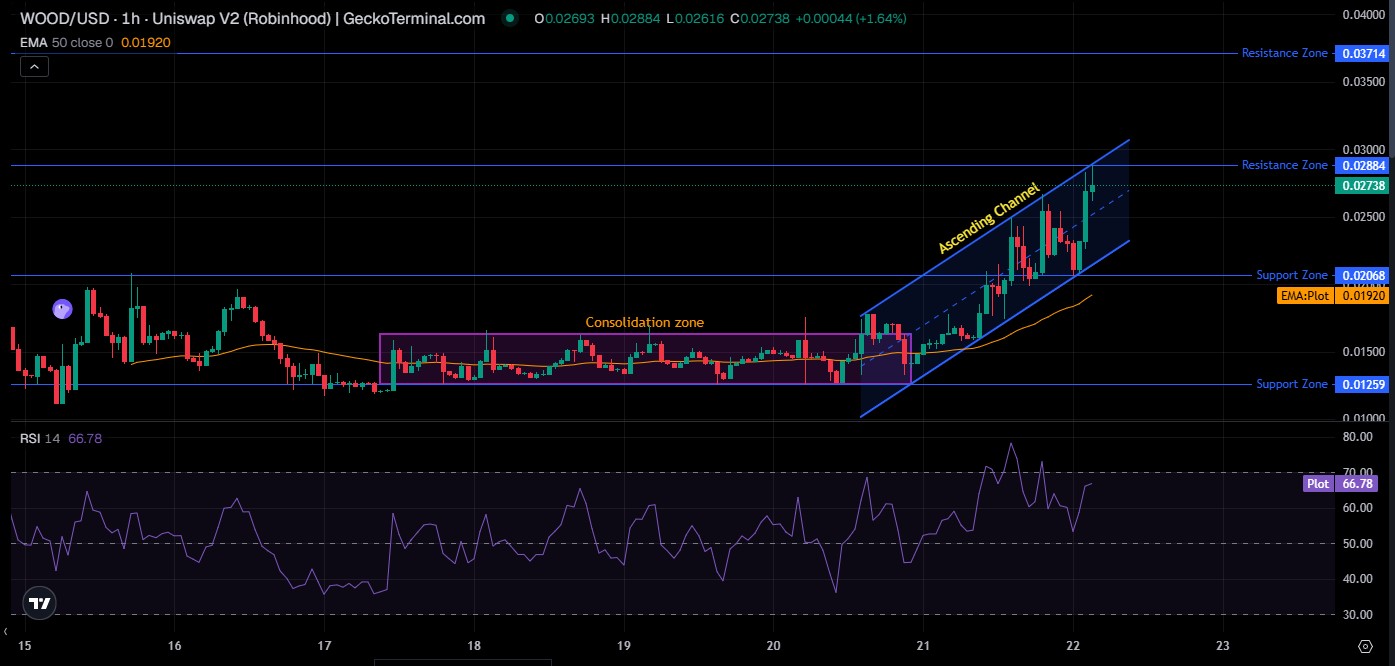
That is not a small move.
RSI on the 1-hour sits at 66.78. Warm, leaning toward overbought, but not flashing exhaustion yet. The 50 EMA is way down at $0.0192, trailing far behind spot price, which tells you how fast this thing has been running relative to its own average.
Turns out the two resistance zones that matter most sit at $0.02884 and $0.03714. WOOD is trading right against the lower one as of this writing. Above $0.03714, there is genuinely no chart history to lean on, because the token has never traded there before.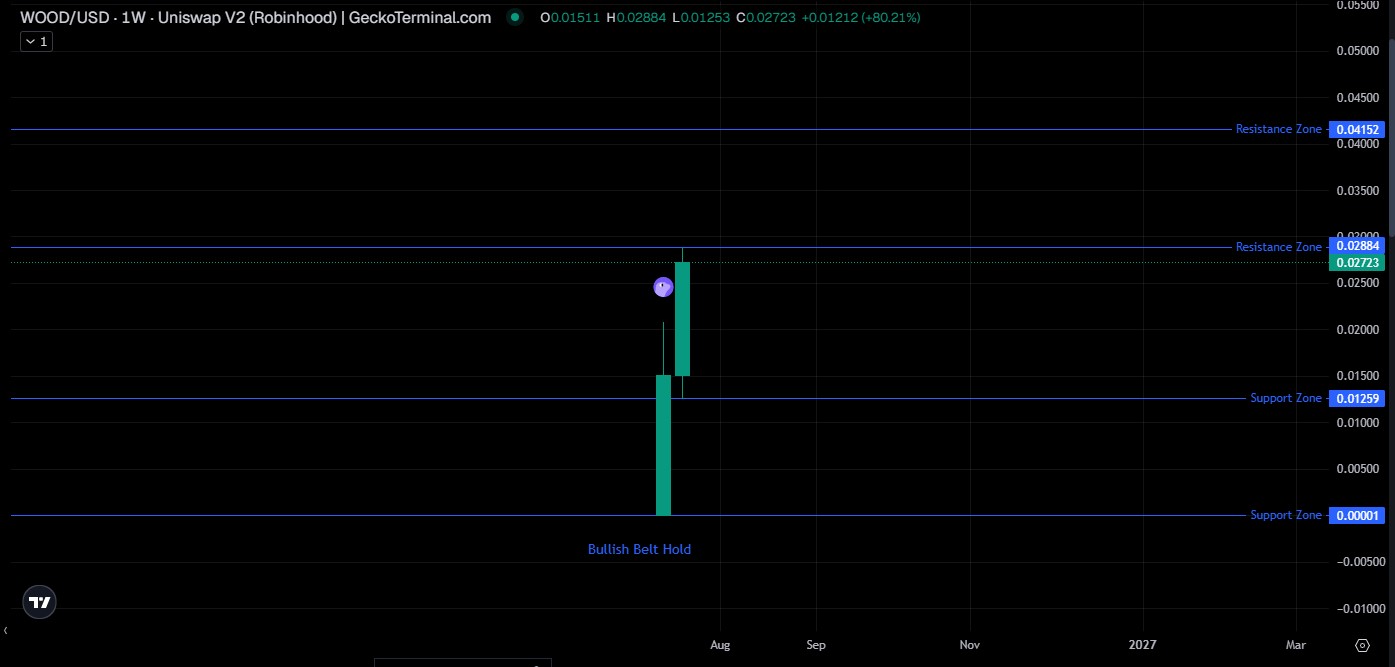
On the weekly chart, the picture is more dramatic. The week's candle opened at $0.01511 and closed at $0.02723, a move of over 80%. That candle is what chartists call a bullish belt hold, opening near its low and closing strongly higher. It is a pattern that shows buyers took control from the very first tick and never let go.
Weekly support zones sit at $0.01259 and effectively $0.00001, which is really just the token's launch floor rather than a level anyone should expect a retest of anytime soon.
Key levels on the current chart structure:
-
Immediate resistance: $0.02884, then $0.03714
-
Immediate support: $0.02068, then $0.01259
-
Weekly resistance: $0.02884, then $0.04152
-
Weekly support: $0.01259
None of these levels come from years of price history the way they would for an established coin. WOOD is five days into trading. Every one of these zones is being written in real time, which cuts both ways: more room to run if buyers stay in control and less of a track record to lean on if they don't.
Breaking Down the Move
Here's where it gets interesting.
WOOD is up 85.3% over the last seven days.
It is up over 129% from its all-time low, set just five days ago.
And it hit a brand new all-time high today, at $0.02871, only minutes before this was written.
Read that sequence again.
A token going from its all-time low to its all-time high inside a single week is not a slow accumulation story. It is a token finding real price discovery in public, in real time, with a market cap barely north of $27 million. Every candle on that chart right now is uncharted territory in the most literal sense.
But five-day-old price discovery on a token with thin liquidity is exactly the kind of setup that can reverse just as fast as it built. Extra volume can walk in from good news and walk right back out once that news gets priced in, the same pattern that shows up whenever the crypto market rallies today on thin volume.
That's the mechanical story. Now the fundamental one.
Where the Attention Is Actually Coming From
Sherwood's own thread on X account laid out the fundamental case directly this week, and it is worth understanding because it explains a lot of the current volume.
Franklin Templeton, a $1.5 trillion asset manager, published a thesis this week calling agentic AI the killer use case for blockchain. Their argument is straightforward: AI agents will transact at a scale legacy payment rails cannot support, since a card transaction costs 2 to 3% plus a flat fee while an agent paying for a fraction of a cent of compute needs on-chain rails to make economic sense at all. Franklin Templeton projects agentic commerce at $3 to $5 trillion by 2030, with agents driving 15 to 25% of US e-commerce.
The report strengthens interest in the broader agentic AI infrastructure theme, which may have contributed to attention around projects such as Sherwood Protocol, though Franklin Templeton's thesis does not name Sherwood specifically and should not be read as an endorsement of the project.
Sherwood picked up on one specific gap in that thesis. Franklin Templeton's report leans on auditability, the idea that every agent decision gets recorded immutably so there is accountability after the fact. Sherwood's pitch is that auditability alone is not enough, because by the time a bad transaction is recorded, the money has already moved.
Their answer is verification before execution instead of a receipt after it. On Sherwood, agents propose strategies, and a network of guardians simulates every proposal on a fork of the chain to see exactly what it would do before anything executes for real.
And the timing lines up with something concrete. Robinhood is already letting AI agents manage portfolios on Robinhood Chain, which is the same ecosystem WOOD lives on. Sherwood is positioning itself as the verification layer sitting underneath that exact use case.
That's the part of this story that is easy to miss if you are only watching the candles.
Where This Gets Risky
A strong narrative and a five-day-old chart do not automatically add up to a safe trade.
WOOD is not traded on any leading US centralized exchange yet. Every dollar of that $1.9 million to $2.7 million in daily volume is happening on a decentralized exchange, through the WOOD Uniswap trading pool on Robinhood Chain specifically.
TVL sits at just $421,100, which is thin next to a market cap north of $27 million.Beyond TVL, a few other factors matter for a token this new: how concentrated ownership is among the top wallet holders, whether the liquidity pool is locked or burned versus withdrawable by an insider, whether contract ownership has been renounced, and whether the contract retains permissions (such as minting or pausing trading) that could affect holders. These details were not independently verified for this piece and are worth checking directly on the Robinhood Chain explorer before trading.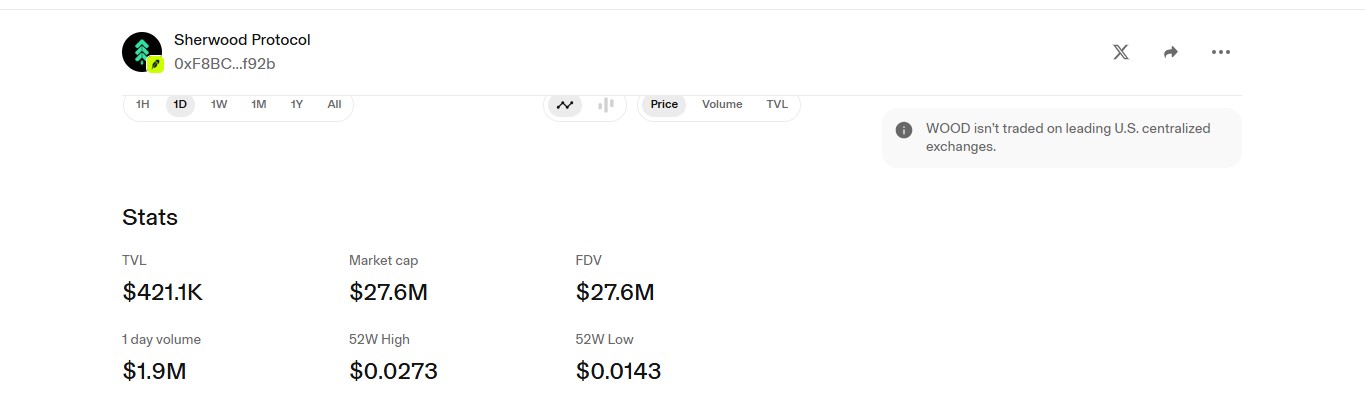
Thin liquidity paired with a fast-moving narrative is a combination that can cut hard in either direction. A handful of large sells could move this price a lot faster than the chart's recent smoothness suggests.
Sit with that for a second.
There is also the plain fact that WOOD has no trading history before this week. Every support and resistance zone on these charts has been tested, at most, a couple of times. That is a thinner foundation than a token with months or years of price action behind it.
The Full Story So Far
WOOD's entire trading history so far fits inside five days.
It printed an all-time low of $0.01249 on July 17, 2026.
It printed a fresh all-time high of $0.02871 today, July 22, 2026.
That is a move from bottom to top of over 129% in under a week, on WOOD's historical price data, on a token that started trading with a market cap most people have never heard of. There is no multi-year chart to compare this against, no prior cycle to check for repeating patterns. Runs like this tend to show up during broader stretches of altcoin market rotation, where small caps move first and hardest. This is the entire history, and it is still being written.
Scenarios: Bull, Base, and Bear
| Scenario | Conditions | Target | Timeframe | Invalidation |
|---|---|---|---|---|
| Bull Case | Ascending channel holds, agentic AI narrative keeps pulling fresh volume, price clears $0.0288 | $0.0371 to $0.0415 | 1 to 3 weeks | Close below $0.0207 |
| Base Case | Price consolidates between the breakout zone and current resistance while volume normalizes | $0.0207 to $0.0288 range-bound | Days to two weeks | Break of either boundary on strong volume |
| Bear Case | Narrative momentum fades; thin liquidity gets tested by a handful of large sells | $0.0126 to $0.0160 (retest toward channel base) | Days to weeks if triggered | Recovery only if price reclaims $0.0237 and holds |
Using the same bull-bear base case framework applied across bigger assets and echoing the setup behind the recent Solana bullish flip, the bear case here is not just a formality. With no centralized exchange listing and TVL under half a million dollars, this is still a market where a small number of wallets can move price a lot.
What Would Actually Change This Thesis
-
Bullish confirmation: A close above $0.02884 held for at least 24 hours, with volume staying elevated rather than fading.
-
Key support to watch: $0.0207 first, then $0.0126 below that.
-
Hard invalidation: A close back below $0.0207, which puts WOOD back inside its old consolidation range.
-
Narrative risk: Any sign the agentic AI story cools off, or that Robinhood Chain activity does not translate into real Sherwood usage, would take the wind out of this fast. It is worth tracking the crypto events calendar for follow-up news around this thesis.
Sherwood Protocol Long-Term Outlook: The Honest Version
Long-term is genuinely hard to call on a token this young, and we are not going to pretend otherwise.
The agentic AI pitch is real, and it lines up with a thesis a $1.5 trillion asset manager just put its name on. The verification-before-execution angle, agents proposing and guardians simulating before anything executes, is a specific, defensible niche rather than a vague buzzword play.
None of that offsets the fact that WOOD has traded for five days, sits on no centralized exchange, and carries TVL that would not even qualify as mid-size on most established chains.
We are not calling this the start of a sustained re-rating, and we are not calling it a flash in the pan either. What we can say plainly is that WOOD right now is a fresh-narrative momentum trade riding real institutional attention, and anyone treating today's all-time high as a floor rather than a level that could still get retested is skipping past exactly the liquidity risk that makes a token like this move so fast in both directions. For comparison against larger, more established assets, see our broader crypto price predictions coverage or check where Bitcoin heads next for the market's overall tone.
Disclaimer: This article is for informational purposes only and is not financial advice. WOOD is a newly launched, thinly traded token, and prices can swing sharply in both directions. Verify all figures independently before making any trading decision. Data sourced from onchain explorers, DEX market data, and public social posts as of July 22, 2026.
Also read: