Pons Launchpad Guide: Understanding Token Launches on Robinhood Chain

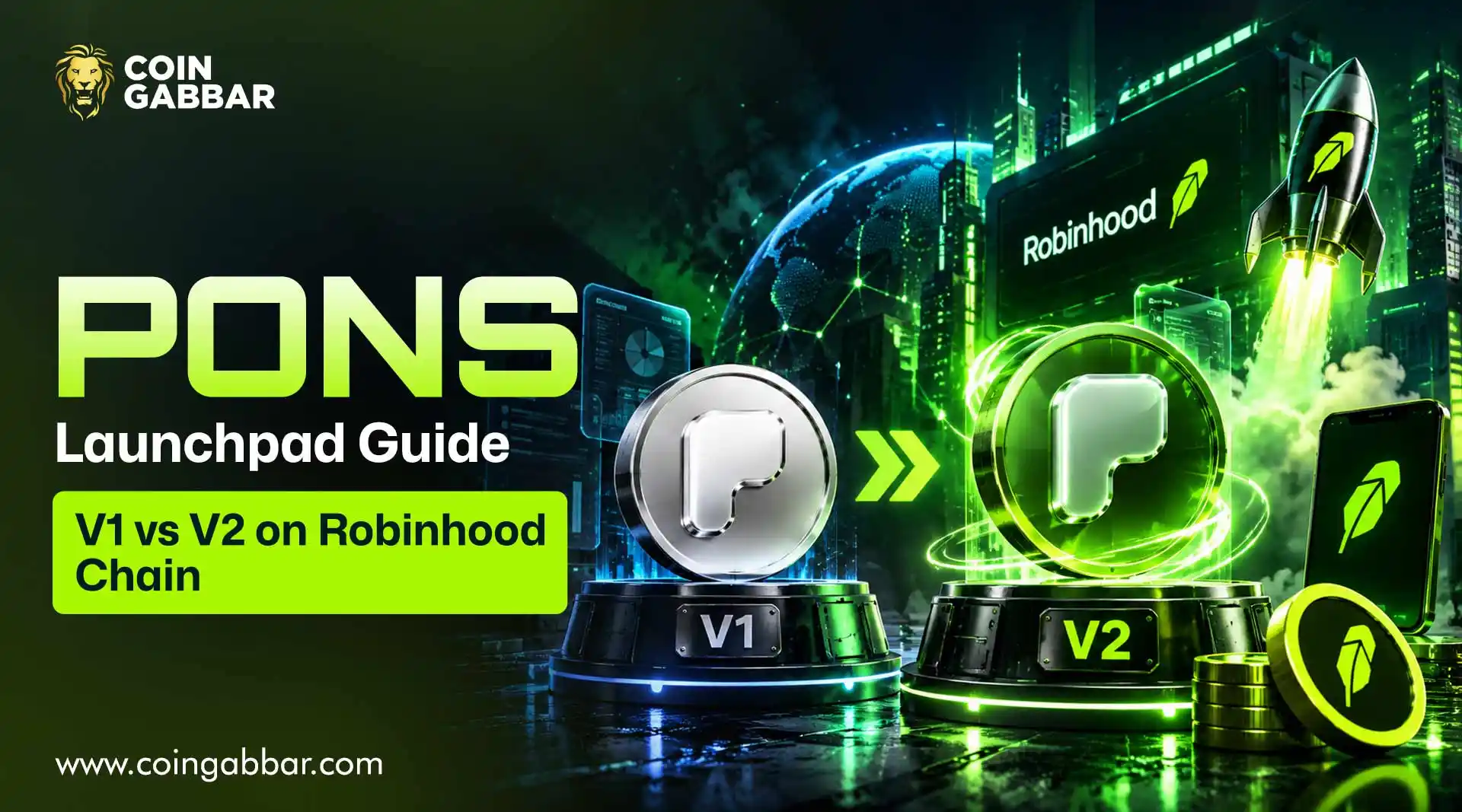
Pons Launchpad Guide: How V1 and V2 Work on Robinhood Chain
Robinhood Chain has quietly become home to one of the more structurally interesting launch protocols in crypto right now, and Pons sits right at the center of it. This Pons Launchpad Guide breaks down how the protocol actually works not as a repeat of the basics, but as a closer look at why two launch models exist side by side and what separates them for anyone trading on the chain.
Most explainers stop at "connect wallet, buy token." This one goes further: how pricing forms before a pool even exists, why a bonding curve changes the opening seconds of a launch, and what happens to fees long after a token graduates.
Key Takeaways
Pons operates entirely on Robinhood Chain (chain ID 4663), and every launch gets its own dedicated pool or curve rather than shared liquidity.
V1 tokens trade against a locked pool from the first block; V2 tokens trade on a bonding curve first and only receive a pool once that curve sells out.
No version of the protocol ever takes custody of funds every buy, sell, claim, or launch is a transaction the trader's own wallet signs.
Why Pons Runs Two Launch Models at Once
A fair question a new trader might ask: why does a single Pons Launchpad run two separate systems instead of retiring the old one?
The answer comes down to what each model solves. V1 proved out the core idea: instant, locked liquidity with no custodial risk but it also meant a token's pool existed the moment it launched, which left an opening window for early buyers to move fast. V2 was built specifically to close that gap by delaying pool creation until a bonding curve has fully sold out, removing the launch-day liquidity problem altogether.
Both versions remain live. Tokens launched earlier continue operating under V1's rules permanently, since none of Pons's contracts are upgradable after deployment.
How V1 Pricing Works
A V1 launch mints a fixed supply of one billion tokens and creates its WETH trading pool in the same transaction. There is no curve and no separate migration step the pool is live and priced from block one.
Early trading carries built-in limits. For the first two blocks after launch, no wallet can hold more than 5% of supply or buy more than 5.5% of it in a single transaction. Selling is never restricted, and once the window closes, so do the limits.
Pool fees sit at 1%, with a flat 0.0005 ETH launch fee. A launch is considered "graduated" once 4.2 ETH has been paired into its pool, though graduation on V1 is a milestone, not a change in venue trading simply continues in the same pool.
Source: Pons' Official documentation
How V2's Bonding Curve Changes the Opening Moments
V2 replaces the pool-first design with a bonding curve that holds the entire token supply from creation. Price is not set by a market maker or the creator it rises as buyers step in and falls as sellers exit, and the curve always takes the other side of a trade.
The most distinctive feature is the opening snipe tax. A newly created V2 launch charges a steep tax on buying that starts near 99% and decays exponentially over roughly five seconds. The intent is straightforward: make it unprofitable for a bot to buy the very first block before ordinary traders even know a launch exists. Selling is never taxed by this mechanism.
Once the curve sells out completely, graduation happens automatically inside that final purchase, and a Uniswap V4 pool is created with liquidity locked permanently. Nothing about a holder's tokens changes when that switch happens.
Source: V2 documentation
Custom Pairs: Launches Priced Outside ETH
A feature unique to V2 is the ability to price a launch against an asset other than ETH. Only assets Pons has explicitly approved can serve this role, which prevents a creator from pairing against a token of their own making to manufacture a fake price.
When a launch uses a custom pair, that asset becomes the currency for the entire lifecycle buying, selling, the graduation threshold, and even creator payouts all run through it instead of ETH. This also means the pairing asset's own volatility layers on top of the launch's, something worth factoring into any risk assessment.
Buying and Selling: What Stays the Same Across Versions
Regardless of which version a token launched under, the trading flow through the Pons app follows the same basic pattern:
Open the specific token page and confirm the contract address, since names and logos can be copied freely.
Review the quoted price, price impact, and slippage tolerance before confirming a trade.
Sign the transaction in a connected wallet Pons never holds funds at any stage.
On V2 tokens still trading pre-graduation, the trade routes through the curve; post-graduation, it routes through the pool automatically.
Selling on V2 has one nuance: the sell side of the curve can close slightly earlier than the buy side, in the narrow window right before graduation finalizes. On V1, selling is never restricted once a token is live.
Fees, Buybacks, and Where Bought-Back Tokens Go
Fee handling is one of the clearest differences between the two systems.
Current V1 launches split trading fees 70/30 between creator and protocol, while tokens from the legacy factory retain the original 90/10 split. Protocol-level buybacks use 80% of protocol fees through an automated TWAP, and the Pons purchased this way is sent to a burn address, permanently reducing supply.
V2 fees work differently. Every launch has a base trading fee plus an optional creator tax, capped by the protocol and fixed for life at creation. If a creator enables buybacks, the tokens bought back are not burned they're locked in a vault and released gradually over five years, split between the creator and the protocol.
Community Takeovers and Abandoned Token Recovery
Both versions support community takeovers, allowing an active community to redirect a creator's fee stream when the original creator has clearly stepped away. This changes who gets paid, never the token itself supply, liquidity, and trading rules stay untouched.
V2 goes a step further with a migration mechanism built for tokens Pons never launched at all coins with a dead market but a community still holding on. It moves that community onto a fresh pool funded by selling the old token gradually, with no admin control over the process once it begins.
A Closing Note on Safety
Reaching graduation, on either version, only confirms that a threshold was met. It says nothing about future price, liquidity, or the quality of the project behind it.
Locked liquidity on a graduated pool has no withdrawal function available to anyone not the creator, not the protocol. That single design choice is what closes off the most common way a launch platform gets exploited.
This Pons Launchpad Guide is meant as a working reference, not financial advice. For contract addresses, integration details, and the latest audit status on V2, the official Pons documentation remains the most current source, alongside the Pons app itself for live launches on Robinhood Chain.
Disclaimer
This Pons Launchpad Guide is for informational purposes only and is not financial advice. Crypto trading involves significant risk. Always verify contract addresses, fees, launch mechanics, and security information through official Pons sources before trading.





.jpg)