Not on GamStop" Betting Sites: What Australia's Searches Reveal

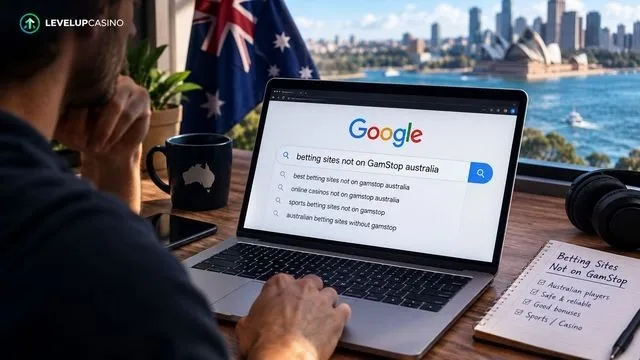
Most search queries tell you what people want to buy. A few tell you something else entirely.
"Betting sites not on GamStop" is one of the few. So is its younger Australian cousin, "betting sites not on BetStop," which pulls roughly 2,400 searches a month by itself. Two countries, two national self-exclusion registers, and the same query appearing in both places within months of each scheme going live.
That repetition isn't coincidence. It's a pattern, and it tells you something useful about how these systems are built. It also matters here now, because Ontario switched on its own centralized register in May 2026 and the same question is about to get asked in Canada.
What these registers actually do
The mechanics are identical in all three cases. You register once, and the block applies to every operator inside a defined regulatory boundary. The boundary is where they differ.
| Register | Where | Live since | What it covers | Terms available | Scale |
| GamStop | Great Britain | April 2018; mandatory for licensees since March 2020 | Every UKGC-licensed online gambling site | 6 months, 1 year, 5 years, 5 years with auto-renewal | About 562,000 registrations by the end of 2025 |
| BetStop | Australia | August 2023 | Roughly 150 licensed wagering providers, online and phone | 3 months up to lifetime | 67,480 registrations, 41,290 still active in July 2026 |
| BetGuard | Ontario | May 2026 | 82 regulated iGaming sites plus OLG's platforms | 6 months, 1 year, 5 years, or custom | First scheme of its kind in Canada |
Look closely at that fourth column. Every one of these registers blocks licensed operators, and only licensed operators. A British regulator can't make a site licensed in Curaçao check a British database, and nobody has claimed otherwise. Australia's is narrower still: it covers wagering, because online casino games aren't licensed there at all.
So the gap the search trend points at isn't a bug. It's the outline of a jurisdiction.
Reading the query honestly
The easy assumption is that everyone typing "not on GamStop" is trying to break their own exclusion. Some are. But the traffic is messier than the headline suggests, and the mess is worth understanding.
| Likely intent | What they're after | How it behaves |
| Relapse or circumvention | A way around an exclusion that's still running | Highest harm, hardest to measure |
| Curiosity after signing up | Understanding what the block actually reaches | Usually resolves once someone explains it |
| Researchers and reporters | Market sizing, harm coverage | Low volume, disproportionate output |
| Offshore SEO | Nothing at all; these are supply-side pages built to rank on the phrase | Inflates the apparent demand |
That fourth row is the one nobody accounts for. A big share of what ranks on these terms was written specifically to rank on them, which means the volume is partly created by the answer rather than the question. Watch the same thing happen in the Canadian market now that BetGuard has made a fresh phrase rankable.
A register is only as strong as the perimeter it can enforce. Whatever sits beyond that line is a policy problem, not a technical one.
The numbers aren't as bleak as the coverage
Circumvention makes better copy than compliance, so it dominates the reporting. The underlying data points somewhere less dramatic.
An independent Ipsos study found that roughly three-quarters of GamStop users stopped gambling online altogether. Survey research puts the share who went on to gamble with unlicensed sites at around 8%, which is a real problem and also means nine in ten people did not.
Uptake keeps climbing. GamStop added more than 117,000 registrations during 2025, its biggest year since launch, and sign-ups from 16 to 24-year-olds jumped 40% year over year in the second half. Across all users, 47% chose five years. Australia looks similar: 78% of BetStop registrants are under 40, and 38% picked lifetime exclusion.
Young people signing up early and choosing long terms is what a working harm-reduction tool looks like, which adds confidence in Canada that BetGuard was worth waiting four years for. The stories about the leak rarely mention how full the bucket is.
Canada is now running the same experiment
Self-exclusion here used to be a patchwork, and a frustrating one. Each province handled it through its lottery corporation. In Ontario's competitive market, every licensed operator kept its own separate list, so a player could block themselves at one sportsbook and open an account at another before the coffee went cold.
BetGuard ended that on 14 May 2026. Anyone 19 or over in Ontario registers through one portal, in about five minutes, without needing an account anywhere first. The block reaches all 82 regulated sites plus OLG. Terms can be extended but never shortened, which is deliberate. It runs in English and French, and it routes people to ConnexOntario rather than leaving them at a confirmation screen.
Alberta went further in July 2026, opening its private iGaming market with centralized self-exclusion working from day one. Ontario's four-year delay was the lesson.
What still doesn't exist is a federal register. Worth stating plainly for Canadian users: exclude yourself in Ontario and you are not excluded in Manitoba. There's no national view of any of this.
What three registers teach about design
Eight years separate GamStop from BetGuard, and the design has clearly improved along the way. A few things stand out.
• Friction kills uptake. BetGuard's five-minute flow with no account required exists because the old process handed paperwork to people in crisis.
• Irreversibility is the whole point. A term you can extend but can't cancel removes the argument someone has with themselves at 2am.
• Blocking marketing matters as much as blocking accounts. All three schemes cut promotional contact, which is frequently what pulls someone back.
• A phone number beats a closed door. Registers that hand you a support pathway do more than registers that just say no.
• Be honest about the perimeter. Telling people what isn't covered builds more trust than implying everything is.
That last one is where the offshore question actually lives, and it's why licensing checks matter to anyone comparing real money casinos in Canada, or ranking the best online casino in Canada on anything other than bonus size. Offshore sites take Canadian traffic in every province, and they continue to attract Canadian interest whatever the registers say. Brands in that category, LevelUp among them, sit outside every scheme in the table above. Saying so is more useful than pretending otherwise.
Where operators fit
Licensed operators have legal obligations here. The better offshore brands publish equivalent tools voluntarily, and you can tell within two minutes which ones bothered.
On any site tailored for Canadian casino players, look for:
• Deposit caps, session limits and cooling-off periods that are documented rather than mentioned
• A written self-exclusion process with a stated minimum term
• Licensing details including a number, not just a badge in the footer
• Named payment rails; casinos accepting Interac have banking relationships to protect, and Interac e-Transfer casinos in Canada are visible to a domestic network that notices patterns
• CAD balances, since casinos with Canadian dollar payments spare you conversion arguments at withdrawal
The spread between casinos accepting Canadian players on those five points is wide. LevelUp is one of the brands that puts its responsible-gaming tools and account controls next to its terms instead of three clicks deep; you can see how that’s laid out on the LevelUp Casino official site. Reading that page before you deposit tells you more than any ranking of top-rated casinos for Canadian players ever will.
So what does the trend actually mean
Demand for "not on GamStop" measures a boundary. It isn’t a verdict on self-exclusion, and treating it as one gets the story backwards. All three registers work for most people who use them, especially for users in Canada who until this year had no single option at all. They cover licensed markets. The searches trace the edge.
If you've self-excluded and you find yourself looking for a route around it, that urge is a documented part of the pattern rather than a personal failure. Support exists across Canada through ConnexOntario, the Responsible Gambling Council and provincial helplines, and one phone call gets you further than any workaround. Safe gambling platforms in Canada are the ones that make that number easy to find, and that standard is trusted across Canada for the simple reason that anyone can check it in thirty seconds.





.jpg)