SpaceX Stock SPCX Price Prediction 2026, 2027, 2028, 2029, 2030

SpaceX stock is back in focus this week. Shares of Space Exploration Technologies Corp. (NASDAQ: SPCX) climbed 4.45% on Monday, closing at $146.23.
That move came with fresh institutional filings and a wave of SpaceX news. Traders are asking one thing: where does SpaceX stock go from here?
This article breaks down the SPCX stock price today, the share unlock schedule, and price levels worth watching from 2026 through 2030. This is not financial advice, just a look at the data.
What is the SPCX stock price today?
SPCX stock last closed at $146.23, up $6.23 on the day. In after-hours trading, shares slipped slightly to $145.90.
Here is the snapshot traders are watching right now.
Metric | Value |
Last close | $146.23 (+4.45%) |
After-hours price | $145.90 |
Day range | $139.58 to $149.80 |
52-week range | $104.83 to $225.64 |
Market capitalization | $1.928 trillion |
Volume | 114.90 million shares |
Average daily volume | 116 to 122 million shares |
Industry | Space Infrastructure |
Exchange | NASDAQ |
Sentiment | Bullish Long-Term |
Average analyst price target | $222 to $228 |
Next earnings date | November 3, 2026 |
SpaceX priced its IPO at $135 per share back in June 2026, giving it a $1.77 trillion valuation. That made it the largest IPO in market history, ahead of Saudi Aramco's 2019 listing.
Since then, SPCX stock has swung hard. It spiked above $225, dropped to $108.27 in early August, and has since clawed back toward $146.
Why is SpaceX stock moving this week?
Second-quarter revenue came in at $7.81 billion, above the roughly $6.9 billion analysts expected. Net loss narrowed sharply from a year earlier.
The AI segment grew over 200% year on year. Starlink, the connectivity business, added more than a million net subscribers in the quarter.
SPCX also confirmed Starmind AI1, an orbital AI computing satellite built with Nvidia, and closed its $60 billion acquisition of AI coding startup Cursor's parent company, Anysphere.
Big institutions are piling in too. Harvard's endowment disclosed a $2.2 billion stake, its largest single US holding. Intesa Sanpaolo holds $966 million, and Nvidia's stake sits near $21 billion.
When does the next SpaceX share unlock happen?
Lock-up expirations are a key part of any SpaceX stock price prediction right now, since the company is still a young public listing.
On August 6, roughly 911.5 million insider shares became eligible to trade. Many expected a sell-off. Instead, SPCX rose more than 6% that day.
Date | Event | Unlock | Total Float |
IPO | Float | Float | ~5% |
Aug 11 | Wave 1 | +20% | ~25% |
Aug 20 | Unlock | +7% | ~32% |
Sep 10 | Unlock | +7% | ~39% |
Sep 25 | Unlock | +7% | ~46% |
Oct 10 | Unlock | +7% | ~53% |
Oct 25 | Unlock | +7% | ~60% |
Nov 9 | Q3 unlock | +28% | ~60% |
Dec 9 | 180-day unlock | Remainder | ~58-60% |
Jun 13, 2027 | Founder unlock | Remainder | ~100% |
By year-end, roughly 4.9 billion $SPCX shares could be free to trade, about 70% of the stock not held by Elon Musk. Even a small amount of selling from that pool could pressure the SpaceX share price.
Musk's own stake, close to 6.4 billion shares or about 48% of the company, stays locked until June 2027. So the biggest holder is not a near-term seller.
SPCX stock price prediction: key technical levels
On the daily chart, SPCX keeps getting turned away near $150. That level lines up closely with the 0.382 Fibonacci retracement of the swing from the $225.59 high to the $104.87 low.
Fibonacci level | Price |
0.236 (support) | $133.36 |
0.382 (resistance) | $150.98 |
0.5 | $165.23 |
0.618 | $179.48 |
0.786 | $199.76 |
The 14-day RSI sits near 57.7, above its signal line around 46.7. That points to improving momentum, though not an overheated market.
A daily close above $151 could open the path toward $165 and then $179. A rejection near $150 could send SpaceX stock back down to test $133.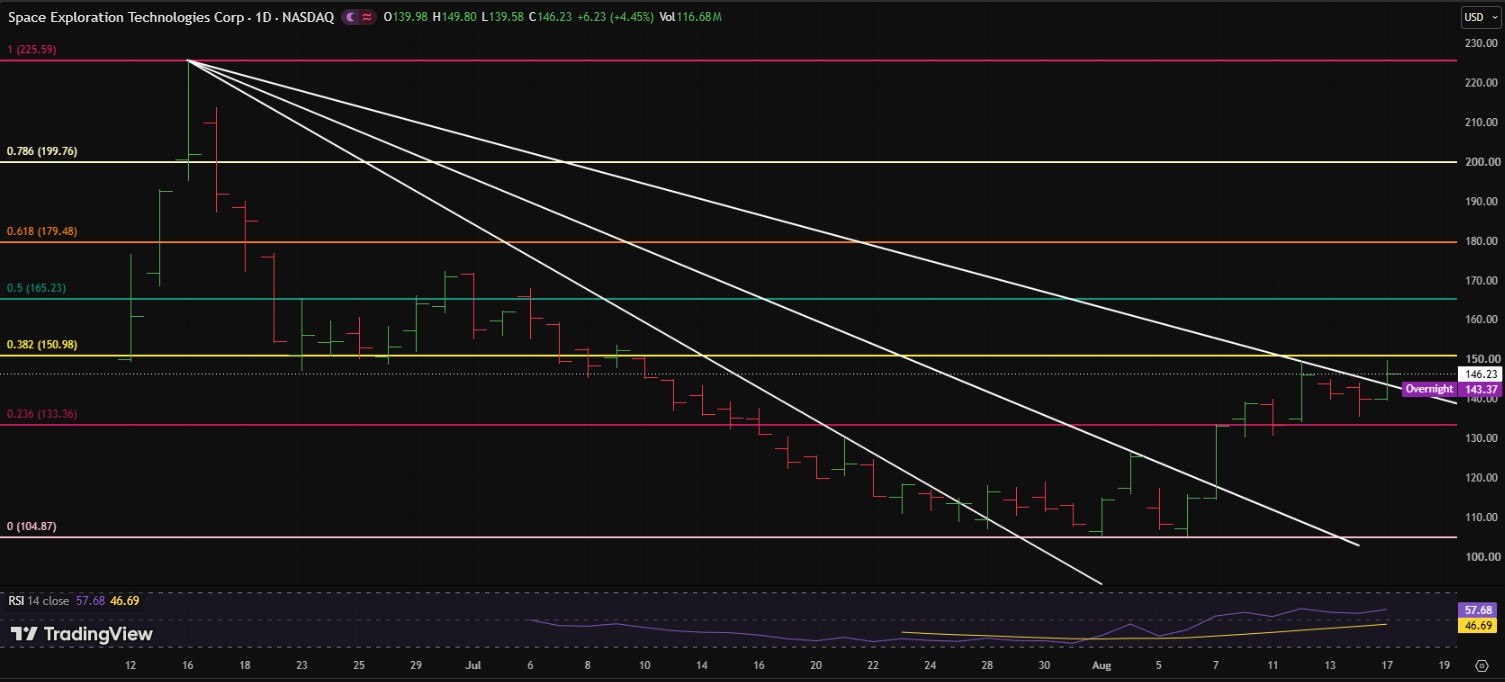
Who owns the most SpaceX stock?
Institutional ownership of $SPCX stock is unusually concentrated for such a young listing. Big names across finance and tech have taken large positions since the IPO.
Holder | Position |
Elon Musk | ~6.4 billion shares (~48%), locked until June 2027 |
Alphabet | ~551 million shares, near $77 billion |
Nvidia | ~123 million shares, ~$17 billion (also a separate $21 billion SEC-disclosed stake tied to its earlier xAI investment) |
Founders Fund (Peter Thiel) | ~427 million shares |
Antonio Gracias | 500 million+ shares |
Harvard Management Company | ~13 million shares, worth more than $2.2 billion |
Intesa Sanpaolo | $966 million position |
Norway's sovereign wealth fund | 0.05% stake, worth $1.22 billion as of June 30 |
Nvidia's stake is worth noting since it came through its earlier investment in xAI, before Musk folded that business into SpaceX. Even with the size of the position, Nvidia's 123 million shares have lost roughly $4 billion in value since the June IPO.
Fidelity, BlackRock, Baillie Gifford, and Ontario Teachers also collectively hold hundreds of millions of $SPCX shares, according to recent 13F filings.
SpaceX operations update: Starlink and Falcon 9
Away from the stock chart, SpaceX's satellite business keeps expanding. The Starlink constellation currently stands at 12,745 satellites launched, 10,981 in orbit, and 10,965 operational.
Starlink's subscriber base doubled year over year to 12 million, and the segment remains SpaceX's main profit engine, generating $4.3 billion in revenue and $1.7 billion in operating income last quarter.
On the launch side, SpaceX also set a record by sending two Falcon 9 rockets up just 38.5 minutes apart.
Not all the news was positive. A Falcon 9 upper stage that had been drifting uncontrolled for 19 months crashed into the lunar surface at roughly 8,700 km/h. The incident has raised fresh questions about lunar disposal policy ahead of planned crewed Moon landings by 2030.
How big is SpaceX's AI business getting?
The AI segment is SpaceX's fastest-growing unit, even though it is not yet profitable. Revenue there rose almost 247% year over year to $2.6 billion last quarter.
That means AI now makes up close to one-third of total sales, but the segment posted a $1.3 billion operating loss. SpaceX spent $15.8 billion on AI capital expenditures in the same quarter.
Total capital expenditures across the company reached $18.4 billion for the quarter, more than double SpaceX's quarterly revenue. That spending gap is central to any long-term SpaceX stock price prediction, since it will take years for AI infrastructure investment to pay off, if it pays off at all.
SpaceX Stock Price Prediction 2026
For the rest of 2026, the story is mostly about supply. Another 319 million shares unlock this week, followed by more tranches in September and October.
If SPCX holds above $133, the recovery structure stays intact, and a push toward $165 to $179 is possible into year-end.
If it slips under $133, that would suggest buyers are losing conviction, with November's Q3 earnings as the next big catalyst.
Scenario | 2026 Target Range |
Bearish (unlock pressure wins) | $108 to $133 |
Base case (range-bound) | $133 to $151 |
Bullish (clears resistance) | $151 to $180 |
SpaceX Stock Price Prediction 2027
By June 2027, most of the founder shares are still locked, and the market will likely be pricing in SpaceX's expected 2028 growth.
Assuming around 13.7 billion shares outstanding after the Cursor deal and option dilution, and revenue tracking toward the roughly $160 billion analysts project for 2028, a share price near $220 is one plausible outcome if the current sales multiple holds.
UBS carries a Buy rating with a $210 target. The wider analyst average sits between $222 and $228, though estimates range from as low as $62 to as high as $800.
Source | 2027 Target |
UBS | $210 |
Analyst average | $222 to $228 |
Sales-multiple model | ~$220 |
SpaceX Stock Price Prediction 2028
Goldman Sachs and Morgan Stanley have projected SpaceX could generate around $160 billion in revenue and $110 billion in adjusted EBITDA by 2028.
Morgan Stanley has gone further, setting a $300 price target and arguing the market is not fully pricing SpaceX's AI business. Analyst Adam Jones called the current AI valuation "conservative."
That $300 target roughly lines up with the 1.618 Fibonacci extension some traders are tracking off the IPO range.
Source | 2028 Target |
Morgan Stanley | $300 |
Fibonacci 1.618 extension | ~$300 |
SpaceX Stock Price Prediction 2029
Looking further out, forecasts get harder to pin down, since so much depends on Starship's success and whether AI infrastructure spending pays off.
Capital expenditures already hit $18.4 billion in a single quarter, more than double SpaceX's revenue for that period. If Starlink and the AI business keep scaling as expected, the 2.618 Fibonacci extension near $420 becomes a level some chartists will watch.
If spending outpaces returns, the stock could instead stay range-bound closer to 2027 levels.
Scenario | 2029 Target Range |
Conservative | $220 to $300 |
Extended (2.618 fib) | ~$420 |
SpaceX Stock Price Prediction 2030
By 2030, SpaceX expects to be flying crewed lunar missions, and Phillip Capital's bearish $75 target assumes negative cash flow could persist into that year.
On the optimistic side, the 3.618 Fibonacci extension sits near $540, a level that would require sustained revenue growth and margin improvement in both Starlink and the AI segment.
Source | 2030 Target Range |
Phillip Capital (bear case) | $75 |
Fibonacci 3.618 extension (bull case) | ~$540 |
Wall Street's overall spread on SpaceX stock, from $62 to $800 across roughly 30 analysts, shows just how wide the uncertainty is this far out.
Will Tesla and SpaceX merge?
Part of the buzz around SPCX stock involves Kalshi prediction markets, where traders price the odds of a Tesla-SpaceX merger.
Recent readings put the chance of a deal before 2028 between 60% and 71%, though that number has moved around a lot. No formal merger has been announced by either company.
This is a betting market reflecting trader sentiment, not a confirmed event. Independent forecasting panels tracking the same contracts have shown noticeably lower odds. Any real merger talk would likely move both stocks sharply.
What to watch next for SpaceX stock
This week's 319 million share unlock is the immediate test for SpaceX stock, followed by more lock-up tranches later this year and Musk's shares in mid-2027.
Q2 results already showed real revenue growth and narrowing losses, and the Starmind and Cursor deals add weight to the AI story.
Whether SPCX can clear and hold $150 to $151 may say a lot about near-term direction. A slip under $133 would suggest buyers are losing conviction.
Outcomes could go either way depending on how the next unlock and the November 3 earnings report land.
Disclaimer
This article is for informational purposes only and does not constitute financial, investment, or trading advice. Stock prices can go up or down, and past performance does not indicate future results. Always do your own research and consult a licensed financial advisor before making investment decisions.
Also read:







.webp)