Canton Ripple Custody Update Opens Canton Coin to Institutions 2026

Canton Ripple Custody: What the Update Means for Users and Price
Institutions can now hold Canton Coin and CIP-56 tokens inside Ripple's existing custody platform, with no separate custodian needed. The Canton Ripple Custody integration arrived with Ripple Custody version 1.43, and it places one of finance's most privacy-focused blockchains under controls that banks already know. It is a practical step, not a dramatic one.
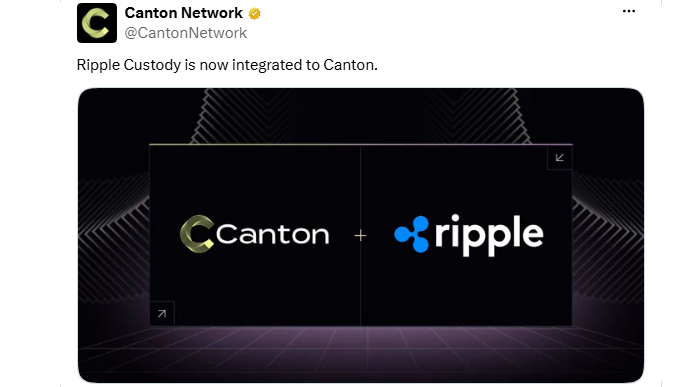
Source: X Official Announcement
So what does it change, and what does it leave out?
What Ripple Custody v1.43 Now Adds for Canton Coin and CIP-56 Tokens
Ripple version 1.43 brings native Canton support, according to the official documentation. Clients can hold and move Canton Coin (CC, also called Amulet) and CIP-56 tokens on the same platform used for other digital assets.
CIP-56 is Canton Network's token standard, the rulebook that lets assets be issued and transferred on the network, much like ERC-20 does on Ethereum.
The update brings three things:
One policy engine for approvals and rules
Compliance tools that cover Canton assets
A single audit trail instead of separate records
Canton Ripple Custody: How the Bring-Your-Own-Validator Model Works
The setup relies on a bring-your-own-validator design. The client, or a node provider, runs the Canton validator. XRP’s ripple manages the parties on the network, while signing keys stay in the client's own vault, either an HSM or a KMS.
Transactions pass through the same approval steps as any other asset. Pre-approvals for incoming transfers and two-step transfer offers are supported, which suits cold storage and multi-person sign-off. Management is API-only for now, per the integration release summary.

For institutions, the gains are practical:
One place for balances, policies and approvals
Less operational overhead than a separate Canton custodian
Keys that remain under client control
An easier route into Canton tokenization and settlement
Canton Coin Price Today: CC Drops as Crypto Market Cools
When the Canton network news of Ripple integration drew attention, the $CC token price fell over 2.7%. CoinMarketCap data from October 8 confirms:
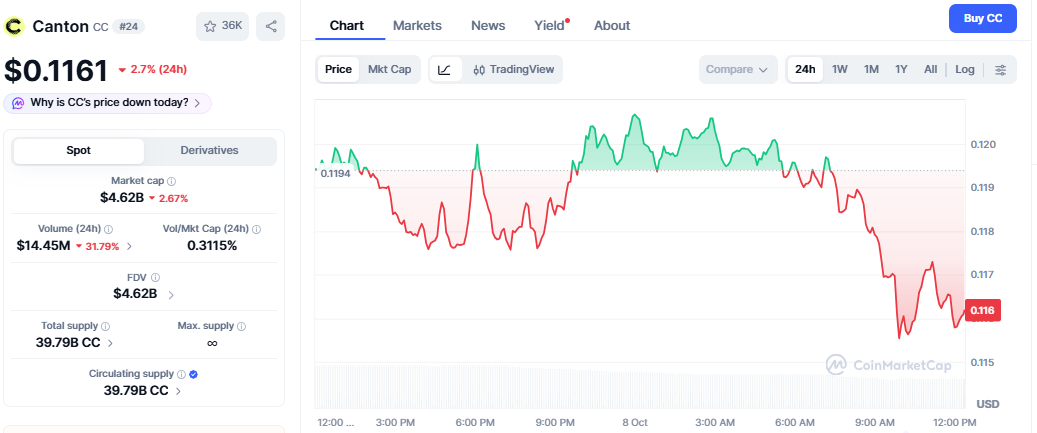
Price: $0.1161, down 2.7% in 24 hours
Market cap: $4.62 billion
24-hour volume: $14.45 million, down 31.79%
Supply: 39.79 billion CC in circulation, with no maximum cap
Over the day, CC traded between roughly $0.1155 and $0.1205. The slide tracks a softer market, with Bitcoin down about 1.6%, as heavy ETF outflow weighed. The next macro test is the September CPI report on October 14.
Canton Ripple Custody news has not driven this move, and the integration carries no promise of price impact.
Why Canton Network Privacy Design Matters for Institutions
Ripple Custody pairing makes sense because of how Canton is built. It is a public Layer-1 with selective disclosure, so each party sees only the parts of a transaction it is entitled to, per official docs.
Ethereum chain, by contrast, is transparent by default with transactions and contract activity visible on its public blockchain. Privacy can be added through separate protocols and applications. This gives Canton a different design approach for institutions handling sensitive positions, clients information and settlement activity.
Canton: privacy built in, suited to positions, client data and large trades
Ethereum: open, liquid and composable, with a huge ecosystem
What Canton Ripple Custody Means for Users and Where Limits Remain
Institutions already on Ripple Custody gain the most, since Canton ecosystem assets now sit beside everything else they hold. Retail CC holders benefit only indirectly, through possible institutional adoption and deeper liquidity.
The scope is narrow. This release covers basic holding and transfers only. It does not support arbitrary Daml commands, contract deployment, CIP-56 allocations or delivery-versus-payment workflows. Clients must still run, or pay someone to run, a validator, and the SaaS rollout is gradual.
The test now is volume. If institutions switch the feature on and move real assets, Canton Ripple Custody will look like early plumbing for a larger shift. If they do not, it stays a footnote.
Disclaimer: This article is for informational purposes only and does not constitute financial or investment advice. Crypto markets carry significant risk. Always do your own research before making any investment decisions.









