Crypto Bull Run 2026 or 2027: What the Market Is Saying Today


Crypto Bull Run Predictions: Three Signals That Could Set the Timeline
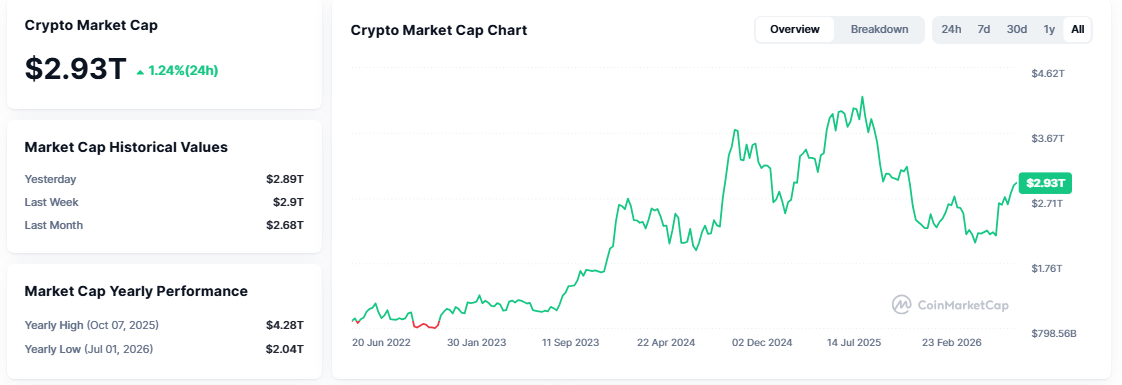
The total crypto market is worth $2.93 trillion, and Bitcoin trades near $86,000, according to on chain data. That has revived a familiar question: is a new crypto bull run coming in 2026, or does the real surge come in 2027?
Crypto news today offers three answers, from Tom Lee, Raoul Pal and a proposed $5,000 payment to Americans.
Crypto Market Today: Bitcoin Holds Above $86,000 as Greed Builds Up
Prices are firm but not euphoric. A crypto bull run today would need more proof than one good week. The latest CoinMarketCap readings as of October 5 show:
-
Total market cap: $2.93 trillion, up 1.24%
-
Bitcoin: $86,038, up 1.08% in 24 hours and 4.14% over seven days
-
Ethereum: $2,718.79, up 0.74% in 24 hours and 3.05% over seven days
-
Fear & Greed Index: 68, in the "Greed" zone
-
Altcoin Season Index: 61
-
Crypto ETF flows: +$13.84 million
-
Liquidations: $117.11 million of shorts against $46.98 million of longs
Short sellers took the bigger hit. That points to a squeeze, which can fade quickly.
What Counts as a Crypto Bull Run? A Simple Test Before Naming a Year
No official rule exists, but analysts lean on a few common tests. A crypto bull run is a sustained climb over months, not one green week. Stock markets treat a gain of about 20% from a recent low as the usual marker, and many crypto analysts borrow that yardstick.
-
Trend: higher highs and higher lows over several months
-
Size: a rise of roughly 20% or more from the last major low
-
Money flow: rising trading volume and steady ETF inflows
-
Mood: sentiment moving into the greed zone and staying there
Today's readings fit only part of this. Bitcoin is up 4.14% over seven days and the Fear & Greed Index sits at 68, but one week is not a run.
Tom Lee Says the Crypto Bull Run Is Already Running: What Backs It
Tom Lee, chairman of BitMine Immersion Technologies, told Korea Blockchain Week 2026 on September 30 that this cycle could be the biggest yet. He gave some reasons:

Source: X Official
-
Trend signal: Bitcoin trades above its 200-day average, which he says preceded eight of the past nine bull markets
-
Inflows: steady institutional money into Bitcoin products through September
-
Tokenization: BlackRock and JPMorgan Chase are moving assets onto blockchains
-
Inheritance: Americans in their twenties will inherit about $700 billion this year, versus roughly $100 billion in 2019-2020
Lee links these to a possible $10 trillion crypto market. That is about 3.4 times today's size, so it is a long-range view, not a near-term target.
Raoul Pal Crypto Bull Run Prediction: Liquidity Points Toward 2027
The Raoul Pal crypto bull run prediction rests on liquidity, meaning how much money is available to borrow and invest. He says the current debt cycle is about 5.8 years old. A normal cycle would see liquidity peak in the first or second quarter of 2027.
He expects it to run longer, because governments must fund large debts while companies pour money into artificial intelligence infrastructure. His key signal is the US Dollar Index. If the dollar turns lower, he argues, liquidity is expanding again.
Crypto Bull Run 2026: Could a $5,000 Trump Dividend Fuel the Rally?
President Donald Trump has promised $5,000 to every American if Republicans win both chambers of Congress in the November 3 midterms.
The head of DWF Labs, Andrei Grachev, said the payments would equal about 150% of the pandemic-era checks and could feed crypto as they did in 2021, per his X post.
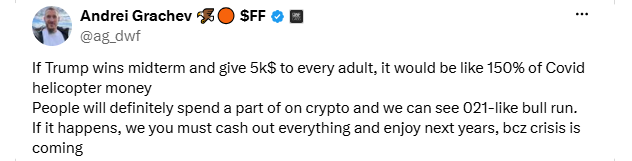
Caution is needed. This is a campaign pledge, not law. It carries an estimated cost of $1.2 trillion to $1.3 trillion, needs congressional approval and has a vague funding plan built on tariffs and growth.
Crypto bull run 2026 hopes tied to it would differ from 2021 in one way: spot ETFs and clearer rules now give money easier routes into Bitcoin and Ethereum.
Crypto Bull Run Theory: 2026 or 2027?
So which year? On the evidence here, the best-supported answer is that the cycle may begin in late 2026 and reach its strongest phase in 2027.
Pal sees liquidity peaking in Q1–Q2 2027, while Lee’s drivers build over years. A 2026 surge remains possible but would need the unconfirmed Trump Dividend. The November 3 midterms, weaker dollar, ETF inflows and a 20% rise from the last low could provide clearer signals. This is not a forecast or investment advice.
Disclaimer: This article is for informational purposes only and does not constitute financial or investment advice. Crypto markets carry significant risk. Always do your own research before making any investment decisions.









