Ethereum News Today: ETF Inflows, ETH Roadmap Upgrade and Whale Moves

Ethereum News: Wang Chun Moves ETH to Binance, ETF Inflows Hit $697M
Ethereum is back at the center of crypto conversation this week, and the reasons go well beyond price action alone. ETH has outpaced Bitcoin on a percentage basis this cycle, according to commentary from mining pool founder Jiang Zhuoer.
That relative strength is being fed by institutional demand, a fresh long-term protocol roadmap from co-founder Vitalik Buterin, a patched flaw in a widely used hardware wallet, and large holders repositioning their portfolios. Together, these threads explain why the network is dominating headlines on August 23 and 24, 2026.
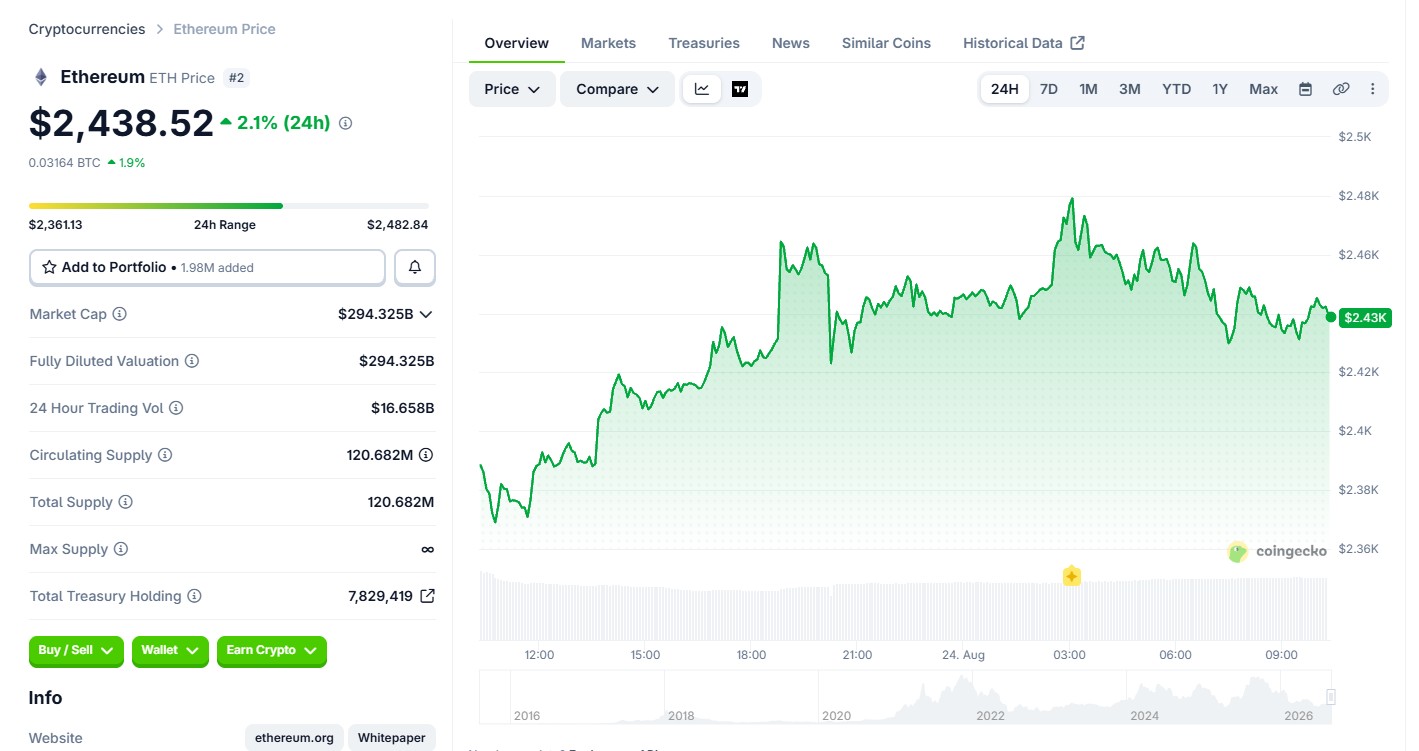
On 24 August 2026 at 5:00 AM UTC, Ethereum Price Today Gains 2.1% trades at $2438.52 with market capitalization $294.32 billion and 24-Hour trading $16.65 billion.
ETF Inflows Outpace BTC on a Relative Basis
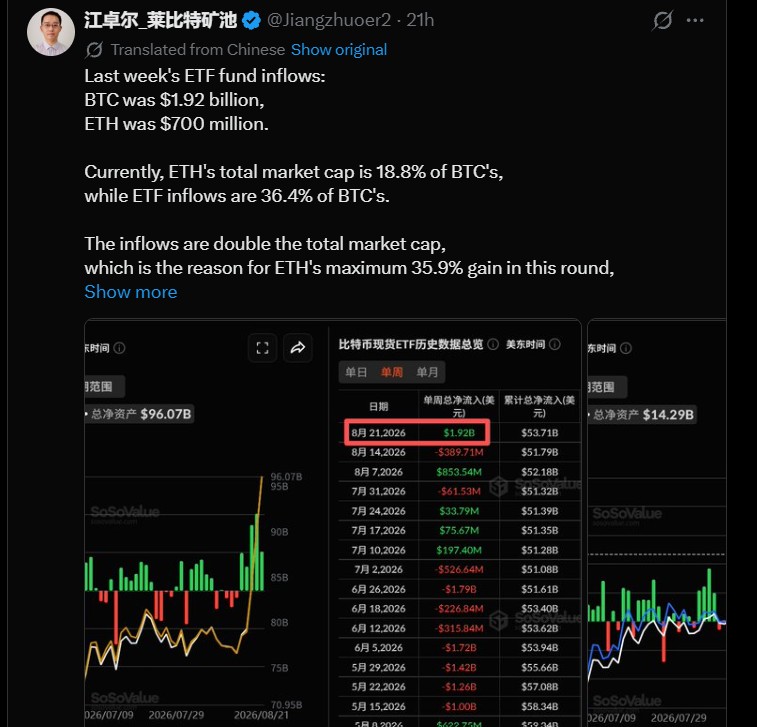
Spot ETH funds pulled in roughly $697 million last week, while spot BTC funds took in about $1.92 billion, per SoSoValue data cited by Jiang Zhuoer. Both figures reportedly mark the largest single-week inflows of 2026 for their respective assets.
What stands out is the relative sizing: this asset's market cap sits at roughly 18.8% of bitcoin's, yet inflows amounted to close to 36.4% of bitcoin's total. New capital appears to be flowing in at nearly double the rate market size alone would suggest.
| Metric | ETH | BTC |
| Weekly Spot ETF Net Inflow | ~$697M | ~$1.92B |
| Market Cap Ratio | ~18.8% | 100% |
| Relative ETF Inflow Share | ~36.4% of BTC | 100% |
| Key Impact | Stronger relative inflow | Larger absolute inflow |
Jiangzhuoer2
Vitalik Buterin Ethereum Updates: Roadmap With Privacy, Quantum Security in Focus
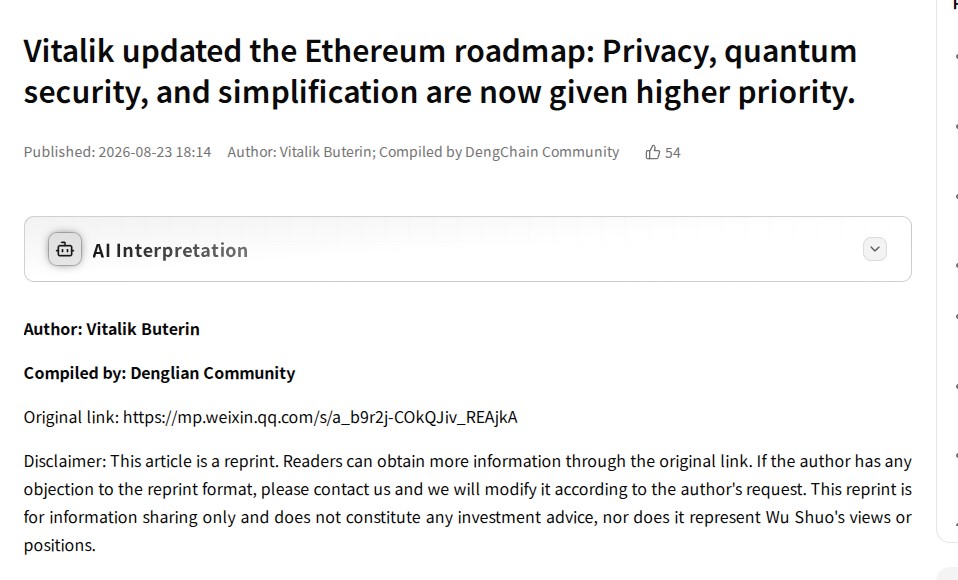
Vitalik Buterin published an updated version of the long-term technical roadmap, often called the "Strawmap." The overall structure closely tracks the original 2023 version, but priorities have shifted: quantum-resistant security has moved up the list, while items like verifiable delay functions and several virtual-machine tweaks have been pushed down. Older proposals such as Verkle trees and state expiry are being replaced with newer designs. The stated goals: a network that's quantum-safe, privacy-preserving, censorship-resistant, high-performance, and structurally simpler.
Wu Blockchain X post
Toward STARKs, AI Verification and Specialized Scaling
In plain terms: privacy protections are getting more attention, aiming to make transaction details harder to trace. Development is also leaning into "post-quantum" cryptography built to stay secure against future quantum computers. Formal verification — mathematically proving code behaves as intended — is being simplified so it's achievable with AI assistance rather than years of manual proof work.
Newer concepts like blob and gas futures markets, rollups built into the base layer, and fresh state-management designs weren't feasible when the original plan was written, since the underlying proof systems (STARKs) have matured since then. The common thread is specialization: purpose-built systems for the heaviest use cases, like payments and privacy, instead of one general system doing everything.
Ledger App Flaw Patched, Users Urged to Update
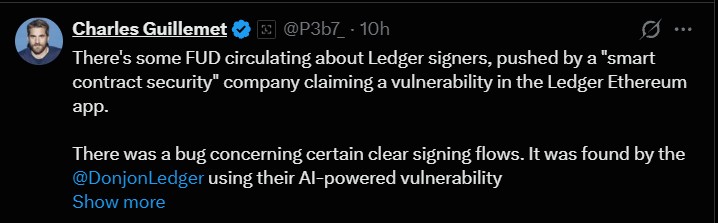
On the security side, Ledger's internal research team, Ledger Donjon, found a flaw in the plaintext (clear-signing) transaction flow of the company's app for this network, using an AI-assisted vulnerability research tool. Ledger says a fix shipped roughly two weeks before the news broke publicly, and users who keep firmware and companion apps current were never affected.
Ledger CTO Pushes Back, Calls for Responsible Disclosure
Ledger CTO Charles Guillemet pushed back publicly on how the flaw was framed. He said a firm describing itself as a smart-contract Ethereum security company only reached the bug bounty program after the fix had shipped, then published material implying the issue was unresolved — a departure, he argued, from responsible disclosure norms. His advice: keep device firmware and apps updated.
F2Pool Co-Founder Trims Position, Repays Loan
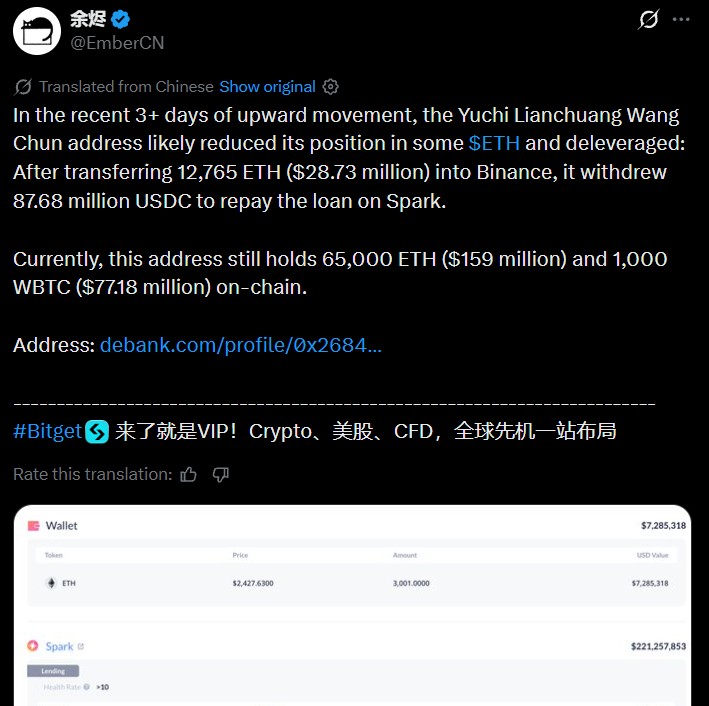
On-chain trackers flagged wallet activity tied to F2Pool co-founder Wang Chun during the rally. His address sent 12,765 coins, worth about $28.73 million, to Binance, and withdrew $87.68 million in USDC to pay down Spark lending protocol loans. Even after that, the wallet still holds an estimated 65,000 coins plus 1,000 WBTC — activity that looks like routine deleveraging rather than a full exit.
EmberCN
Abraxas Capital Builds Short Hedge While Buying Spot
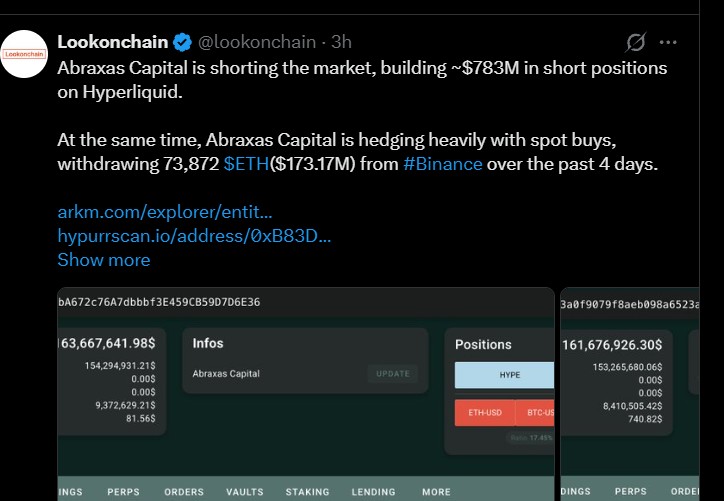
Trading firm Abraxas Capital has built a sizable short book on Hyperliquid, reportedly around $783 million, while simultaneously withdrawing 73,872 coins — roughly $173.17 million — from Binance over four days. The combination suggests a hedged strategy: shorting the broader market with derivatives while accumulating spot holdings, rather than taking one directional bet.
Lookonchain
Whales and Traders Take Profits as Rally Continues
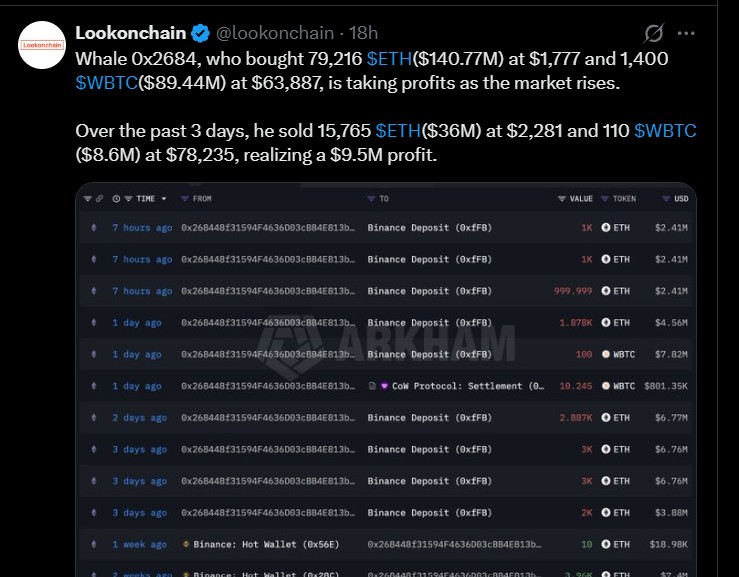
Large holders are also cashing in. One whale who built a position in prior months sold a portion over three days for an estimated $9.5 million in realized profit. A trader on Aster saw a leveraged long roughly double, up about $219,000.
Well-known Hyperliquid trader Machi's large position swung into profit after a rough stretch, even as separate bets on other tokens stay underwater. Another wallet sits on an estimated $21.4 million in unrealized gains across combined BTC and coin longs opened weeks ago.
Lookonchain
Outlook: What to Watch Next
Together, Ethereum latest developments show an asset drawing attention from several directions — institutional allocators, core developers reshaping long-term protocol design, security researchers hardening the ecosystem, and large holders managing risk mid-rally.
Whether momentum continues likely hinges on whether fund inflows persist, how the market digests the shift toward privacy and quantum-resistant infrastructure, and whether current profit-taking stays contained or turns into broader selling pressure. No single outcome can be predicted from these signals alone, but each is worth tracking as the story develops.
Disclaimer: This article is for informational purposes only and does not constitute financial, investment, or trading advice. Cryptocurrency markets are volatile and involve significant risk. Always conduct your own research and consult a qualified financial advisor before making investment decisions.
Also read:







