Kalshi Market News: Exchange Seeks Approval for New Perpetual Futures

Kalshi Market News: US500 Perpetual Futures Filed With CFTC
KalshiEX just asked its regulator for permission to launch something new. On August 18, 2026, the exchange filed a request with the U.S. Commodity Futures Trading Commission to list a product called US500, a perpetual contract built around the largest publicly traded companies in America.
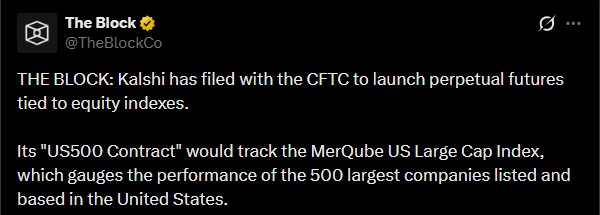
Source: Information Cover by TheBlock
It's a straightforward filing on paper, but it touches on a much bigger question the industry has been chewing on all year: how far can perpetual-style trading go beyond crypto? Here's the Kalshi market news breakdown of what's actually in the paperwork.
What This Kalshi Market News Filing Actually Proposes
This isn't a casual product tease, either. The submission came in under Commission Regulation 40.3(a), which is the formal, voluntary channel exchanges use when they want the CFTC to sign off on something before it goes live.
Xavier Sottile, the exchange's head of markets, signed it and sent it through the CFTC's portal.
So what's actually on the table? A few things stand out:
The product itself: US500, complete with its own rulebook.
What it tracks: the MerQube US Large Cap Index (Bloomberg: MQ5C; Reuters: .MQ5C) — a broad, float-weighted basket of the 500 biggest U.S. companies, run by MerQube.
The format: a perpetual future. That means it's cash-settled and never expires, unlike the quarterly index contracts traders are used to rolling over every few months.
Who it's for: The filing frames this as a fit for anyone whose exposure to big U.S. stocks doesn't really have an end date—think asset managers, index funds, and dealers offsetting client risk.
How The Contract Would Actually Work
The filing gets pretty specific about the mechanics:
Term | Detail |
Contract Multiplier | US$1.00 per Index point |
Minimum Tick | 0.05 Index points ($0.05 per tick) |
Trading Hours | Continuous, 6:00 PM ET Sunday to 5:00 PM ET Friday |
Funding (Periodic Transfer) | Calculated daily at 4:00 PM ET on each Index Business Day |
Funding Deadband | Rates under 0.002% are set to zero |
Funding Clamp | Capped at ±2.00% |
Position Accountability Level | $25,000,000 mark-to-market |
Clearinghouse | Kalshi Klear LLC |
There's no expiration date here, so instead the price stays anchored through periodic payments passed between long and short-term holders.
That funding only kicks in while the index is actually being priced. Weekends, holidays, and off-hours don't generate any funding activity, even though trading itself never really stops.
Why This Is Happening Now
This isn't the exchange's first attempt at a perpetual. Back on May 29, 2026, the CFTC gave the green light to its bitcoin perpetual, BTCPERP—the first domestic perpetual contract ever approved as a futures product.
Alongside that approval, the Commission also put out guidance saying perpetuals tied to other kinds of assets should go through this same Regulation 40.3 review process.
So in a sense, it's testing whether the playbook that worked for bitcoin can stretch to something as mainstream as a large-cap stock index.
That regulatory green light is really the backdrop driving this round of Kalshi market news.
A Legal Fight Still Hangs Over All This
There's an unresolved wrinkle worth knowing about. Back in June 2026, CME Group sued the CFTC's chairman, arguing that Kalshi perpetual futures contracts should really be classified as swaps rather than futures, mostly because of that funding mechanism rather than a fixed settlement date.
The exchange pushes back on that directly in its filing, citing court precedent that says a contract doesn't need a fixed expiration date to legally count as a future.
What Happens Next
For now, the filing sits with the CFTC for review, along with a stack of supporting appendices covering contract terms, trading restrictions, and how the product lines up with the Commission's core principles.
A few pieces, including its agreement with MerQube, were filed under confidential treatment. There's no set timeline for approval yet.
The exchange says it plans to launch the contract soon after getting the green light, so this Kalshi market news story is one worth keeping an eye on.
Disclaimer
This article is for educational and informational purposes only and should not be considered financial or investment advice. Always conduct your own research before making investment decisions.






