Dogecoin vs Bitcoin: Can the Original Meme Coin Catch Up

What Are Bitcoin and Dogecoin: Core Difference Between
Two coins, two very different starts. Dogecoin vs Bitcoin sets a scarce digital asset against a joke that grew up.
Bitcoin (BTC) is digital money that moves from person to person without a bank. Satoshi Nakamoto, a pseudonym, described the idea in a 2008 paper. The network went live in 2009.
Dogecoin (DOGE) came later. Two software engineers, Billy Markus and Jackson Palmer, launched it on December 6, 2013, as a joke. Its code comes from Luckycoin and Litecoin, and a Shiba Inu meme gave it a face.
Call it a joke coin. Then think again. Real people use it for tips and small payments.
Both coins run on Proof of Work. In simple terms, miners spend computing power to confirm payments, and they earn new coins for the effort.
Quick answer:
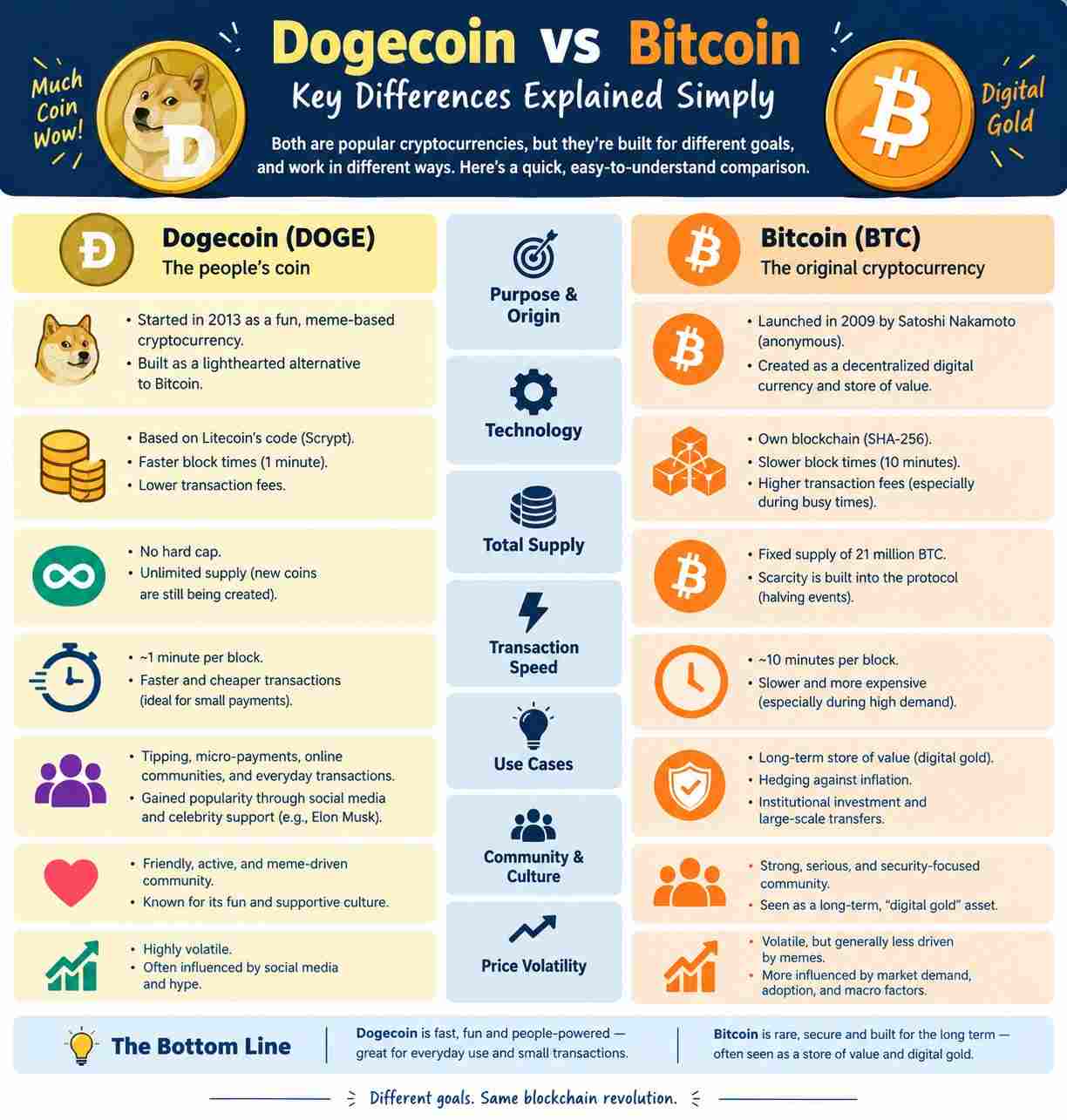
Bitcoin caps supply at 21 million coins. Dogecoin has no cap.
Blocks arrive about every minute on Dogecoin and about every ten minutes on Bitcoin.
Bitcoin mining uses SHA-256. Dogecoin mining uses Scrypt.
Dogecoin vs Bitcoin: Key Differences at a Glance
Feature | Bitcoin | Dogecoin |
Symbol | BTC | DOGE |
Creator | Satoshi Nakamoto (pseudonym) | Billy Markus, Jackson Palmer |
Launch | 2009 | 2013 |
Consensus | Proof of Work | Proof of Work |
Block time | About 10 minutes | About 1 minute |
Maximum supply | 21 million BTC | No fixed maximum |
Main use | Store of value, payments | Payments, tipping |
Mining algorithm | SHA-256 | Scrypt |
Block times are averages, so real waits can vary.Dogecoin vs Bitcoin: How Does Supply Differ?
Why Does Bitcoin Have a 21 Million Cap?
Bitcoin's supply stops at 21 million coins. That hard limit is why many people call it digital scarcity, and it was built in on purpose.
A halving cuts the miner reward in half, roughly every four years. After the April 2024 halving, the reward fell from 6.25 to 3.125 BTC per block. New coins keep arriving, only more slowly each time.
Does Dogecoin Have a Maximum Supply?
No. Each block pays 10,000 DOGE, which adds roughly 5 billion coins a year.
Here's the thing: the yearly growth rate shrinks over time because the same 5 billion lands are on a bigger total. But the coin count never stops rising.
Scarcity matters. Supply rules shape how markets value each coin.
Dogecoin vs Bitcoin: Which Is Faster?
Dogecoin blocks arrive about every minute. Bitcoin blocks take about ten.
Faster blocks help small payments feel quicker. Still, that's not the whole story. Block time alone doesn't set fees, reliability, or the full experience of sending money.
How Do Bitcoin and Dogecoin Mining Differ?
How Does Bitcoin Mining Work?
Bitcoin mining runs on SHA-256 Proof of Work. Competition is fierce, so specialized hardware does most of the work.
How Does Dogecoin Mining Work?
Dogecoin mining uses Scrypt, a different type of puzzle. Since 2014, miners can also mine Dogecoin alongside Litecoin through merged mining.
Turns out, one machine's work can count on two chains. That also lets Dogecoin borrow security from Litecoin's larger hashrate, which means total mining power.
But the reward stays at 10,000 DOGE with no halving.
Dogecoin vs Bitcoin: Which Network Is More Secure?
Security here means how costly an attack would be. More mining power makes attacks harder.
Bitcoin's network is older and larger, which gives it a maturity edge. Dogecoin shares Litecoin's mining power, which helps, but fewer apps are built around it.
Here's the thing: decentralization is harder to judge. Mining concentration shifts over time.
Are Fees and Payments Different?
Both networks move money peer to peer. Fees depend on traffic, so neither coin is always cheaper.
Dogecoin's quick blocks suit tips. Bitcoin suits larger moves.
What Is Bitcoin Mainly Used For?
Bitcoin investment is the big draw. Many holders treat it as a long-term store of value, something to keep rather than spend.
Supporters also call it a hedge against inflation, though that claim is still debated.
In January 2024, U.S. regulatory approval of spot Bitcoin ETFs ushered in a new era of Bitcoin regulation. An ETF is a fund that trades like a stock; thus, it enables people to buy exposure to Bitcoin without having the coins.
What Is Dogecoin Mainly Used For?
Dogecoin leans on tipping, small payments, and online communities. Meme culture drives much of the attention.
Celebrity posts matter too. One study found that Elon Musk's positive Dogecoin tweets moved the price by up to 20%.
The atmosphere of the community is different. Dogecoin is a fun and 'meme' coin, whereas Bitcoin is serious and security-oriented.
A Dogecoin private key is the private code that is used to manage DogeCoins that are stored in a wallet. It needs to remain private, as anyone who has access to it will be able to use the money.
What Do the Latest Prices Show?
Bitcoin price comes first. It traded near $63,000 in mid-2026 after a wild week.
Dogecoin price is next. It mostly held between $0.09 and $0.12 this year.
Volatile.
Bitcoin leads the market, and Dogecoin tends to follow, often with sharper swings. Prices change by the minute, so live figures should be checked before any decision.
Dogecoin vs Bitcoin: Pros and Cons
Coin | Pros | Cons |
Bitcoin | Fixed supply, mature network, wide recognition | Slower blocks, costly mining hardware, and fees can rise. |
Dogecoin | Faster blocks, simple payments, active community | No supply cap, meme identity, volatile price |
Dogecoin vs Bitcoin: Which Fits Which Need?
So which coin deserves a closer research pass?
If the goal is | Worth researching |
Fixed supply | Bitcoin |
Digital scarcity | Bitcoin |
Faster basic payments | Dogecoin |
Tipping and community use | Dogecoin |
Established network | Bitcoin |
Final Verdict: Dogecoin vs Bitcoin Explained Simply
Bitcoin stands for scarcity, security, and a store-of-value story. Dogecoin stands for faster blocks, payments, and community culture.
Turns out, the better coin isn't the point. Their supply rules, mining tech, and goals simply differ.
On supply design alone, Bitcoin takes the edge. Dogecoin wins on payment speed.
But the final call depends on the use case. Dogecoin vs Bitcoin comes down to scarcity versus payment speed.
Disclaimer
This article is for information only and is not financial advice. Neither asset is risk-free, and prices can fall sharply. Readers should research independently before any transaction.









.webp)




