ETH to XMR: How to Swap Ethereum for Monero Without KYC in 2026

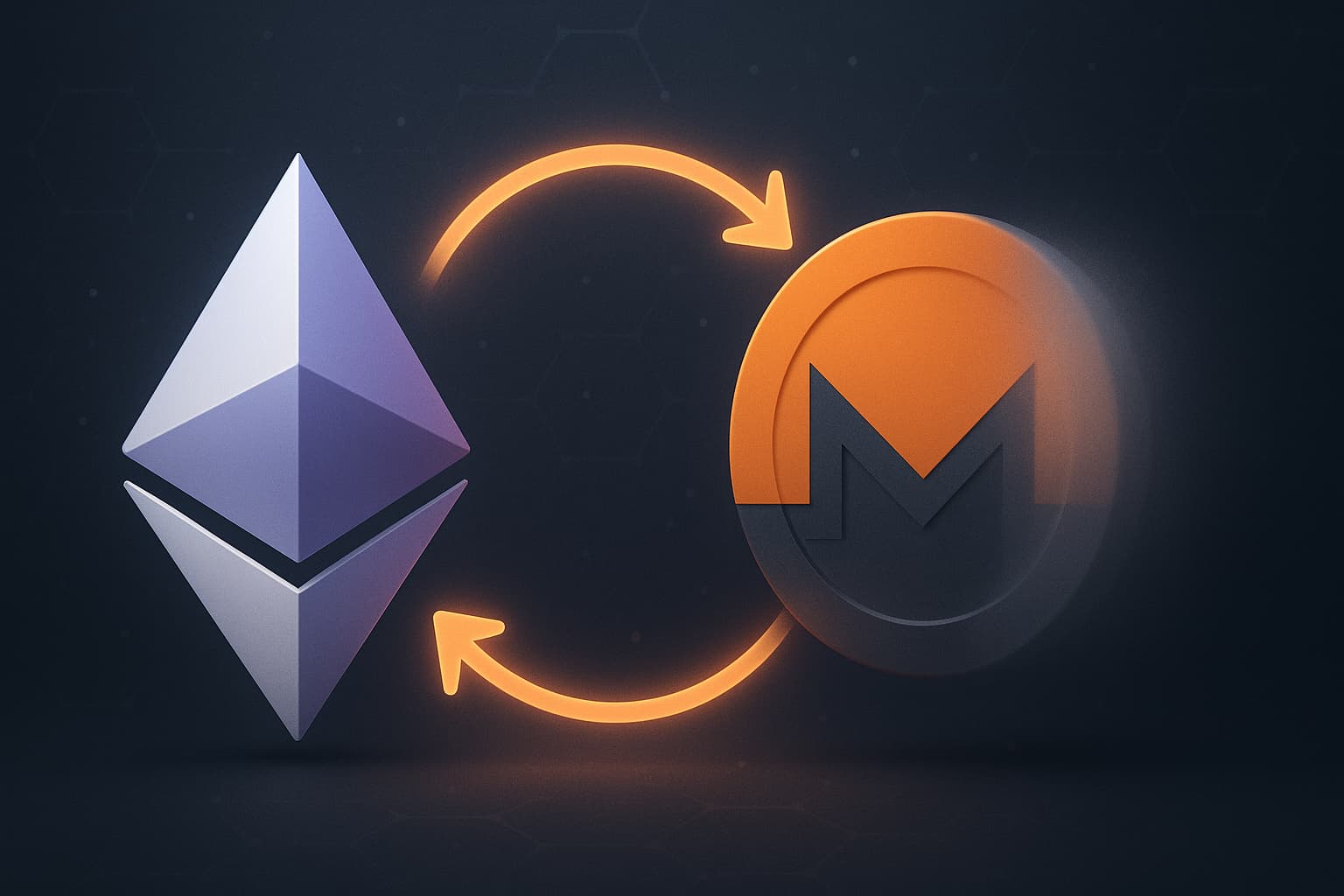
Ethereum writes every transfer into a public ledger, while Monero keeps senders, receivers and amounts out of view. Here is how an ETH to XMR swap works without an account, which network to use and where people usually slip up.
If you hold Ether and want part of it in Monero, the route is less obvious than it once was. Many centralized exchanges no longer list XMR, and those that do usually want a passport scan and a selfie before your first order.
An instant swap is the shorter path. You send ETH from your own wallet, it is converted at the market rate, and the Monero arrives in a wallet you control. There is no order book, no balance left on a platform and no identity check to start.
Why people move from ETH to XMR
Ethereum is an open book
Every Ethereum address has a public history. Paste one into a block explorer and anyone can see its balance, its tokens and every contract it has touched. Once that address is tied to your name, through an exchange withdrawal or an ENS domain, the whole history is tied to you too.
Monero is private by default
Monero works the other way round. Ring signatures blend the real sender with decoys, stealth addresses give each payment a one-time destination, and RingCT conceals the amount. These protections apply to every transaction, with nothing to switch on.
The motives are usually ordinary: keeping savings out of public view, paying a contractor without exposing a whole portfolio, or holding some funds in a coin whose ledger does not broadcast balances.
How to swap ETH to XMR in five steps
Step 1: Choose the pair and the amount
Set Ethereum as the coin you send and Monero as the coin you receive, then enter the amount. On GhostSwap, the page to swap ETH to XMR opens with the pair already selected, and the form shows an estimate of the XMR you will get, along with the pair's current minimum and maximum.
Step 2: Paste your Monero receiving address
Copy an address from a Monero wallet you control, such as the official Monero GUI wallet or Feather Wallet. A standard Monero address has 95 characters and begins with a 4, while a subaddress begins with an 8. A fresh subaddress for each swap keeps incoming payments from being linked.
Step 3: Add a refund address for your ETH
If a deposit falls outside the limits, the Ether needs a way home. Enter an Ethereum address you control, ideally the wallet you are sending from.
Step 4: Send the ETH deposit
You get a deposit address created just for this swap. Send the amount you entered from your own wallet, on the Ethereum network, and compare the first and last characters of the address after pasting.
Step 5: Receive the Monero
Ethereum adds a block roughly every 12 seconds, so the deposit is picked up quickly and the swap runs once it has enough confirmations. The XMR appears in your wallet straight away, but Monero keeps newly received coins unspendable for 10 blocks, roughly 20 minutes.
Native ETH, ERC-20 tokens and the right network
In a modern wallet, “ETH” can mean several things, and this is where many failed swaps begin. An ETH to XMR swap expects native Ether on the Ethereum network, so check the network label in the swap form before you send.
| In your wallet | What it is | What to do |
| ETH on Ethereum | Native Ether | Use the ETH to XMR pair as normal |
| ETH on a layer-2 | Same ticker, different chain | Move it to Ethereum first, unless the form lists that network |
| WETH | ERC-20 token wrapping Ether | Unwrap it to ETH before sending |
| USDT or USDC (ERC-20) | Stablecoin tokens | Select that token as the coin you send |
ERC-20 tokens move through a smart contract, so a deposit address expecting native ETH will not treat a token transfer as an ETH payment.
Fees, gas, limits and the floating rate
• Gas. A plain ETH transfer uses 21,000 gas units, priced by network demand. If you send your whole balance, use your wallet's “max” option so it reserves enough for gas.
• Swap fee. Instant swap services usually build their fee into the rate. Judge a quote by the XMR you will receive, not the headline rate.
• Minimum and maximum. GhostSwap shows both before you create the swap. A deposit outside them is not exchanged as normal, which is when the refund address matters.
• Floating rate. The first figure is an estimate. The market keeps moving until your deposit confirms, so the final XMR amount can end up slightly higher or lower.
Mistakes to avoid
• Sending from a centralized exchange account. Exchange withdrawals are often queued, and a refund sent to an exchange hot wallet may never reach you.
• Using an Ethereum address as the destination. Ethereum wallets cannot receive Monero.
• Trusting your clipboard. Some malware replaces copied addresses with an attacker's. Check every paste.
• Setting gas too low. An underpriced deposit can sit unconfirmed while the rate floats.
• Skipping a test. Before moving a large amount, a small first swap shows every step for little cost.
Final thoughts
A Monero wallet you control, native ETH on the right network, a refund address and enough gas: get those four things right and the swap itself is the easy part.
Live since October 2024, GhostSwap is an instant swap service that works without KYC or an account. It is non-custodial: swapped coins are paid directly into the user's own wallet. More than 1,600 coins are supported, among them the privacy coins Monero, Zcash and Dash, and there is a Tor onion address for users who prefer to connect over Tor.









.webp)