Lab Terminal Crypto Hack Lost $130K: What Affected Users Should Do?

Lab Terminal Crypto Hack: Losses, Wallet Risks and USDT Compensation
A Lab Terminal crypto hack 2026 disclosure has put a hard number on the damage: $129,986. LAB confirmed on October 8 that unauthorized transfers had drained wallets created in or imported into its legacy Terminal.
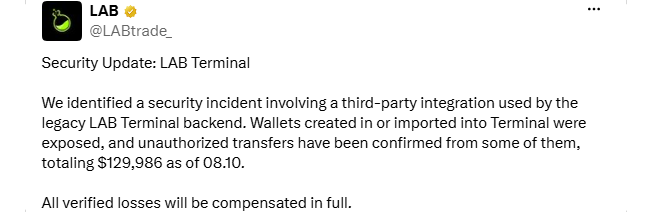
Source: X Official Announcement
The cause of this crypto news today was a failure in a third-party integration. The Lab crypto hack October 2026 also highlights the growing security risks associated with third-party integrations, following the Bitget security incident in September 2026.
What the Lab Terminal Crypto Hack Exposed and How Much was Stolen
LAB Terminal is the project’s legacy trading product, where users could create wallets or import existing ones. Its backend relied on an outside provider, and that dependency is where the Lab Terminal crypto hack started.
The crypto hack began with an outside service tied to the old Terminal backend. The provider's name has not been released yet. Wallets that touched Terminal were left exposed, and some were emptied.
LAB says the legacy backend is now fully shut down. That stops new exposure but does not protect wallets already compromised. The current LAB App runs on separate infrastructure and was not affected. Confirmed theft stands at $129,986 as of October 8, according to the project’s announcement.
Who Is at Risk: Every Wallet Created or Imported Into Lab Terminal
Shutting down the backend stops new exposure, but it does not secure wallets already compromised. Risk reaches three groups:
-
Holders of wallets created inside the Terminal.
-
Users who imported an existing wallet. Every chain and account sharing that seed phrase is affected, in any wallet app.
-
Holders expecting LAB allocations or vesting. Payouts linked to affected wallets are paused and will go to a new address after verification.
What to Do?
-
Treat every wallet created in or imported into Terminal as compromised, across every chain using that seed phrase.
-
Send no more funds or tokens to those addresses.
-
Move remaining assets to a new wallet built on a fresh seed phrase.
-
Do not claim LAB allocations or vesting to affected wallets. Those payouts are paused until verification.
Lab Hack Compensation: How Verified Losses will be Repaid in USDT

Source: X Official
LAB says it will repay the full dollar value of verified losses. Each amount is priced at the moment of the theft and paid in USDT. Outreach has started through the official LAB Terminal bot. Anyone who believes they were hit but has heard nothing can use the project’s support chat.

The team also reports that its investigation is complete. It is talking with the providers involved about recovering costs, but user payouts do not depend on those talks. LAB repeated that it never asks for seed phrases, private keys, wallet connections or signatures.
Lab Token Price Crashed After the News: Check Current Number
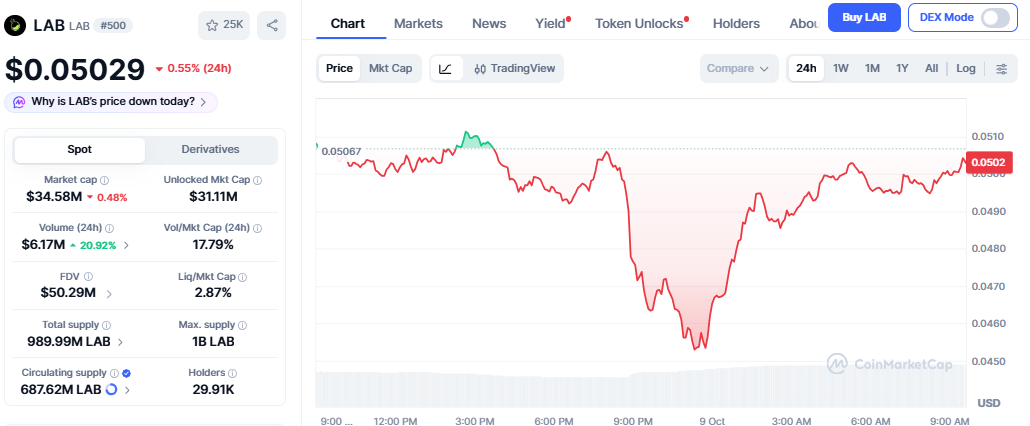
Lab security breach news hit the market hard. CoinMarketCap data shows the token sliding to a 24-hour low of $0.04516, roughly 11% under its earlier level near $0.0507. At the time of writing, the recovery is largely complete:
-
Lab token price: $0.05029, down 0.55% over 24 hours
-
24-hour range: $0.04516 to $0.05118
-
Market cap: $34.58M
-
24-hour volume: $6.17M, up 20.92%
-
All-time high: $27.22 (June 3, 2026), about 99.81% above the current level
Lab Terminal Incident vs. the Bitget Hack: Similar Patterns
Recent crypto hack news shows a clear pattern. Bitget lost roughly $387 million from hot and warm wallets in late September after attackers exploited flaws in third-party security tools. Private keys were reportedly not stolen, and a protection fund reportedly above $400 million covered the losses.
During the same month , TradeWiz, a Solana Telegram trading bot, also saw about $459,000 swept from user wallets around September 30.
The pattern is familiar. Vendor tools become high-value pivots, and even a narrow feature can expose seeds.
User Safety Tips: How Wallet Holders Can Limit Third-Party Risk
-
Never import a main seed phrase into a third-party terminal or bot.
-
Keep trading wallets small and apart from long-term holdings.
-
Replace any seed after possible exposure.
-
Verify the exact official handles and ignore unsolicited DMs or fake support.
-
Favor tools where private keys never leave the device.
-
Keep addresses and transaction times on record for claims.
The real test for the Lab Terminal crypto hack is no longer the $129,986 figure. It is delivery: how fast verified losses reach victims in USDT, and whether LAB recovers costs from its providers. Until payouts land, Terminal-linked wallets stay burned, and the next integration audit will decide whether trust returns.
Disclaimer: This article is for informational purposes only and does not constitute financial or investment advice. Crypto markets carry significant risk. Always do your own research before making any investment decisions.









