Orbinum Network Roadmap: From Public Testnet to the Mainnet Era

Orbinum Network Roadmap 2026: From Testnet to Mainnet
Most blockchain projects talk about the future. Orbinum has something more useful to show: three quarters of its 2026 plan are already marked complete, and the toughest stretch is happening right now. Between October and December 2026, the team aims to move from a public testnet to a live network, with a token sale, audits and exchange liquidity all in the same window.
This guide walks through the Orbinum Network roadmap one phase at a time. It looks at what each phase delivered, why the order makes sense for a privacy chain and what readers should watch before and after mainnet.
Key Takeaways
Three phases are complete. Research, the community program and the public testnet are all marked as done.
Q4 2026 decides the story. The public sale, audits, validator selection and mainnet launch all sit in this one window.
2027 is a vision, not a promise. It aims at private DeFi, institutions and cross-chain privacy, but only after mainnet works.
What Is Orbinum Network?
Orbinum is a privacy-preserving blockchain built on Substrate. It combines zero-knowledge proofs with EVM compatibility. The goal is private transactions that can still be audited when needed.
Public blockchains show balances, transfers and addresses to everyone. For funds and businesses, that creates real problems. Competitors can study holdings, and visible transactions invite front-running.
Orbinum answers this with a shielded pool. Users can shield public tokens into private notes. They can send value privately, then unshield it back to public tokens.
There is also selective disclosure. A user can share a disclosure key to prove a note's value to a third party. The spending ability stays with the owner.
Source: Official website
What Is the Orbinum Network Roadmap?
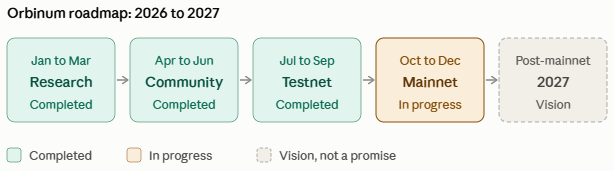
The Orbinum roadmap is the project's public plan for turning a privacy idea into a working network. It is published in the official docs, marked with a status for each phase and was last updated on October 1, 2026. That date matters, because it shows the plan is being maintained and not left to go stale.
To understand why this roadmap looks the way it does, it helps to know what Orbinum is building. The network is a privacy-preserving blockchain on Substrate that combines zero-knowledge proofs with EVM compatibility. Its shielded pool lets users convert public tokens into private notes, send them without revealing sender, recipient or amount, and convert them back. Selective disclosure adds a safety valve, since a user can share a key that proves a note's value to a third party without handing over spending power.
That design explains the roadmap's shape. Privacy technology cannot be judged on promises, so every phase ends in something people can test, audit or verify.
Orbinum Roadmap 2026 at a Glance
Phase | Period | Focus | Status |
Q1 | Jan to Mar 2026 | Research and development | Completed |
Q2 | Apr to Jun 2026 | R&D and community program | Completed |
Q3 | Jul to Sep 2026 | Public testnet | Completed |
Q4 | Oct to Dec 2026 | Mainnet launch | In progress |
2027 | Post-mainnet | Privacy Settlement Layer | Vision |
Source: official roadmap documentation
Q1 and Q2: Building the Engine, Then Opening the Doors
The first quarter was pure groundwork. The team worked on ZK protocol research, documentation, the Substrate node, core primitives and pallets, open-source tools and ZK circuits. None of this is visible to a casual user, yet every later phase rests on it.
The second quarter changed the tone. Orbinum went public on social media and opened Orbinum Hub, which houses the shielded pool and the community. Season 1 of the community program introduced membership and ORB Credits, backed by social quests, streaks and referrals. On the technical side, TypeScript SDKs and a testnet node container image gave developers and node runners their first practical tools.
This pairing is smart. Building the community while research continued meant users and builders were ready when the testnet arrived.
Q3: The Public Testnet Becomes the Proof Point
Q3 was the first time outsiders could use the network. The public testnet launched with a faucet, so anyone could get test tokens, and a Privacy Explorer let users inspect activity. The app supported the four actions at the heart of the design: shield, unshield, private transfer and selective disclosure.
Validator onboarding with telemetry also began here, along with ecosystem integration. Letting validators join early gives the project real data on node performance before real value is at stake. For a network that wants institutions to trust it, that rehearsal is valuable.
Q4 2026: What the Orbinum Mainnet Launch Window Includes
This is the phase every reader is watching. The Orbinum mainnet launch is the final item on a longer list that starts with the public sale, covering both its start and its close. After that come the genesis ceremony, code audits, validator selection for mainnet and consensus migration. The community Season 1 end then follows, with a Credits snapshot and TGE, before mainnet launch and initial exchange liquidity close out the quarter.
The order of this list tells its own story. Audits and validator selection come before launch, which suggests security is treated as a gate and not a final polish. The roadmap gives no exact launch date, so timing will likely follow how smoothly these earlier steps go.
Readers should also note how many things land together. A public sale, a TGE and exchange liquidity within one quarter make this the busiest stretch of the entire plan, and any delay in one step could shift the others.
ORB Token, Tokenomics and Vesting in the Roadmap
Q4 is also where the ORB token moves from concept to market. The public sale and initial liquidity mean token details start to matter quickly, which is why anyone following the roadmap should read the Network Economy docs alongside it.
Two topics deserve attention. ORB tokenomics covers supply, allocation and sale terms, while ORB vesting shows how and when locked tokens become tradable. Unlock schedules can shape market supply for months, so they are as relevant as the launch date itself.
Source: official vision page
Orbinum 2027 Roadmap: The Privacy Settlement Layer
After mainnet, the plan widens. The project calls its next chapter the Privacy Settlement Layer, and this sits at the center of the Orbinum Network 2027 vision. The Orbinum future plans in this section include private DeFi with shielded swaps, lending and stablecoin rails, plus institutional adoption through funds, market makers and compliance partners. Cross-chain privacy through bridges to Ethereum and major L2s is also listed, together with progressive decentralization of governance and open-source contributions backed by grants.
The roadmap labels this section a vision, and the label is fair. Each item depends on mainnet proving itself first. Still, the direction is consistent with the project's founding argument, since institutions need privacy and auditability together, and the 2027 plan targets exactly that audience.
Does the Roadmap Match the Vision?
The vision page names four barriers that keep institutions away from public chains. The roadmap reads like a path toward each one.
Barrier on public chains | Orbinum's answer |
Transparent balances | Shielded pool keeps holdings private |
Visible transactions | Private transfers hide sender, recipient and amount |
Public addresses | Shielded notes reduce address exposure |
Compliance friction | View keys and selective disclosure support audits |
The docs also cite Groth16 proofs on the BN254 curve, with verification around 15 ms. That figure comes from the project itself, so it is worth watching how it holds up under real mainnet load.
Source: official ORB documentation
What to Watch Before and After Launch
Several signals will show whether the plan is on track:
Publication of the code audit results
How mainnet validators are chosen
Terms and close of the public sale
Whether exchange liquidity opens as planned
Early use of private transfers after launch
Readers should also keep expectations realistic. Roadmaps shift, dates move and a smooth testnet does not guarantee a smooth mainnet. New tokens are volatile, so only money that can be lost without harm belongs in them.
Final Thoughts
The Orbinum Network roadmap follows a logical arc: research, community, testnet, then a mainnet push with audits built in. Anyone tracking the Orbinum roadmap 2026 should lean on the official docs and treat Q4 delivery as the real test. If that quarter lands well, the 2027 vision becomes far easier to take seriously.
Disclaimer: This article is for information only and is not financial advice. Crypto is volatile, and losses are possible.








.webp)