Pi Network News: Valour ETP Is Live, but Can an ETF Lift Price?

Pi Network News: Can a Pi ETF Do What Valour ETP Couldn’t?
Pi Network News this week comes down to a gap between headlines and numbers. Valour's Pi product has traded in Europe for more than a year, yet it holds only about $17,000 in assets (-52.5% YTD return), according to the issuer's product page.

Pi coin itself traded near $0.0869 on October 5, down 1.77% in 24 hours, per on chain data. If a regulated product this small cannot move demand, can a full Pi ETF?
Pi Network News: Valour ETP Launched in Sweden but Draws Few Investors
Valour Pi SEK began trading on Sweden's Spotlight Stock Market on August 27, 2025. It was one of eight SEK-denominated products launched that day, per the official announcement and the exchange listing.
The note tracks the PI token and is backed by the underlying asset, so European investors can reach it through ordinary brokerage accounts.
ISIN: CH1108681540
Management fee: 1.9%
Issuer: Valour Inc.
Base currency: SEK
Assets under management: about $17,431, below $20,000 since early 2026
Against $5.24 million in spot volume over a single day, those assets equal roughly 0.3% of one day's turnover. The product is also an exchange-traded product, a tracker note, rather than a US-style fund.
Can a Pi ETF Help the Price When the ETP Has Not? What Is Missing Now
No issuer has publicly filed for a spot or futures Pi ETF with the SEC, based on public records reviewed for this article. Readers can confirm on SEC EDGAR. Analyst reviews in late 2025 called the idea premature. Three gaps explain why:
Price discovery: deep, reliable liquidity on major exchanges
Custody: regulated institutional custodians willing to hold PI
Oversight: clearer rules and surveillance-sharing agreements
Pi Network News cycles often recycle screenshots of supposed filings, and none has matched a real application. A Pi network ETF would widen access, but the Valour experience shows that access without liquidity changes little.
If a Pi Network ETF did launch, the upside would be simple. A backed fund must buy $PI as money flows in, which adds steady demand. That wider access could build trust and bring in new holders over time.
Thin liquidity cuts both ways, so any gain would depend on real interest.
Pi Network Price Today: Thin Volume and a Slight Dip Mark the Market
Pi coin price today went down about 1.7% while the wider crypto market is up 1.23% in the last 24-hours trading. Data from CoinMarketCap as of October 5 shows:
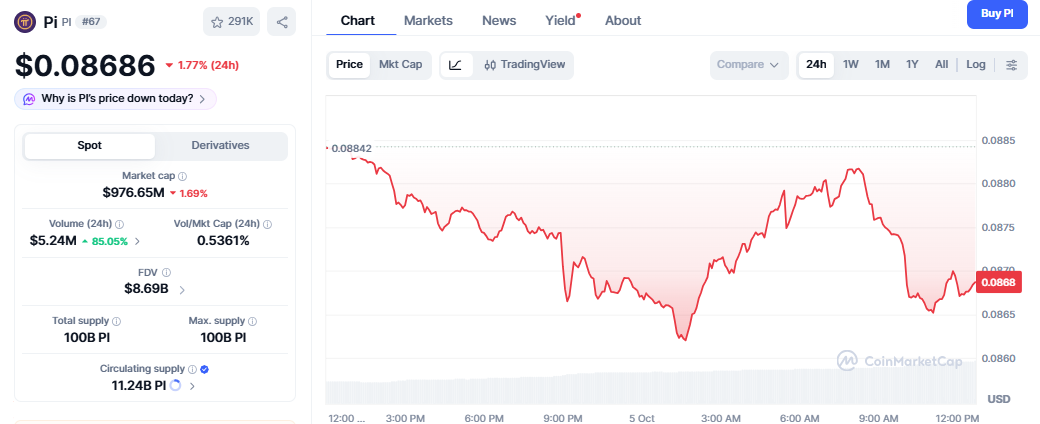
Price: $0.08686, down 1.77% in 24 hours
Market cap: $976.65 million, ranked #67
24-hour volume: $5.24 million, up 85.05%
Fully diluted value: $8.69 billion
Circulating supply: 11.24 billion of 100 billion PI
Volume jumped while price slipped, a pattern that often signals selling into thin bids. Only about 11% of total supply circulates, so future unlocks would matter to any institution sizing a position. The data points to no single catalyst behind the dip.
Pi Network Ecosystem 2026 Growth: Mainnet, Upgrades, DEX and Tools
Price tells only part of the story. Pi's Mainnet finished the Protocol 27 upgrade in September, and Testnet already runs Protocol 28. Public readings from the network's Horizon API put Mainnet past 28.9 million ledgers, with a new one closing every five seconds.
Upgrades: Protocol 27 is live and laid groundwork for swaps and liquidity pools
DEX: official Pi DEX tools are still in testing
Tools: the official BlockExplorer now carries a Launchpad Tokens section on Mainnet
Partnerships: stablecoin-related moves with Open Standard (OUSD), plus robotics and gaming tie-ups
Migration: Pi KYC and Mainnet migration work continues
They build utility, not brokerage access. Protocol 28 follows the same developer-focused path.
Pi Network Uptober 2026 Moves: Protocol 28 Mainnet and DEX Update
October carries the near-term hopes. The Pi Core Team has set Protocol 28 for Mainnet on October 16, with node operators due to upgrade by October 13. The month also includes a TOKEN2049 Singapore appearance.
Four outcomes would matter most: A clean v28 switch, DEX progress, real usage and possible depth and custody.
Disclaimer: This article is for informational purposes only and does not constitute financial or investment advice. Crypto markets carry significant risk. Always do your own research before making any investment decisions.









