Pi Network News: Is the Pi Network Stablecoin Ready to Launch?


Pi Network News: Stablecoin Roadmap, OUSD Deal and Protocol 28
Pi Network News today centers on a bold idea: a stablecoin inside an ecosystem built around a volatile native coin. The Pi Core Team says it is exploring stablecoins that add utility where price stability matters, while Pi coin stays the primary currency.
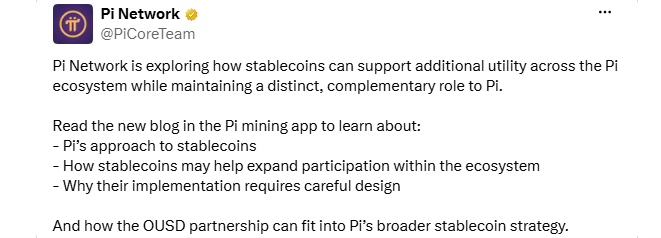
Source: X Official
As of October 9, Pi price sits near $0.0817, down 0.52% as per CoinMarketCap data. Trading volume stands at $8.11 million with market cap near $918.69 million, fallen from its previous $1 billion range.
For readers following Pi crypto news today, the takeaway is simple: Can a coin born on millions of phones find stable footing? The plan is real, but the product is not live.
Pi Network News: Why the Pi Network Stablecoin Plan Matters Right Now
Stablecoins solve a plain problem. Prices swing, and merchants, app builders and everyday users struggle to quote costs in a coin that moves daily. Pi is meant to remain the main asset for participation and utility.
A stablecoin would handle payments, settlements and accounting, where predictable value counts. The Pi Network stablecoin approach treats the two assets as partners, not rivals.
The official blog, published on October 8, stresses careful design and compliance before any rollout.
Pi Network OUSD Partnership: How Open Standard Fits Pi’s Stablecoin Approach
The Pi Network OUSD partnership was announced on September 30, 2026. OUSD is a partner-governed dollar stablecoin backed by more than 200 companies, including Visa, Google and Stripe. Key details:

Source: Official Announcement
Issuer: Stripe’s Bridge platform
Reserves: held at institutions such as BlackRock and BNY
Networks: Ethereum, Solana, Base and Tempo
Model: most reserve income returns to distributing partners
Pi says it chose OUSD because the model keeps value with the people and businesses that build and use a network. Under the plan, Pi will explore Pioneer rewards programs and wider ecosystem utility.
In short, the Pi Network Open Standard approach works like this:
Governance: a consortium of 200+ companies shares control
Access: free minting and redemption at any scale
Income: most reserve income returns to distributing partners
Role in Pi: stable-value use cases only, with Pi staying primary
Status: principles and compliance come first, not a finished product
Pi Network Ecosystem Stablecoin Readiness: What Is Built and What Is Missing
The Pi Network ecosystem has real building blocks. Open Network connectivity has been live since February 2025. Roughly 17 million to 18 million Pioneers are KYC-verified, and about 16 million have migrated balances to Mainnet, though figures shift between updates. Protocol 27 finished on Mainnet in late September and laid groundwork for DEX-style trading.
The gaps are just as clear:
No native OUSD support or bridge on Mainnet
No published reward rules, eligibility or timelines
Thin liquidity and few stablecoin-based trading pairs
On-chain activity still tied to claims and small transfers
A previous independent Pi Network news analysis calls the network only partly ready.
Pi Network Protocol 28 Arrives Oct 16 as Oct 13 marks User Deadline
The next Pi Network update is Protocol 28, set for Mainnet on October 16, 2026. Node operators face an October 13 upgrade deadline. This Pi mainnet upgrade improves handling of delayed transaction data, allows batch smart-contract upgrades and makes data changes safer.
It adds no stablecoin feature directly, but sturdier contracts matter for any future OUSD integration.
The next chapter of Pi Network News will be judged by one test: concrete reward rules, a technical path and live liquidity. Until the team publishes those details, the OUSD deal remains an announcement.
Pi Protocol 28 is the first checkpoint, and what follows will show whether Pioneers get working stablecoins or only a promise.
Disclaimer: This article is for informational purposes only and does not constitute financial or investment advice. Crypto markets carry significant risk. Always do your own research before making any investment decisions.









