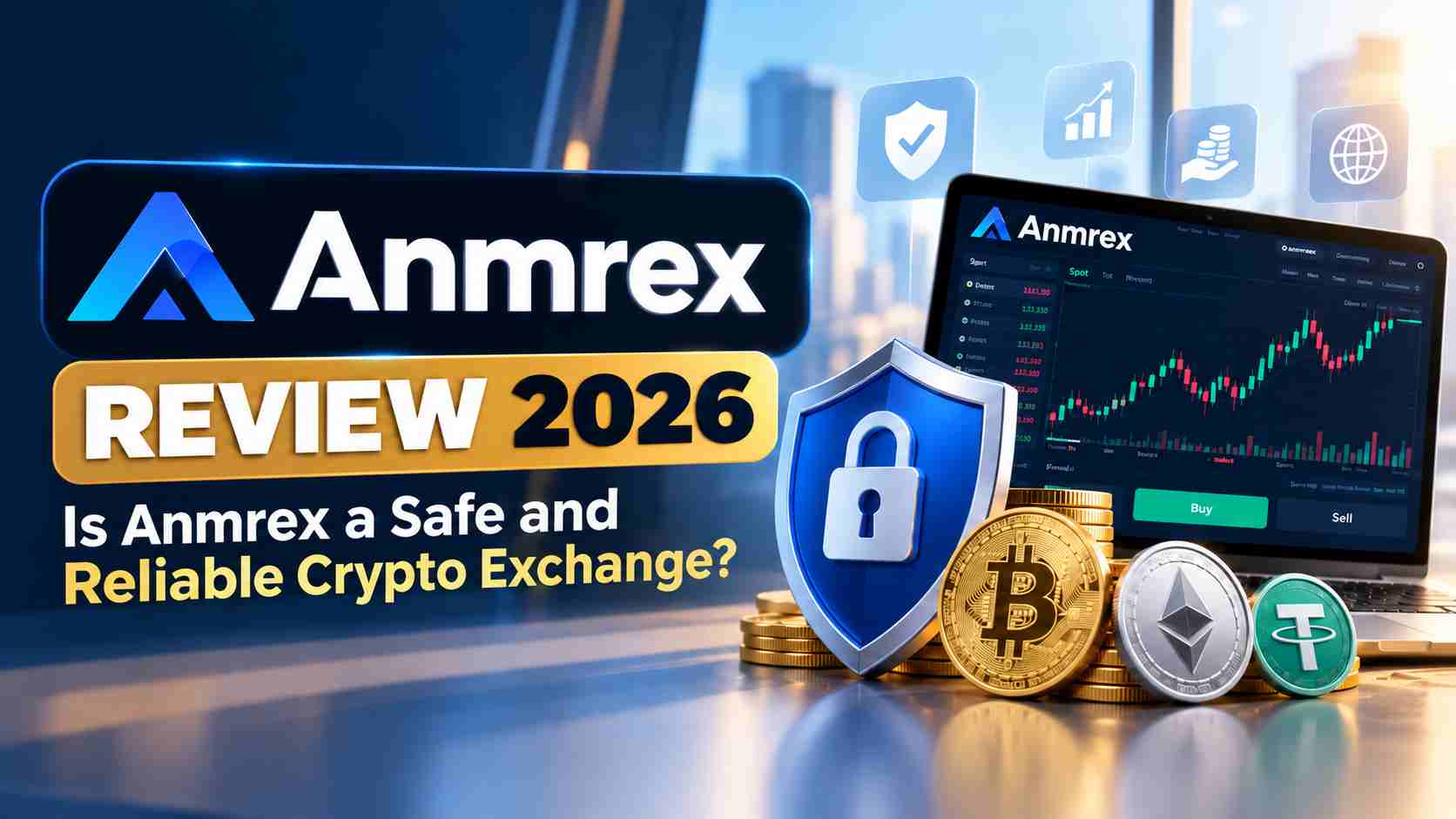
Anmrex Review 2026: Is Anmrex a Safe and Reliable Crypto Exchange?

Choosing a crypto exchange in 2026 is no longer simply about finding the platform with the most trading pairs.
Security, fees, liquidity, withdrawals, KYC, regulatory status, and the quality of account controls can all affect the experience. For that reason, a newer or less widely discussed exchange deserves to be evaluated across several areas rather than judged from its feature list alone.
Anmrex is a centralized crypto exchange offering spot trading, futures, options, crypto conversion, Earn products, and other asset-management services. Its platform also places considerable emphasis on custody security, risk monitoring, and compliance.
So, is Anmrex safe and reliable?
The short answer is that Anmrex has several of the structural features users would expect from a modern centralized exchange, but users should still evaluate liquidity, costs, withdrawal performance, and their own regional eligibility before committing significant funds.
Here is what to know.
Anmrex Review: Quick Overview
| Category | Anmrex |
| Exchange type | Centralized crypto exchange |
| Spot trading | Yes |
| Futures | Yes |
| Options | Yes |
| Crypto conversion | Yes |
| Earn products | Yes |
| USDT lending | Yes |
| KYC | Required for applicable account services |
| U.S. MSB registration | Completed |
| Security approach | Layered custody, MPC, multi-signature and risk monitoring |
| Best suited for | Users looking for a multi-product crypto exchange |
Anmrex is therefore positioned more as a general-purpose crypto exchange than a specialist venue built around one particular trading product.
What Is Anmrex?
Anmrex is a centralized digital-asset trading platform that combines conventional crypto trading with additional account and asset-management services.
The core offering includes Spot and Futures markets, while users can also access Options, Exchange / Convert, Earn, staking-related products, and USDT lending.
That makes the platform relevant to several types of crypto users.
A casual user may only need conversion or spot trading.
An active trader may be more interested in derivatives.
Another user may primarily want to manage assets and transfers from the same account.
The important point is that Anmrex does not appear to be targeting only one of these groups.
Is Anmrex Safe?
Security is probably the most important question to answer before depositing cryptocurrency into any centralized exchange.
Anmrex describes a multi-layer security architecture covering custody, account access, transactions, and asset movement.
Its published security framework includes cold, warm, and hot wallet separation, asset segregation, MPC key management, key sharding, multi-signature controls, zero-trust mechanisms, and real-time anomaly detection.
This is broadly consistent with the direction of modern exchange security.
The advantage of such a model is that there is no single security mechanism expected to protect everything.
For example, wallet segregation addresses custody exposure, while MPC and multi-signature controls are intended to reduce dependence on a single private-key or authorization point.
Users should still remember that exchange-level security does not eliminate account-level risks such as phishing, compromised devices, or poor password practices.
Our view
Anmrex shows a reasonably structured approach to exchange security based on the controls it publicly describes.
That is a more useful conclusion than simply calling an exchange “safe.”
Is Anmrex Regulated?
Regulatory terminology deserves some care here.
Anmrex has completed U.S. Money Services Business registration, while its public information-disclosure approach is positioned around transparency standards associated with SEC-related requirements.
This should not be interpreted as an SEC license or as government endorsement of the exchange.
An MSB registration is a registration status, not a guarantee of safety or profitability.
Anmrex also states that it is working on regulatory adaptation across additional international markets, including MiCA-related development in Europe.
For users, regional availability and applicable rules remain more important than simply seeing a regulatory term on an exchange website.
Anmrex Fees: What Should Traders Check?
Trading fees are an obvious part of exchange comparison, but the displayed trading fee is not necessarily the entire cost of a transaction.
Traders should consider:
-
Trading fees
-
Bid-ask spread
-
Order-book depth
-
Funding costs for derivatives
-
Withdrawal fees
-
Network fees
-
Conversion pricing
This is particularly relevant when comparing Spot trading with an instant conversion function.
A “0 Fee” conversion offer, for example, should still be evaluated using the final quoted exchange rate rather than the fee label alone.
For larger trades, liquidity and spread can sometimes matter more than a small difference in the advertised trading fee.
Practical approach: compare the final execution cost for the specific trading pair and transaction size you actually intend to use.
Anmrex Deposits and Withdrawals
Deposits follow a familiar centralized-exchange workflow:
Choose Asset → Choose Blockchain Network → Receive Deposit Address
The deposit interface currently lists major assets including USDT, USDC, BTC, BNB, and ETH. It also displays minimum-deposit information and warns users to verify the correct network and device security before transferring funds.
This is one area where users should slow down.
Selecting the wrong blockchain network can result in funds not being credited correctly, even when the asset itself is correct.
For a new exchange account, a sensible approach is to start with a small deposit and test a small withdrawal before moving a larger balance.
That is good practice for any centralized exchange, not just Anmrex.
Anmrex User Reviews: What Should You Look For?
Online reviews can be useful, but crypto exchange reviews need to be interpreted carefully.
A single complaint about a failed transaction does not necessarily establish that an exchange is unsafe. Likewise, a large number of positive comments does not prove that an exchange will perform well for every user.
The more useful signals are repeated patterns.
When researching Anmrex user feedback, pay particular attention to:
-
Withdrawal delays
-
KYC-related issues
-
Deposit processing
-
Customer support response
-
Unexpected trading costs
-
Account access problems
-
Platform downtime
-
Repeated complaints involving the same issue
Independent coverage of a newer exchange can also be less extensive than coverage of established global platforms.
That does not automatically make the platform unsafe.
It simply means users have less historical third-party information to rely on and may want to perform more of their own testing.
Who Is Anmrex Best Suited For?
Anmrex may be worth considering for users who want several crypto services under one account.
Spot Traders
Users focused on conventional crypto trading can use the Spot markets without needing to interact with more advanced products.
Active Traders
Futures and Options provide additional trading instruments for experienced users who understand derivatives risk.
Crypto Users Managing Several Activities
Conversion, deposits, transfers, Earn products, and lending can make the platform useful beyond simple buy-and-sell transactions.
Users Prioritizing Security Infrastructure
Those comparing exchanges partly on custody architecture may find Anmrex's published use of MPC, multi-signature controls, wallet segregation, and transaction monitoring relevant to their evaluation.
It may be less suitable for someone whose main priority is simply choosing the most established exchange in terms of historical market presence.
Anmrex Pros and Cons
Pros
-
Broad range of crypto trading and asset-management products
-
Spot, Futures, and Options available
-
Published multi-layer security architecture
-
MPC and multi-signature custody controls
-
Asset segregation and wallet-layer management
-
U.S. MSB registration completed
-
Supports crypto deposits across major assets and networks
-
Suitable for users looking for more than basic spot trading
Cons
-
Independent long-term coverage is less extensive than for the largest established exchanges
-
Trading costs should be evaluated by pair and transaction size rather than by headline fees alone
-
Derivatives and lending products introduce additional risks that may not be relevant to every user
-
Regional availability and compliance requirements should be checked before registration
These are mostly evaluation points rather than red flags.
For example, limited independent coverage does not mean a platform is unsafe. It simply means users have fewer third-party sources from which to build a long-term track record.
Final Verdict: Is Anmrex a Reliable Crypto Exchange?
Anmrex presents itself as a broader centralized crypto exchange rather than a platform focused exclusively on spot trading.
Its combination of Spot, Futures, Options, conversion, Earn, lending, asset transfers, and custody-related infrastructure gives users several ways to interact with digital assets from one account.
Security is one of the stronger parts of its published platform information. Anmrex describes wallet segregation, MPC, multi-signature authorization, zero-trust controls, and real-time monitoring rather than relying on a single security feature.
Its U.S. Money Services Business registration and broader compliance-related disclosures add another part to the platform's operating framework, although these should not be confused with an SEC license or a guarantee of user safety.
For potential users, the most sensible approach is still practical:
verify regional eligibility, compare the actual trading cost for your preferred pairs, start with a small deposit, test a withdrawal, and use strong account-security controls.
On that basis, Anmrex is reasonable to include among the exchanges worth comparing in 2026, particularly for users looking for a multi-product platform with an explicit focus on security and compliance.
As with any centralized exchange, however, the right choice ultimately depends on the user's trading requirements, location, risk tolerance, and preferred level of liquidity.
This review is for informational and educational purposes only and should not be considered financial advice. Cryptocurrency trading involves substantial risk, including the possible loss of funds. Users should conduct independent research and verify current platform terms before depositing assets.








.webp)