Finding the Best AI Coin 2026 Beyond the Narrative


Finding the Best AI Coin 2026 Beyond the Narrative
Every crypto cycle produces a category everyone suddenly claims to understand. Right now, that category is AI tokens.
Type a project name into any search bar, and a chart, a whitepaper summary, and a wall of bullish predictions will follow within seconds.
What rarely follows is proof that anyone is actually using the network behind the ticker.
Search demand for the best AI coin in 2026 keeps climbing, yet most lists answer the question with a name, not a reason.
This piece takes a different approach, looking at five projects that currently show measurable usage, whether that means GPU jobs completed, subnets producing intelligence, or data delivered to AI labs, alongside the risks tied to each one.
referenced below reflect figures gathered while researching this piece, since crypto valuations shift by the hour.
Key Takeaways
The best AI coin 2026 candidates share one trait: usage data that can be checked through a public dashboard, not just a market cap chart.
Bittensor TAO leads decentralized AI marketplaces, with subnet activity that can be tracked directly on-chain through its own explorer.
Render RENDER ties its token economics to completed GPU jobs rather than pure speculation, thanks to its burn-linked supply model.
Aethir ATH and Virtual Protocol VIRTUAL both report large usage numbers, though the figures come from their own disclosures rather than independent audits, so they deserve extra scrutiny.
Grass GRASS stands out for tying its token to AI training data supply, a resource every major AI lab needs and few decentralized projects currently deliver at scale.
All five carry sector-wide volatility risk, so none should be treated as a guaranteed outcome regardless of how strong their usage numbers look today.
Bittensor TAO
Bittensor runs an open marketplace where independent subnets compete to produce useful machine intelligence, covering tasks from text generation to protein folding.
According to taostats, the network's official block explorer, Bittensor, supports 128 active subnets as of mid-2026, up from roughly 32 in early 2025.
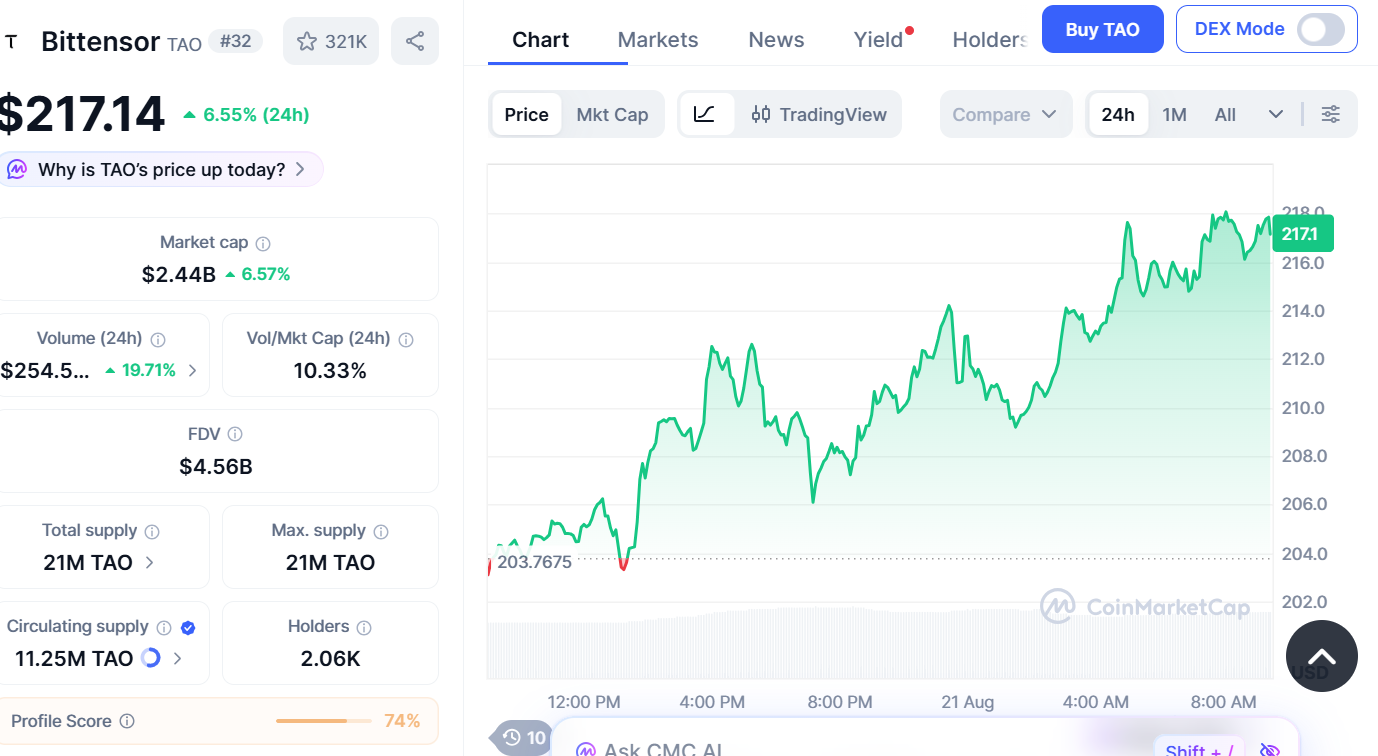
As of this writing, TAO trades at $217.14, up 6.55% in 24 hours, with a market cap of $2.44B and a circulating supply of 11.25M TAO out of a 21M max supply.
That scale of growth is a big reason Bittensor shows up near the top of most best AI coin 2026 shortlists.
Source: CoinMarketCap official website
Key Features
Open subnet marketplace where token emissions flow to the best performing AI services
The dTAO mechanism lets the market, not validators, decide which subnets get funded
Fixed 21 million supply cap with no pre-mine or VC allocation
Fast-growing developer base, per Electric Capital's 2026 ecosystem tracking
First reward halving already completed in December 2025, cutting daily TAO issuance in half
Primary Risk
Subnet revenue capture is still uneven.
One major subnet reportedly receives tens of millions in emissions while generating only a fraction of that in external revenue, a gap worth watching before treating TAO as a settled bet.
Render RENDER
Render Network connects studios and AI developers who need GPU power with node operators who have idle capacity to rent out.
Its Burn-and-Mint Equilibrium model ties token burns directly to completed jobs, giving RENDER a usage-linked economic function rather than a purely speculative one.
Per the Render Network Foundation's own reporting, the network coordinates roughly 5,600 GPU nodes worldwide.
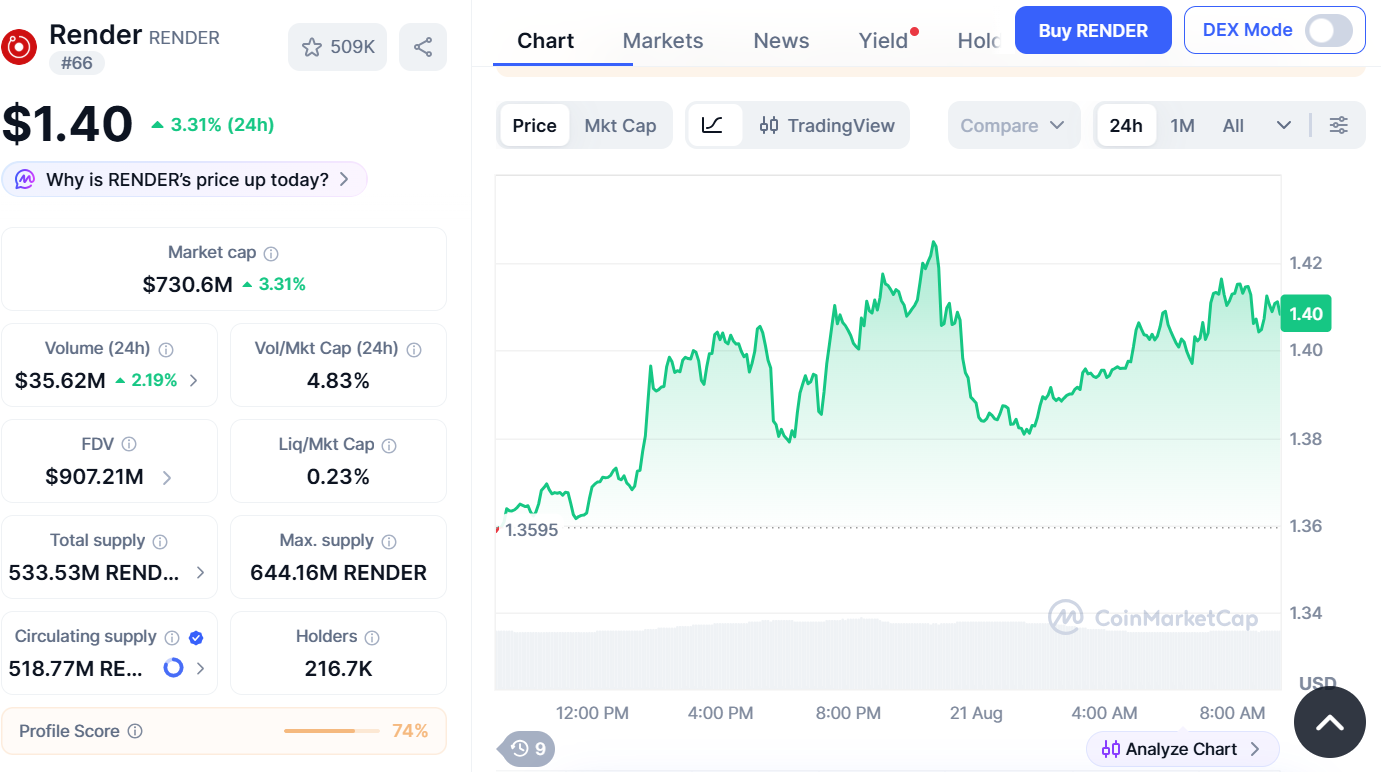
As of this writing, RENDER trades at $1.40, up 3.31% in 24 hours, with a market cap of $730.6M and a circulating supply of 518.77M RENDER out of a 644.16M max supply.
Source: CoinMarketCap official website
Key Features
Burn-and-Mint model that removes tokens from circulation with every completed job
Dual demand base spanning entertainment studios and AI compute clients
The dispersed product line extends the network toward general AI compute, not just rendering
Backed by OTOY, with an advisory board that includes established names in film and tech
Migrated to Solana in 2023, cutting transaction costs and settlement times for job payments
Primary Risk
RENDER still carries an ongoing emission schedule, so inflation from new token issuance can offset burn-driven demand if job volume growth slows.
Aethir ATH
Aethir positions itself as a decentralized alternative to AWS or Google Cloud for GPU-heavy AI workloads.
Enterprises book compute through the network instead of waiting on long hyperscaler contracts.
Aethir's own ecosystem reporting states the network operates more than 430,000 GPU containers, alongside a disclosed Q3 2025 annualized revenue figure north of $166 million.
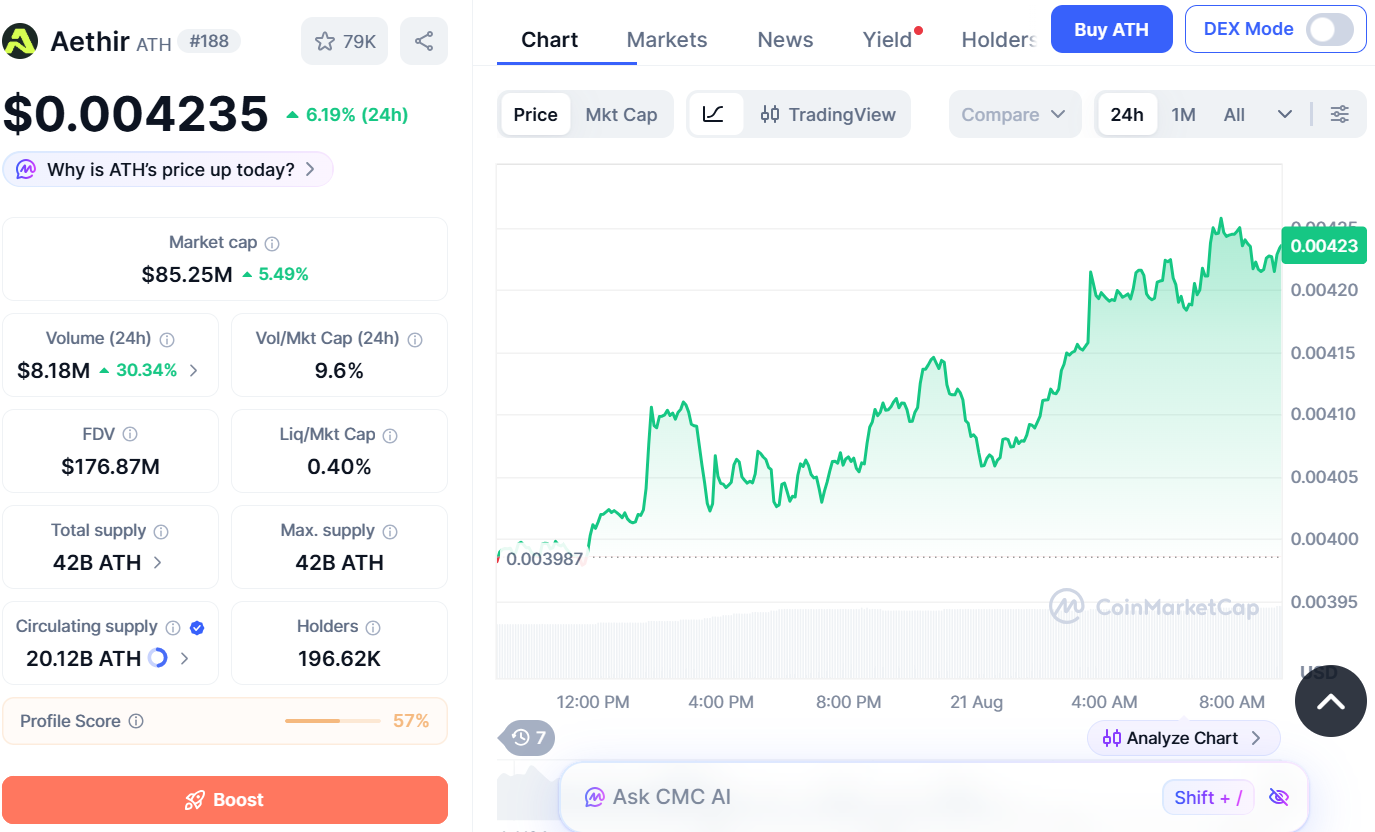
As of this writing, ATH trades at $0.004235, up 6.19% in 24 hours, with a market cap of $85.25M and a circulating supply of 20.12B ATH out of a 42B max supply.
Source: CoinMarketCap official website
Key Features
On-demand GPU-as-a-service model with no long-term contracts required
Checker Node system verifies uptime and service quality across the network
Geographic spread across 94 countries reduces reliance on any single region's GPU supply
Recently added support for newer NVIDIA hardware to serve enterprise inference workloads
The Strategic Compute Reserve mechanism aims to keep GPU availability predictable during demand spikes
Primary Risk
Aethir's usage figures come from its own disclosures rather than an independent auditor, and a meaningful share of its GPU capacity reportedly comes from a small number of large data-center operators, which is worth weighing against the network's decentralized branding.
Virtuals Protocol VIRTUAL
Virtuals Protocol focuses on a different layer of the stack, letting developers launch autonomous AI agents that can transact on-chain without constant human input.
This is one of the fastest-growing subsectors within AI crypto through 2026.
The project stated on its official X account that its agent economy passed $200 million in agent trading volume, with more than 5,600 agents launched.
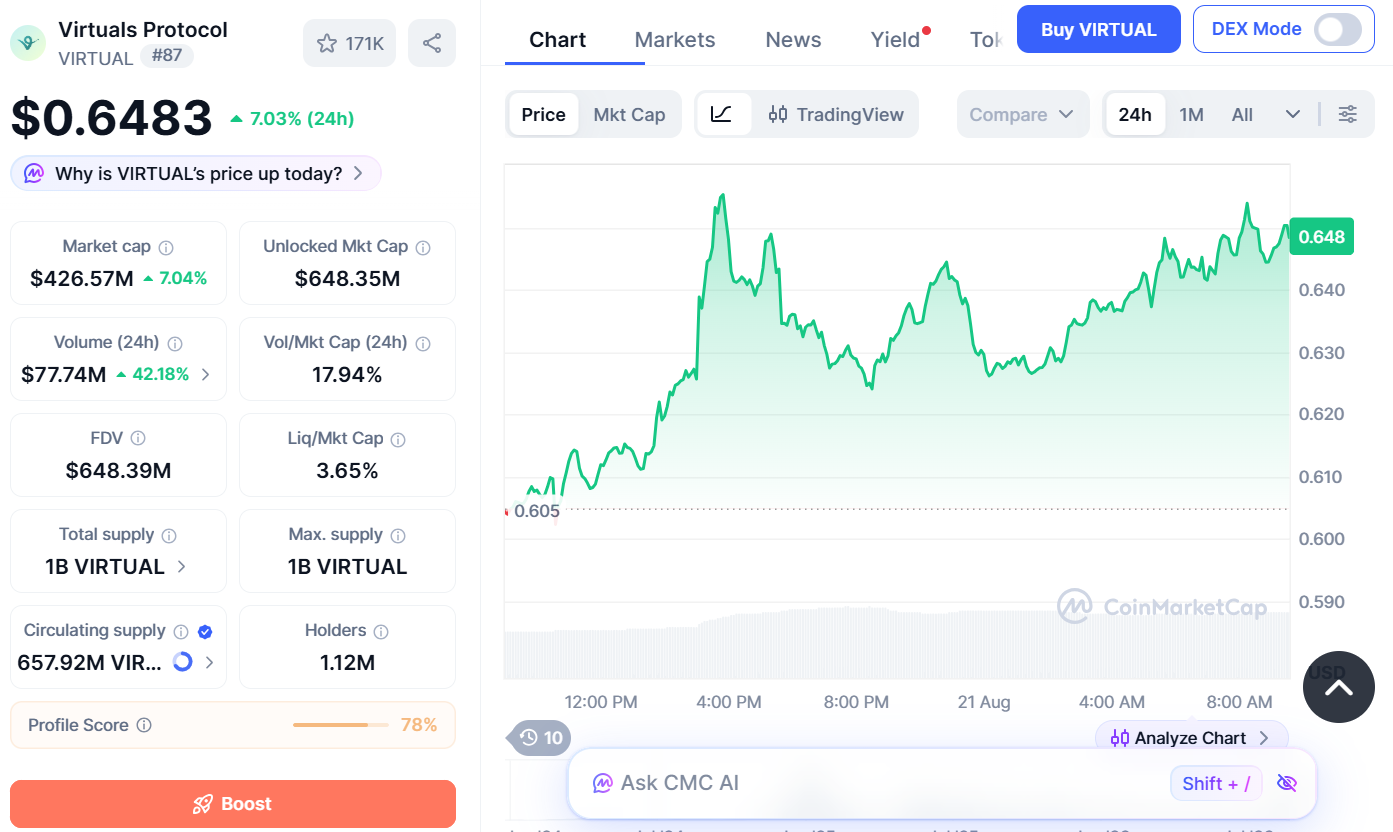
As of this writing, VIRTUAL trades at $0.6483, up 7.03% in 24 hours, with a market cap of $426.57M and a circulating supply of 657.92M VIRTUAL out of a 1B max supply.
Source: CoinMarketCap official website
Key Features
Infrastructure layer for launching and co-owning autonomous AI agents
Agents can hold wallets and transact independently once deployed
Active on both Base and Solana, widening its developer reach
Built-in tooling for agent creation without requiring deep technical expertise
Agent activity has expanded onto newer chains, including a recent integration with Robinhood Chain
Primary Risk
Virtuals' agent-volume figures come directly from the project rather than a neutral source, so they should be treated as a starting point for research rather than a verified external audit.
Grass GRASS
Grass takes a different approach entirely.
Instead of selling compute, it pays users for their idle internet bandwidth, which the network uses to scrape and structure public web data that AI labs can purchase for model training.
Independent research from Solana Compass puts Grass at roughly 2.5 million active nodes across 190 countries, with several terabytes of structured web data delivered daily to foundation model labs.
As of this writing, GRASS trades at $0.3096, up 8.04% in 24 hours, with a market cap of $75.53M and a circulating supply of 243.9M GRASS.
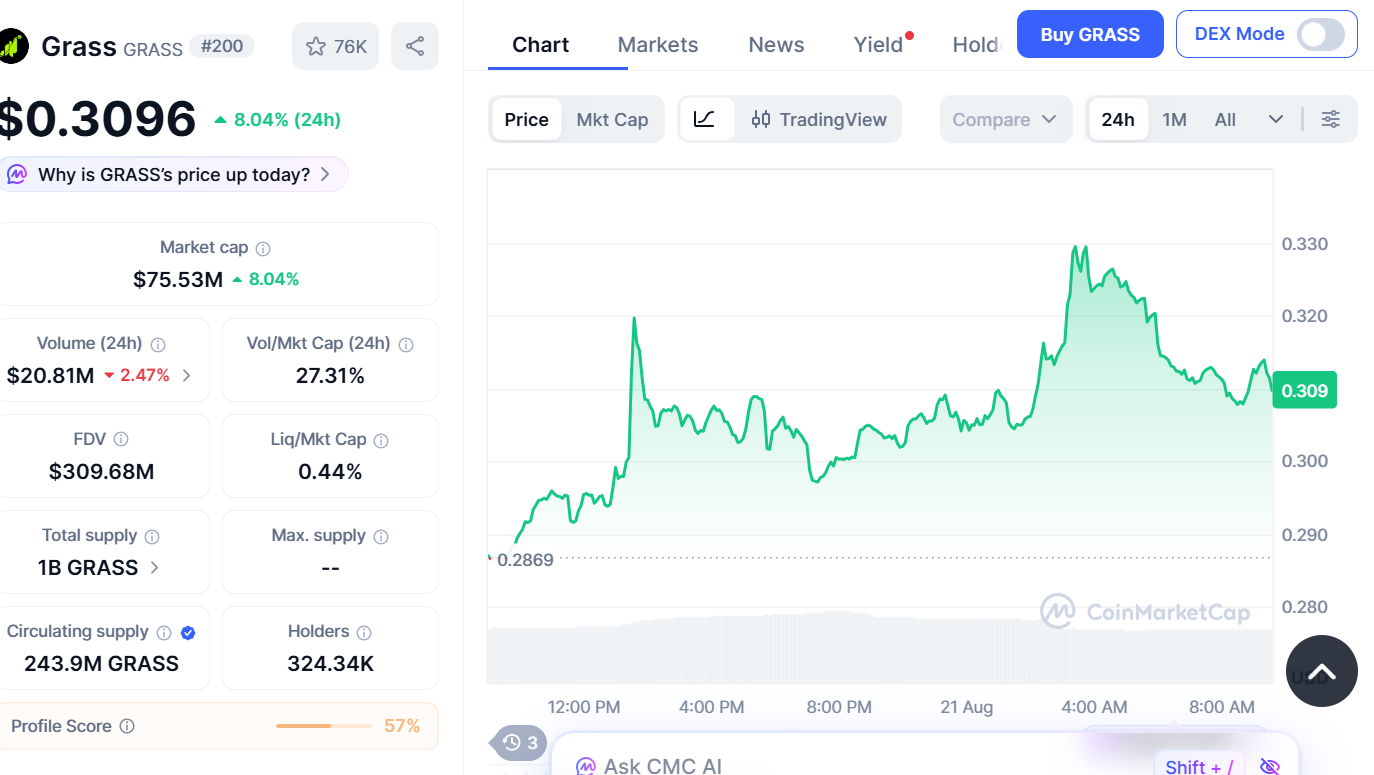
Source: CoinMarketCap official website
Key Features
Pays node operators in GRASS for sharing unused bandwidth
Zero-knowledge proofs verify that scraped data has not been tampered with
Structured data output is sold directly to AI labs, creating real demand for the token
Runs as a sovereign data rollup on Solana for scalability
Primary Risk
More than 60% of Grass nodes reportedly sit in just three countries, creating regional dependency risk if any single jurisdiction restricts bandwidth-sharing tools.
Risk Assessment
Every project on this list carries sector-wide risk that applies regardless of individual usage data.
AI token prices tend to move together during broad risk-off periods, so diversification within the category offers limited protection against a wider market downturn.
Token unlock schedules can also add persistent sell pressure even when usage metrics are improving, since early investors and team allocations often unlock on fixed calendar dates unrelated to network performance.
Anyone comparing the best AI coin 2026 options side by side should weigh unlock calendars alongside usage growth, not just the headline numbers a project chooses to promote.
Regulatory and Reporting Caveats
Regulatory treatment of DePIN-style networks, including how bandwidth-sharing or compute-leasing tokens get classified, is still developing in several major markets.
That uncertainty could affect exchange listings or how these tokens are treated for tax purposes depending on jurisdiction, since different regulators are approaching decentralized infrastructure tokens differently.
None of these projects should be treated as guaranteed winners.
Prices could rise or fall sharply based on factors well outside any single project's usage numbers, and analysts suggest position sizing should reflect that uncertainty rather than any single month's chart.
Self-reported metrics, in particular, deserve extra scrutiny since several figures cited above come directly from project foundations rather than independent auditors.
Cross-checking a project's own claims against a third-party explorer or analytics dashboard, where one exists, is a reasonable habit before allocating meaningful capital to any single name in this sector.
Expert Opinion
The current AI crypto sector is shifting from a narrative-driven phase into an accountability phase, where projects increasingly need to show usage data rather than lean solely on their AI branding.
Analysts covering this space note that networks publishing verifiable node counts, compute hours, or transaction volume, even when self-reported, are setting a new baseline that unaudited AI tickers will struggle to meet.
Projects that cannot point to any measurable activity are likely to face growing pressure from both investors and exchanges to disclose more, not less, over the coming quarters.
A Maturing Sector
This does not eliminate volatility or guarantee outcomes for any individual token.
It does suggest that the best AI coin 2026 conversation is maturing past pure hype cycles toward something closer to infrastructure analysis.
Investors who apply a usage-first filter consistently, rather than chasing whichever AI name is trending, are likely better positioned regardless of which project eventually leads the category.
Disclaimer: This article is for informational and educational purposes only and does not constitute financial, investment, or trading advice.
All coin prices, market capitalizations, and usage figures cited above reflect data available at the time this article was written and will change as markets move, so treat them as a snapshot rather than a live reference.
Cryptocurrency markets are highly volatile, and AI-sector tokens carry additional project-specific and regulatory risk.
Always conduct independent research and consult a licensed financial advisor before making investment decisions.






.webp)