Hypersui Crypto: Tokenomics, Allocation & Roadmap


HyperSui Crypto Explained: A Look at the Sui-Based DEX
Sui's DeFi scene keeps growing, and HyperSui crypto is one of the newer names getting attention in it. A native perpetual trading exchange for Sui, built around a utility token called $HYPESUI — that's the pitch, in short.
Bold pitches draw fast interest. That's exactly where readers should slow down and check the details themselves rather than take the marketing at face value.
Below is a breakdown of what the exchange is meant to do, how $HYPESUI's supply and vesting actually work, and where the roadmap really stands. Every figure comes from HyperSui's official site and GitBook documentation unless noted otherwise.
What Is HyperSui?
At its core, this is a non-custodial decentralized exchange built natively on Sui. Fast swaps, predictable execution, and a stable experience even in choppy markets — that's the stated focus.
Funds never leave a user's own wallet, per the documentation. Custody stays with the trader, not with the platform.
Three groups sit at the center of the design:
Traders get low fees and live quotes with slippage controls.
Liquidity providers get simple deposit and withdrawal flows plus fee accrual.
Builders get a stable router and public contract references once deployment happens.
Why Sui specifically? Low, steady gas costs and parallel transaction processing keep quotes fresher during fast-moving markets — at least according to the technical rationale HyperSui lays out in its docs.
Development right now is funded through a public token sale. Documented use of proceeds points to engineering, third-party audits, and operational readiness ahead of mainnet — not a promised return for buyers.
How Does the $HYPESUI Token Work?
Governance isn't part of the design here, and the documentation is upfront about it: $HYPESUI carries no governance or revenue rights.
What it does carry is utility. Holding the token, or clearing certain tier thresholds, is meant to lower trading costs and unlock product features.
That's a narrower scope than plenty of new DEX tokens attempt. Setting expectations this clearly before anyone looks at price is worth noting on its own.
HYPESUI Tokenomics Explained
Supply is fixed at 7,000,000,000 $HYPESUI. No inflation mechanism changes that number based on demand — it's a hard cap.
Pricing for the public sale follows a staged model, rising as each round fills. A single "current price" isn't published as a static figure anywhere in the official materials reviewed here — it shifts with each stage, so a number quoted today can be outdated within days. Checking HyperSui's own buy page directly is the only reliable way to get the live figure.
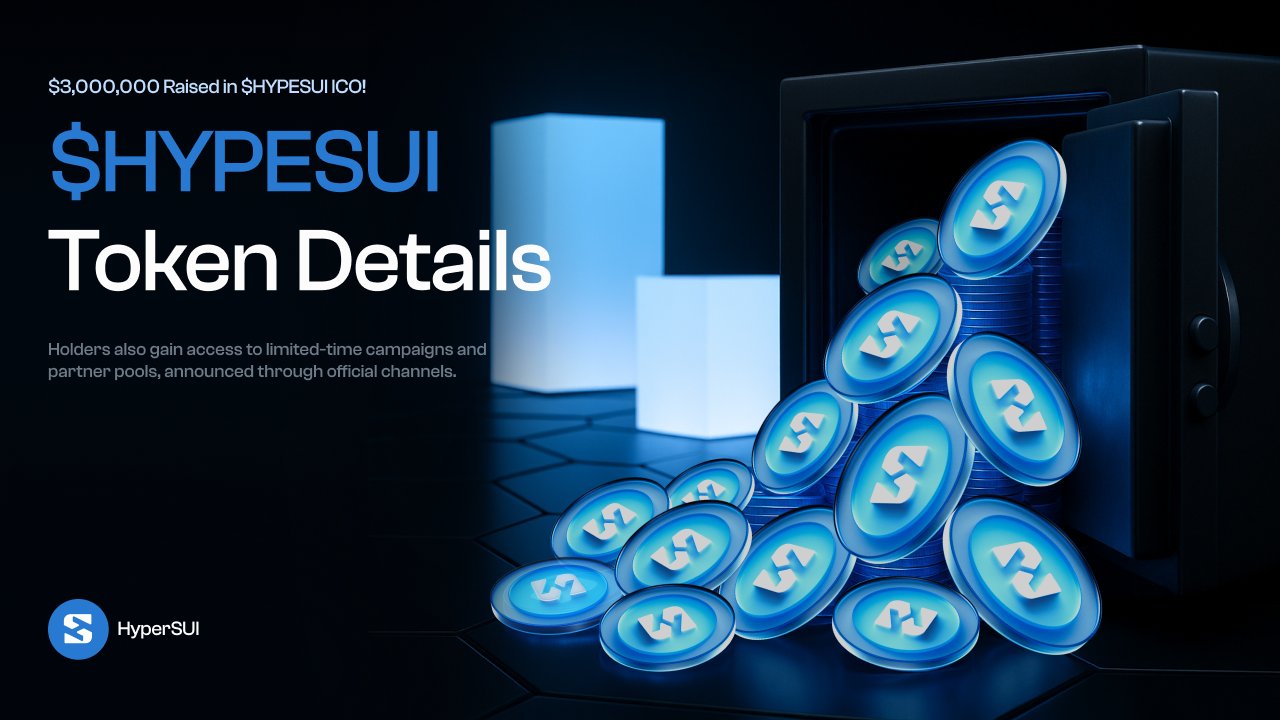
HYPESUI Token Allocation
Supply breaks down across seven categories:
Category | Allocation | Tokens |
Public Sale | 25% | 1,750,000,000 |
Ecosystem Growth | 25% | 1,750,000,000 |
Rewards | 15% | 1,050,000,000 |
Team & Advisors | 13% | 910,000,000 |
Liquidity Pool | 10% | 700,000,000 |
Treasury Fund | 7% | 490,000,000 |
Community & User Acquisition | 5% | 350,000,000 |
Source: HyperSui official documentation, token-and-safety section.
Half of total supply sits between two categories: Public Sale and Ecosystem Growth, each at a quarter of the total. The Ecosystem Growth slice is meant to fund partnerships and adoption pushes after launch, though how those funds actually get deployed is something to track over time rather than take on faith. A 13% Team and Advisors share, meanwhile, lands within normal range for the sector — neither unusually generous nor unusually tight.
HYPESUI Token Utility
Three concrete use cases show up across the documentation:
Trading-fee rebates — holding $HYPESUI or hitting a tier threshold lowers what a trader pays per trade.
LP economics boosts — qualifying users see a bigger personal share of pool rewards, without changing the pool's economics for anyone else.
Feature access — richer analytics, higher API limits, and entry to time-boxed campaigns.
Nothing here is framed as guaranteed income. It reads more like a discount-and-access layer tied to actual product usage than a yield product dressed up as a token.
HYPESUI Vesting & Unlocks
Percentages only tell part of the story. Vesting terms decide how fast that supply can actually reach the open market.
Category | TGE Unlock | Cliff | Vesting Period |
Public Sale | 15% | 0 months | 12 months |
Ecosystem Growth | 0% | 1 month | 36 months |
Rewards | 5% | 1 month | 24 months |
Team & Advisors | 0% | 3 months | 24 months |
Liquidity Pool | 10% | 0 months | 12 months |
Treasury Fund | 0% | 3 months | 36 months |
Community & User Acquisition | 0% | 2 months | 12 months |
Zero unlock at token generation for Team and Advisors, plus a 3-month cliff before anything starts vesting — that's a more conservative structure than seeing insiders cash out on day one, which some projects still allow.
Public Sale buyers see 15% released at launch, with the remaining 85% spread across 12 months. Even after listing, most of that allocation stays locked.
HyperSui Roadmap
Four broad phases carry the plan from early build work through to a full perpetual futures mainnet.
Early core DEX work and the public token sale mark the starting phase. Ecosystem partnerships and AI-layer integration follow next, then a spot trading beta paired with a perpetuals testnet, and finally mainnet perpetuals alongside a mobile app to close things out.
Sequence matters more than most readers assume. On-chain perpetual futures — arguably the headline feature — sits at the tail end of that plan, not the start.
HyperSui Roadmap 2026–2027
Phase by phase, with stated timing:
Foundation and launch — protocol development begins, the token sale opens, early core DEX and perpetual engine work starts.
Ecosystem and community growth — partnerships across Sui and EVM chains, community reward programs, AI Layer integration.
Product beta and perpetuals expansion — public spot trading beta, perpetual futures testnet.
Mobile and growth — perpetual futures mainnet launch, mobile app, developer SDK.
Comparisons to Hyperliquid come up often, and it's easy to see why — both center on self-custody and on-chain perpetuals. But Hyperliquid already runs live, high-volume markets today. HyperSui's version of that same feature is still sitting in a future phase, which makes the comparison aspirational rather than apples-to-apples right now.
How Tokenomics Supports the Roadmap
Vesting and roadmap timing appear designed to move in sync, at least on paper. Public Sale and Liquidity Pool tokens unlock fastest, which tracks with funding the early build and seeding trading liquidity.
A longer runway applies elsewhere. Team, Treasury, and Ecosystem Growth allocations vest across 24 to 36 months — well past the point where mainnet perpetuals are supposed to arrive. Read one way, that stretches out insider and treasury supply so it doesn't flood the market at once around listing.
Whether that alignment actually plays out depends on one thing: hitting the stated milestones on time. Good tokenomics design can still fall short of its intended effect if the roadmap slips.
HyperSui Tokenomics: Key Strengths and Risks
What looks solid:
A fixed, transparent supply with a full allocation and vesting table published
Zero Team and Advisor unlock at TGE
A treasury and fee policy that includes monthly public reporting, per the docs
What deserves caution:
The core perpetual trading product isn't live yet, so a good chunk of token utility is still forward-looking
Public Sale, Rewards, and Liquidity unlocks will keep adding sell-side supply over the following year
Ordinary DeFi risks still apply — smart contract bugs, thin early liquidity, phishing around new token launches
Documentation depth is the clear strength here — few early-stage projects lay out vesting terms specifically. The catch is that a meaningful share of the token's actual usefulness hinges on a product that hasn't shipped.
What's Next for HyperSui?
Two milestones stand out as the next real checkpoints: the spot trading beta and the perpetual futures testnet. Both are supposed to arrive before mainnet perpetuals, and both would give outsiders their first genuine look at whether the product performs the way it's described.
Audit reports, testnet activity, and changelog entries are worth watching directly. Marketing claims alone won't confirm any of it.
Conclusion
A non-custodial perpetual DEX on Sui, currently funded through a staged public token sale — that's what HyperSui amounts to today. Confirmed: a fixed 7 billion token supply, a detailed allocation and vesting table, and a roadmap that pushes full perpetual trading to a later phase rather than launch. Unproven: execution, and whether real usage shows up once the product actually ships.
Verifying current pricing, audit status, and roadmap progress through official channels is worth doing before forming any view on this one.
Disclaimer
This article is for informational purposes only and isn't financial advice. Crypto token sales carry high risk, including possible loss of funds. Always verify details through official sources and consult a licensed financial advisor before investing.







.webp)