Oxin Chain Tokenomics: How OXIN and OUSD Supply Works

Oxin Chain Tokenomics: Understanding OXIN and OUSD
Oxin Chain has built its pitch around one idea: mine crypto from your phone, no rig required. But before anyone mines a token, it helps to know what that token is actually worth mining. Oxin Chain tokenomics splits the project's economy into two assets, OXIN and OUSD, with a fixed allocation model and a burn mechanism layered on top.
Most of what's public right now comes straight from the project itself. There's no live exchange listing and no mainnet yet. So the numbers below come from Oxin Chain's own whitepaper and website, checked against each other, as of late August 2026. Every figure here reflects a stated plan from the project.
What Is Oxin-Chain and How Does Its Ecosystem Work?
Oxin-Chain describes itself as a Layer-1, EVM compatible blockchain built around mobile mining. According to the project's whitepaper, it uses a consensus model called Proof of Community (PoC), which the team says blends Delegated Proof of Stake with Proof of Activity.
In practice, that means two types of participants:
Validators, who stake-OXIN to process and confirm transactions.
Mobile miners, who check in daily through the Miner app or website to earn rewards, without draining battery or data.
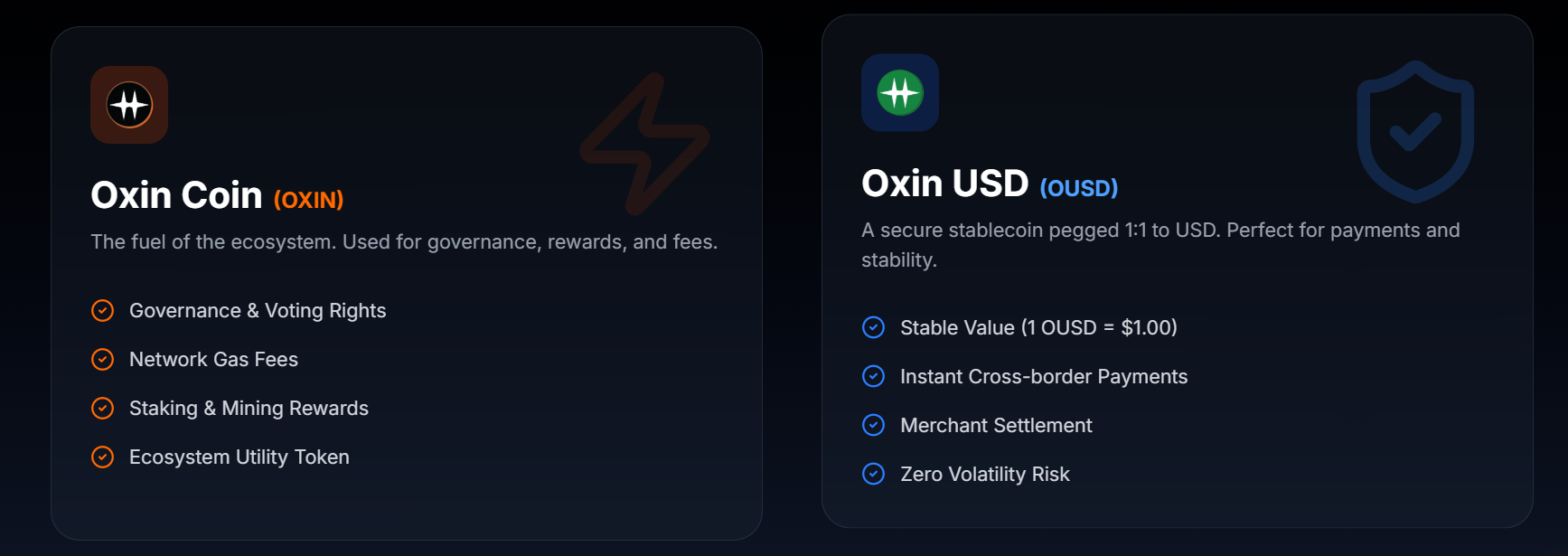
The project also runs a dual-token model. OXIN is the native coin used for gas, staking, and governance. OUSD is a stablecoin the project says is soft-pegged to the US dollar. It is currently in what it calls its "Mining Era" phase, with mainnet, audits, and exchange listings described as upcoming on its own roadmap.
How Is OXIN-Supply Allocated?
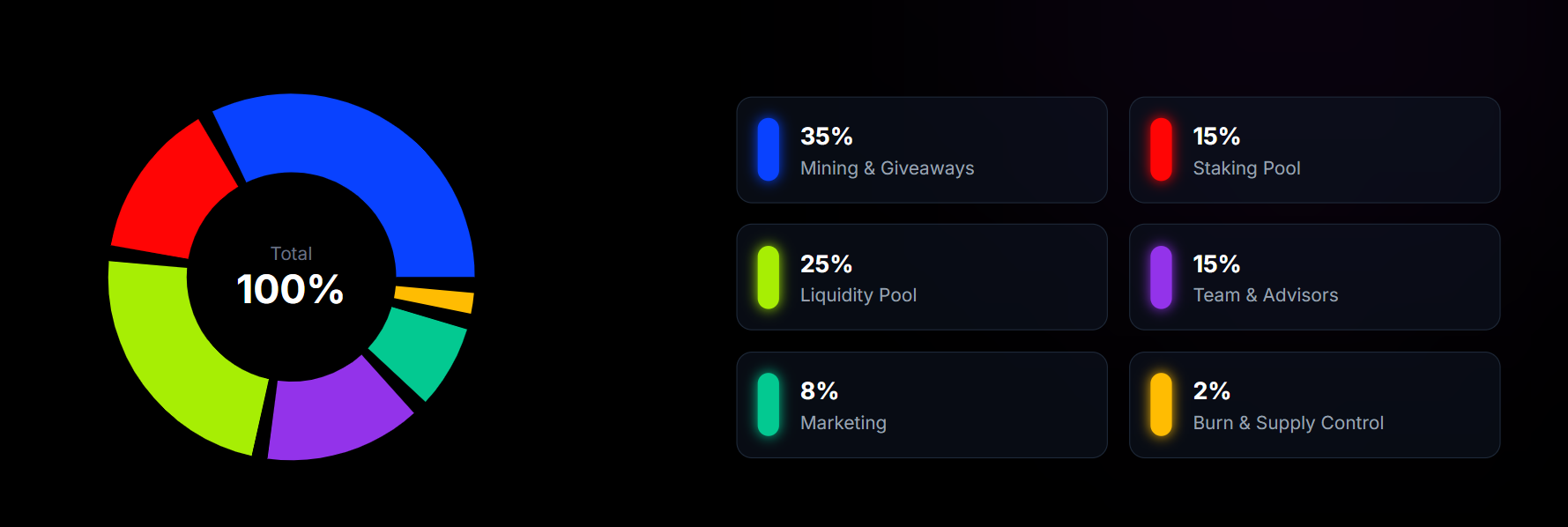
The whitepaper lays out a six-way split for It's total allocation. Here's how the project describes it:
Allocation | Percentage | Stated Purpose |
Mining & Giveaway | 35% | Rewards for mobile miners and early adopters via Proof of Activity |
Ecosystem & Liquidity | 25% | DEX/CEX liquidity and developer grants |
Staking Pool | 15% | Incentives for validators and stakers |
Team & Advisors | 15% | Core team, locked 1 year then vested linearly over 24 months |
Marketing & Partnerships | 8% | Brand awareness and strategic alliances |
Burn & Supply Control | 2% | Treasury reserve for contingencies |
Community-facing allocations (mining, staking, liquidity) add up to 75% of supply. The 15% team allocation carries a one-year lock and a 24-month linear vesting schedule, according to the whitepaper.
Elsewhere in the same document, a separate section on mining halving refers to a "40%" mining allocation, while the allocation table itself lists mining at 35%. Both figures appear in the project's own whitepaper.
The whitepaper does not list a specific max supply figure for-OXIN in the version reviewed for this article (v1.0.0, dated December 2025). Circulating supply figures are not published either, since there is no live block explorer yet.
How Does the Oxin-Chain Burn Mechanism Work?
Token burning is when coins are permanently removed from circulation, usually by sending them to a wallet no one can access. Oxin-Chain says it burns OXIN-token in two ways.
Transaction fee burn. The project says a portion of every gas fee, roughly half of the base fee, is burned automatically by the protocol.
Revenue-based buyback and burn. It's ad network, built into the mining app, is meant to generate ad revenue. The project says 100% of net profit from that advertising is used to buy-OXIN on the open market and burn it.
The stated goal is to tie token scarcity to app usage rather than pure speculation. This depends on the ad network generating ongoing revenue, which is part of the project's own model.
What Is OUSD and How Does It Work With OXIN?
OUSD is Oxin Chain's stablecoin, aimed at 1 OUSD ≈ $1.00. According to the whitepaper, users can mint OUSD by burning-OXIN when its price is high, and redeem OXIN-token by burning OUSD when the stablecoin needs support. The project says OUSD is backed by a reserve of crypto assets plus algorithmic mechanisms inside an "Oxin-Treasury."
This is an algorithmic-leaning stablecoin design, rather than one backed 1:1 by cash reserves in a bank. That's the mechanism as the project describes it in its whitepaper.
How Does Oxin-Chain Staking Work?
Oxin Chain's site includes a staking calculator, with lock periods described as ranging from three months to two years. The project's own materials state an APY of up to 36% for staking-OXIN.
15% of total token supply is earmarked for the staking pool, per the whitepaper's allocation table. The project has not published a detailed emissions curve for staking the way it has for mobile mining.
How Does the Oxin-Chain Roadmap Shape OXIN’s Future?
Oxin Chain's roadmap places mainnet launch, the Token Generation Event (TGE), security audits, and exchange listings in its "Global Grid Activation" phase, dated 2026/2027 on the project's own site. The allocation percentages, burn totals, and staking rewards described above are tied to that roadmap and to the network reaching those later phases.
Two roadmap phases, listed as "Phase 4: Project 'Stability'" and "Phase 6: The Oxin-Zenith," are described only as "Classified" or under "strict NDA" on Oxin Chain's website. Details of what those phases involve for tokenomics have not been published yet.
Conclusion
Oxin Chain's tokenomics follow a fairly standard structure for a mobile-mining project: a majority of token supply set aside for miners, stakers, and liquidity, a smaller cut for the team under a vesting lock, and a stablecoin (OUSD) meant to handle payments separately from the native coin. The burn mechanism is tied to both gas fees and ad revenue, as described in the whitepaper.
The supply split, burn structure, and staking terms discussed here all come from it's own whitepaper and website. The project's roadmap places mainnet, audits, and exchange listings in later phases that have not been completed yet.
Disclaimer
This article is for informational purposes only and does not constitute financial advice. Cryptocurrencies are highly volatile and carry risk of loss. Always do your own research before making any financial decision.







.webp)




