Solana Staking: How It Works, Rewards and Risks

What Makes Solana Staking Worth Exploring?
Something like two out of every three SOL tokens in circulation are currently staked, based on data from crypto staking trackers as of mid-2026. That's a lot of supply sitting with validators instead of just idling in wallets.
It tells you something about how holders are behaving. People aren't just buying and forgetting about SOL. A large share of them are actively delegating it.
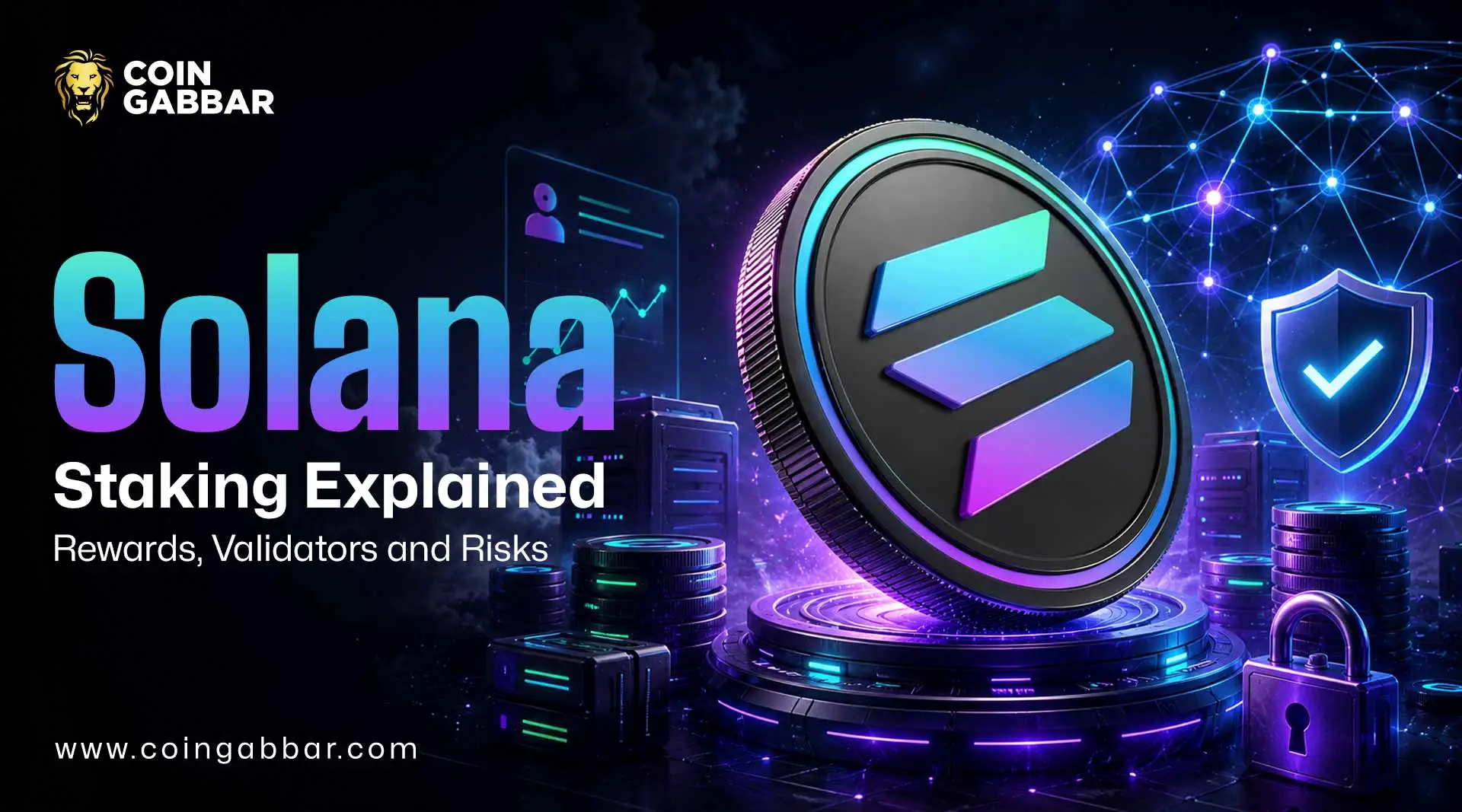
Solana staking, in plain terms, is locking your SOL with a validator so it helps secure the network. In exchange, you get a cut of the new SOL the network issues as rewards.
This guide walks through how staking-actually works on Solana, what kind of returns are realistic today, and where things can go wrong. It's not the same as parking cash in a savings account, and it shouldn't be treated that way.
What Is Proof of Stake and How Does Solana Use It?
Solana runs on Proof of Stake, or PoS. Strip away the jargon and it's just the system that decides which transactions make it onto the blockchain, and in what order.
Validators are the machines running this process. They vote on which blocks get confirmed, and the amount of SOL-delegated to a validator determines how much weight its votes carry.
That's the role staking-plays. Delegating SOL to a validator doesn't hand over ownership of your tokens — you keep full control. What you're really doing is lending your stake-weight to back that validator's votes in the network.
How Do Solana Validators Work and Earn Rewards?
A validator's job is to process incoming transactions and vote on new blocks. Each vote that gets confirmed earns it a "vote credit," and those credits are what determine how rewards get split between the validator and everyone delegated to it.
Validators also take a cut, known as commission, typically somewhere between 0% and 10% according to network data. That fee comes out before the rest of the rewards reach delegators.
Two things matter most when picking a validator:
Uptime and vote success rate – a validator that misses votes earns fewer rewards for everyone delegated to it
Commission rate – higher commission means a smaller share of rewards for you, though extremely low commission can sometimes signal an unsustainable setup
How to Stake SOL: A Step-by-Step Guide
The steps are more straightforward than the terminology suggests.
Move SOL into a stake account: This is a separate account from your regular wallet balance, created specifically to hold staked tokens.
Delegate the stake account to a validator: A single stake account can only be delegated to one validator at a time.
Wait for activation: The newly delegated stake is "activating" until the start of the next epoch, which is roughly two days long, according to Solana's own documentation.
Earn rewards each epoch: Once active, rewards are calculated and paid automatically into the stake account.
Undelegate when you want out: The stake account enters a "deactivating" or cooling-down state until the next epoch boundary, after which the tokens become withdrawable.
How Much Can You Earn From Solana Staking in 2026?
Rewards trace back to Solana's inflation schedule. Per the network's published design, inflation started at 8% annually, steps down by 15% each year, and is meant to eventually settle at a long-term rate of 1.5%.
Inflation Parameter | Stated Value | Purpose |
Initial inflation rate | 8% annually | Starting point after rewards launched |
Disinflation rate | -15% per year | Rate at which inflation steps down |
Long-term inflation rate | 1.5% annually | Target floor for issuance |
That's the official design, but it's not the same thing as your actual staking-yield. What you earn also depends on how much total SOL is staked network-wide, plus your validator's uptime and commission.
What Are the Risks of Solana Staking?
Staking isn't risk-free, and treating it like a fixed-income product would be a mistake.
Price risk stays intact: Staking-rewards don't protect you from SOL's price moving against you. If SOL drops 20%, your staking-yield doesn't offset that.
Slashing exists, but works differently here: On many Proof of Stake networks, slashing automatically destroys a portion of a validator's stake for bad behavior. Solana's own FAQ states slashing is not automatic on the network today, and that a validator could be slashed if it causes the network to halt and is penalized on restart. Future protocol changes could alter how this works.
Validator selection matters: If you delegate to a validator with poor uptime, your rewards shrink even though your principal generally isn't at risk in normal conditions.
Liquidity is not instant: Undelegating takes at least one epoch to process. You can't withdraw staked SOL the moment you decide to unstake.
Smart contract risk applies to liquid staking: If you use a liquid staking-token instead of staking natively, you're adding exposure to that protocol's smart contracts on top of normal staking-risk.
None of this means staking is dangerous by default. It means it carries a different risk profile than simply holding SOL in a wallet.
Native vs Liquid-Staking: Which Solana Staking Option Is Better?
Native-staking is the straightforward version — you delegate SOL directly to a validator through a stake account. Your tokens are locked, and the only thing you get back is the rewards accruing in that same account.
Liquid staking adds a layer. You deposit SOL into a staking-protocol and get a liquid-staking-token (LST) in return, representing your staked position. That token can then be used elsewhere in DeFi, so in theory your capital keeps working even while it's staked.
The catch is added complexity. You're now trusting that protocol's smart contracts, its peg mechanism, and its own choices about which validators to use. Liquid staking-tokens can also trade at a slight discount or premium to SOL-depending on market conditions at any given time.
Neither approach is clearly better than the other. It comes down to whether you'd rather keep things simple or stay flexible.
What Does the Data Say About Solana Staking Right Now?
The stronger signal here is participation, not price. With a large majority of circulating SOL already staked, most long-term holders are choosing to delegate rather than just sit on their tokens, and that says more about network conviction than any single yield number does.
The bigger question mark is where yield goes next. Disinflation is already baked into the design, and it could speed up further if the proposed governance changes go through, so the rate you see today probably isn't the rate you'll see a year from now. Before delegating, it's worth checking a validator's actual uptime and commission yourself, confirming your wallet supports staking, and deciding whether native staking or a liquid staking-token fits how you actually plan to use your SOL.
Conclusion
Solana staking lets SOL holders earn rewards by delegating tokens to validators who help keep the network secure. The mechanics are all publicly documented — stake accounts, epochs, validator commission, and an inflation schedule that gradually steps down toward a 1.5% long-term rate.
Yield estimates currently sit in the mid-single digits, but that number moves with network conditions and could fall further if inflation-related governance proposals get adopted. The main risks come down to validator underperformance, delays getting your SOL back after unstaking, and added smart contract exposure if you go the liquid staking-route.
Before delegating anything, check a validator's uptime and commission, make sure your wallet actually supports staking, and decide whether native or liquid staking fits how you plan to use your SOL.
Disclaimer
This article is for informational purposes only and does not constitute financial advice. Staking-involves risk, including price volatility and potential loss of value. Always research validators and platforms independently before staking any assets.
Also read:









.webp)




