Torium Network Halving: What Happens Every 100M TOR Mined?

Most crypto mining projects treat halving as a single, dramatic cliff edge. Torium Network does something different.
Instead of one big cut, mining rewards step down gradually as global participation grows, and the entire schedule is mapped out in advance.
For anyone currently running a session on the Torium app, that raises a practical question: what actually happens to your hourly rate once the network crosses each new threshold, and does every part of your earnings shrink at the same pace? The short answer is no.
Some pieces of the Torium Network halving model move together.
Others decay on their own separate curve entirely, which is where most confusion about future mining rates tends to start.
What Triggers a Torium Network Halving Event?
Torium's halving is not tied to time or block height. According to the whitepaper, the trigger is cumulative coins mined globally, checked each time a user claims a completed session.
Every time the network crosses a 100,000,000-coin threshold, the active era increments, and a new multiplier applies to sessions created after that point.
The official white paper explicitly says the system checks the global mined total after a completed session is claimed and increments the era if the 100M threshold has been crossed.
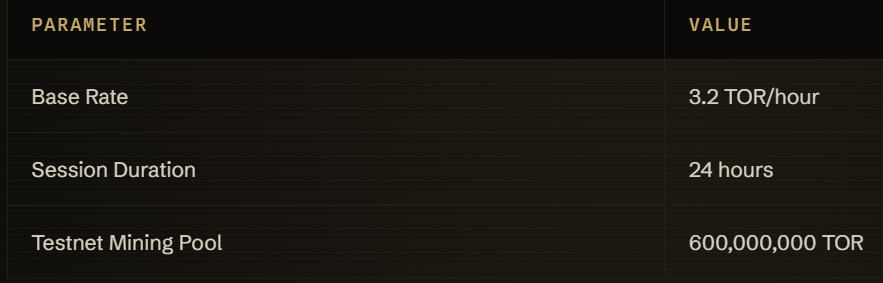
Six eras cover the full 600,000,000-coin testnet mining pool, so the entire Torium Network Split schedule is fixed in advance rather than adjusted later.
Sessions already running when a threshold is crossed keep their original Price. it calls this session-locked fairness, meaning nobody is penalized mid-session for the network's overall growth.
How Does the Torium Halving Schedule Work Across Six Eras?
The clearest way to see the Split model in action is era by era. Each of the six eras distributes exactly 100,000,000 coins before handing off to the next.
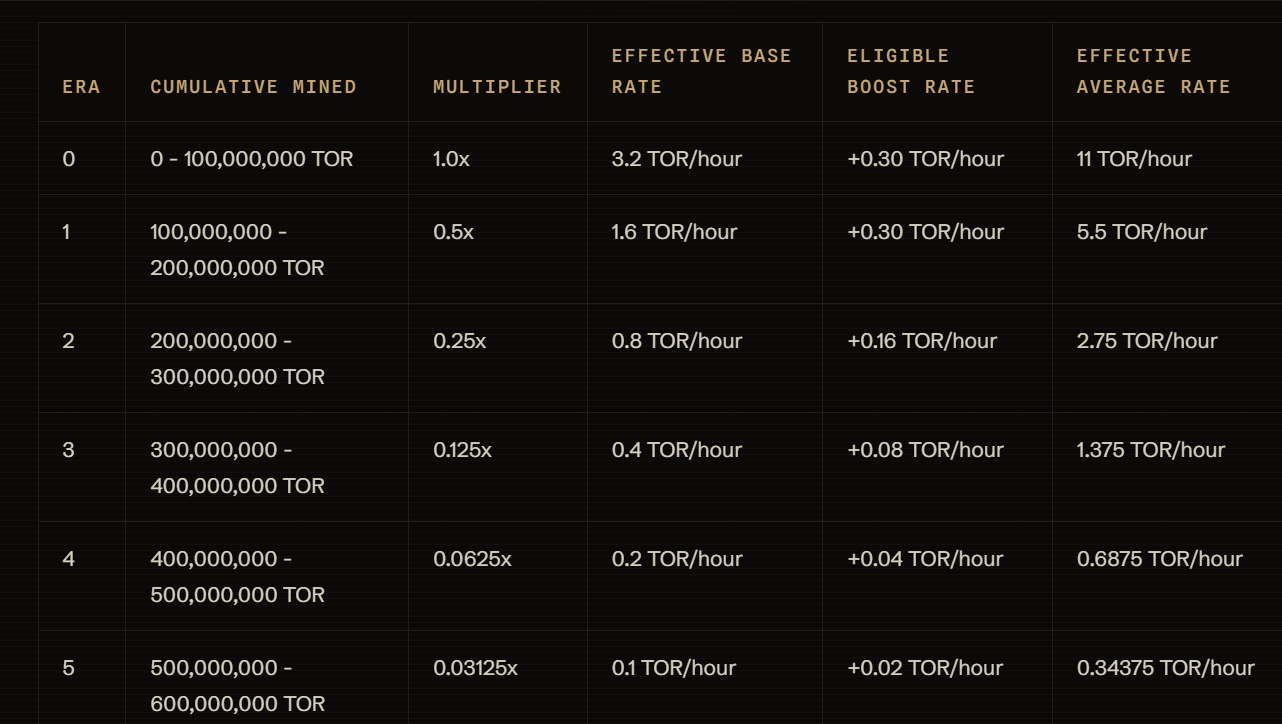
Era | Cumulative Mined (M) | Multiplier | Base Rate (per hr) | Boost Rate (per hr) | Avg Rate (per hr) |
0 | 0-100 | 1.0x | 3.2 | +0.30 | 11 |
1 | 100-200 | 0.5x | 1.6 | +0.30 | 5.5 |
2 | 200-300 | 0.25x | 0.8 | +0.16 | 2.75 |
3 | 300-400 | 0.125x | 0.4 | +0.08 | 1.375 |
4 | 400-500 | 0.0625x | 0.2 | +0.04 | 0.6875 |
5 | 500-600 | 0.03125x | 0.1 | +0.02 | 0.34375 |
Figures in TOR. Each era spans 100,000,000 TOR of cumulative mining.
By Era 5, the average hourly rate has fallen to roughly 3% of where the Torium Network halving schedule started, though the decline is front-loaded rather than steady across all six stages.
What Is Torium's Current Mining Rate in Era 0?
The Torium Network is currently in Era 0, the first of six halving eras under the its Network halving schedule.
The base mining rate is 3.2 TOR per hour, boosts add up to 0.30 per hour, and the reference average sits near 11 TOR/hour.
This Price applies until the cumulative mined total crosses 100,000,000.
Why Do Mining Boosts Decay Differently Than Base Rewards?
Base mining and session boosts do not follow identical curves under the Torium Network halving model.
The base rate halves exactly in half at every era, moving from 3.2 down to 0.1 TOR per hour by Era 5. Sources official X tweet
Boost rates behave differently. They hold flat at +0.30 TOR per hour through both Era 0 and 1, covering the first 200,000,000 coins mined, and only begin Split from Era 2 onward.
That gap explains why two users mining in different eras can see boost contributions that look proportionally larger or smaller relative to their base Price.
Referral tier bonuses and other rate additions are halved alongside base mining, but percentage-based streak and task boosts scale naturally since they are calculated from whatever the current rate happens to be.
How Does Proof of Participation Halving Affect Referral Earnings?
Referral income is not exempt from the schedule.
Under the planned framework, referral tier bonuses, which range from +0.5 TOR per hour at 20 referrals up to +2.0 TOR per hour at 100 or more, are halved at the same rate as base mining under this Proof of Participation halving structure.
Referral earnings tied to a referred user's output also scale from that user's era-adjusted mining rate when Split is active, rather than a fixed value set at signup.
That keeps referral rewards consistent with whatever era the network happens to be in at claim time, instead of paying out figures that no longer match current network conditions.
What Happens When the Torium Testnet Mining Pool Runs Out?
The six eras are designed to exhaust the entire 600,000,000-coin testnet allocation. Once the testnet mining pool is fully mined, testnet mining stops for everyone.
Users keep every coin balance already earned. According to Torium's white paper, pre-mainnet balances then convert 1:1 into mainnet TOR at the Token Generation Event, separate from a newly opened 400,000,000-coin mainnet mining pool with its own parameters.
Ecosystem and marketing rewards, including referral onboarding incentives and campaign payouts, are funded from a different allocation entirely and continue regardless of where the halving schedule stands.
Expert Opinion
From a token-emission perspective, the published schedule gives earlier eras higher nominal mining rates than later eras.
The slower decline of certain boost mechanics may also keep participation incentives relevant as the base rate falls
The gap between base-rate Split and the slower-decaying boost curve appears designed to keep short-term engagement mechanics relevant even as raw mining yield drops.
Whether the reference average of 11 TOR per hour in Era 0 holds in practice depends on real referral growth and boost eligibility, both of which vary by user rather than being guaranteed.
The broader test for the Torium Network could be whether utility features are planned for the mainnet.
The broader test for the Torium Network will be whether planned utility features such as Torium Pay and Scan & Earn develop meaningful use cases as mining rewards decline
Disclaimer
This article is for informational purposes only and does not constitute financial or investment advice.
Mining rates, halving mechanics, and reward figures reflect Torium Network's published whitepaper and website as of writing and may change.
TOR is a utility coin, and mainnet launch, exchange listings, and future value are not guaranteed, so outcomes may vary.







.webp)