Arthur Hayes FLOP Token: Tokenomics, Airdrop and 2027 Launch Details


Arthur Hayes FLOP Token News: Whitepaper Delayed as Tokenomics Develop
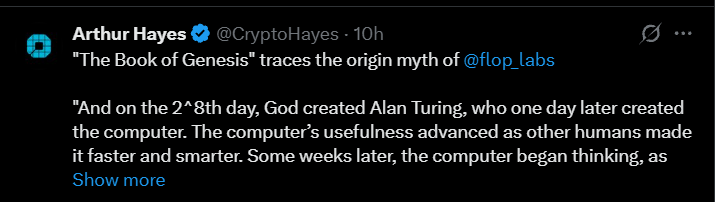
Arthur Hayes, the co-founder of BitMEX, has published a new essay titled "The Book of Genesis," introducing a project called the Flop Network. The piece lays out his vision for a decentralized AI computing market and explains why he believes the Arthur Hayes FLOP Token could become a foundational piece of infrastructure for the AI agent economy. The article, framed in a mix of storytelling and market theory, sets up a simple question: what is FLOP, and why is Hayes building it?
Arthur Hayes Reveals FLOP Network
The core announcement is straightforward. He wants to build a marketplace where computing power is priced according to actual floating-point operations, or FLOPs, rather than the abstracted pricing models used by most AI providers today.
It is meant to serve as the network's native settlement currency, connecting AI agents, miners, and validators around a shared, transparent unit of compute.
What Is FLOP Token and How Will It Work?
In simple terms, AI agents would use tokens to buy computing power and pay for inference. Miners earn by supplying compute to the network, while validators check that the work was actually delivered and help keep the system secure. The broader idea is to give AI agents a way to access compute without depending entirely on traditional payment rails like credit cards or bank transfers.
Network at a Glance
| Feature | Key Details |
| Project | Flop Network |
| Founder/Leader | |
| Native Token | $FLOP |
| Main Purpose | Decentralized AI computing marketplace |
| Compute Measurement | FLOPs / actual computing power |
| AI Agents | Spend on compute and network services |
| Miners | Provide computing power and earn FLOPs |
| Validators | Verify work and help secure the network |
| Presale | No presale planned |
| VC Funding | No VCs, according to Hayes |
| Launch Model | 100% fair launch |
| Community Allocation | Roughly 20% planned for testnet and network participants over the long term |
| Expected Genesis Block | Q1 2027 |
| Expected Major Crypto Airdrop | Q4 2026 |
Why Arthur Says FLOP Could Become "Food" for AI Agents
Hayes argues that compute is the resource AI agents fundamentally need to function, much like food sustains a living being. He points out that current AI pricing is inconsistent, since each provider defines and charges for tokens differently, making it hard for users or agents to compare true costs across platforms. His proposed fix is a standardized market where compute is priced directly in FLOPs, with the token representing a claim on that computing power.
The Goal of a Decentralized AI Compute Market
The flow he describes is fairly simple: agents submit requests for compute, pay in crypto, miners fulfill those requests, and validators confirm the work was done correctly. The intent is to keep this explanation approachable rather than deeply technical.
No Presale or VCs: Arthur Hayes Promises a Fair Launch
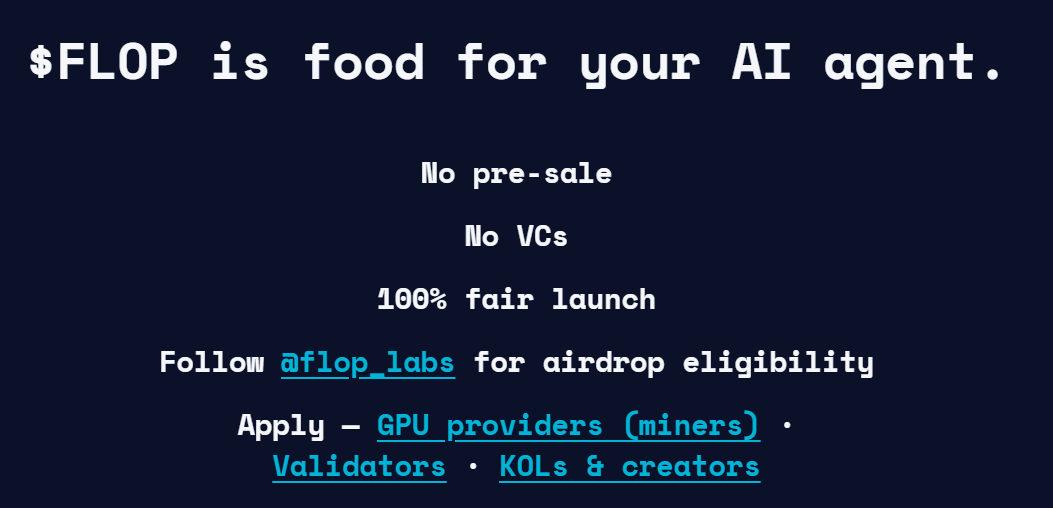
This part of the announcement is likely to draw the most attention from crypto audiences. Hayes says he is self-funding the team building the Network, which removes the need for an early token presale. He has also stated there will be no venture capital allocation, positioning tokens as a fully fair-launch token aimed at rewarding people who actually contribute to the network.
Around 20% of FLOP Supply Planned for Network Participants
Roughly a fifth of the token supply is expected to go toward long-term distribution among participants, including testnet users and other contributors. Hayes has also teased a sizable airdrop, though he has been clear that final tokenomics are still being worked out.
FLOP Whitepaper Still Pending as Team Finalizes Tokenomics
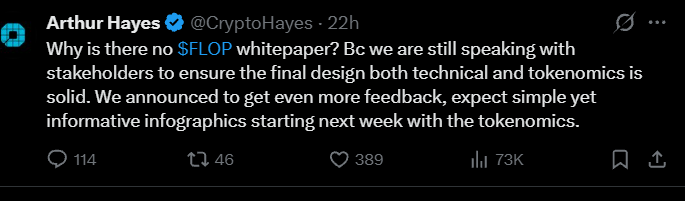
A formal whitepaper hasn't been released yet. Hayes has said the team is still in conversation with stakeholders to lock down both the technical architecture and the token economics. A simplified tokenomics infographic is expected to roll out the following week.
What Arthur Hayes Has Confirmed So Far
-
No presale
-
No VCs
-
Fair launch
-
The network used for compute and network services
-
Community-focused distribution planned
-
Full FLOP tokenomics still in progress
Arthur Hayes Project Timeline
-
August 18, 2026: The founder announces he is leading Labs and introduces the Network concept.
-
August 19, 2026: He confirms the whitepaper isn't ready yet and previews a tokenomics infographic for the following week.
-
August 20, 2026: "The Book of Genesis" is published, expanding on the Network's design and purpose.
-
Q4 2026: A major FLOP airdrop is expected.
-
Q1 2027: The network's genesis block is expected to go live.
What Comes Next for Arthur Project?
The tokenomics infographic is the next concrete milestone to watch, followed by the full whitepaper. Beyond that, the project still needs to detail exactly how supply, mining, and validation will function at scale. The planned airdrop and testnet participation are likely to be the biggest draws for early community members as the Q1 2027 genesis block approaches.
Conclusion
The network proposes an ambitious idea: a native currency built specifically to let AI agents pay for computing power in a decentralized, transparent way. Its no-presale, no-VC, fair-launch structure gives it a distinct crypto-native angle, while its link to the growing AI agent economy broadens its appeal beyond typical token launches.
With the whitepaper and finalized tokenomics still pending, upcoming updates from Labs will be key to understanding how the token and network actually operate in practice.
YMYL Disclaimer: This article is for informational purposes only and does not constitute financial, investment, or trading advice. Cryptocurrency markets are highly volatile and carry significant risk. Always conduct your own research before making any investment decisions.
Also read:







