Trump Economic D-Day Iran Escalates Pressure Amid Iran War

Trump Economic D-Day Iran: Economic Warfare Intensifies Amid Iran War
President Donald Trump announced what he called the most crushing operation ever taken against a country, targeting Tehran in a post shared on his Truth Social account on August 19, 2026.
The Trump economic D-Day Iran announcement marks a sharp escalation in Washington's pressure campaign, moving the fight from the battlefield to global finance, and arrives after the Trump-Iran War Update and reopening the Strait of Hormuz to oil traffic.
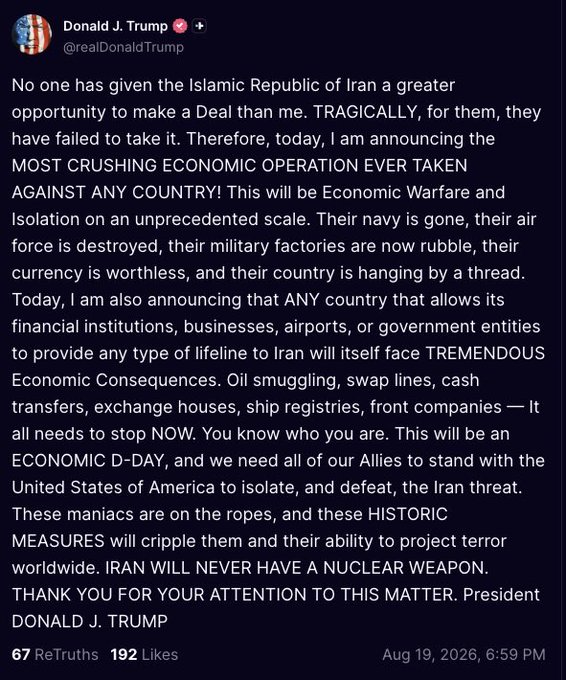
Source: Truth Social
What Trump Actually Said
In his post, the president said no country has been offered a greater chance to negotiate than this one and that Tehran has failed to take that opportunity.
He described the coming plan as financial warfare and isolation on an unprecedented scale, pointing to the country's damaged navy, air force, and military production as evidence it is already under severe strain.
He added that Tehran will never be allowed to obtain a nuclear weapon and called the moment a turning point after fifty years of pressure that had not stopped the country's nuclear ambitions.
Warning To Countries That Deal With Iran
The Trump Economic D-Day Iran plan is not limited to Tehran alone. He said any nation that allows its banks, businesses, airports, or government bodies to provide any kind of support to the Islamic Republic will face tremendous consequences of its own.
He specifically listed oil smuggling, swap lines, cash transfers, exchange houses, ship registries, and front companies as activities that need to stop immediately—without naming any specific nation by name, though reporting has pointed to China as a likely target, given it remains the largest buyer of Iranian oil.
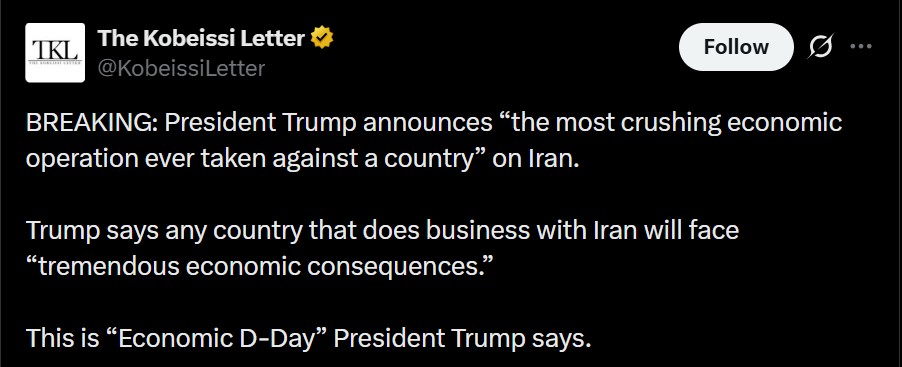
Source: KobeissiLetter on X
How This Builds On Existing Iran Sanctions
Washington has maintained an extensive sanctions program against the country for decades, covering its oil sector, financial institutions, and military-related industries.
The US Treasury's Office of Foreign Assets Control lists numerous executive orders and statutes forming this framework and has continued adding new designations in recent weeks—including actions dated August 7, July 29, and July 24, 2026.
The State Department has run a parallel track of measures under this same pressure campaign, including an August 7 action aimed specifically at digital asset exchanges accused of helping the regime move funds around sanctions—a detail that matters directly for anyone tracking crypto-related exposure to Iran.
The newly announced Trump Economic D-Day Iran push builds directly on top of that existing legal structure rather than replacing it, signaling a broader coordinated effort against remaining financial channels used by Tehran.
Key Details From The Announcement
-
The operation was described as the most crushing ever taken against a country.
-
Any nation aiding the Islamic Republic financially faces its own consequences.
-
Oil smuggling, swap lines, and front companies were named as targets to shut down.
-
Treasury has already branded this wider push "Economic Fury," alongside the ongoing naval blockade.
-
Recent State Department actions have specifically targeted digital asset exchanges tied to Tehran.
-
No specific nations were named directly in the post.
Why Pressure Is Ramping Up Now
The president framed the announcement as the next stage after weeks of military and financial pressure, following joint US and Israeli strikes earlier this year and an ongoing blockade around the Strait of Hormuz on US-Iran tensions.
Treasury Secretary Scott Bessent had previewed the shift days earlier, telling media the department was applying maximum pressure to the regime through a combination of economic isolation and a continued blockade that keeps ships from moving in or out of the country's ports.
Treasury data cited in recent reporting shows average daily oil loadings from the country have fallen from roughly 1.8 million barrels before the war to under 500,000 barrels over the past month — a sign the blockade is already squeezing revenue even before this newest round of measures takes effect.
What Comes Next
The Trump Economic D-Day Iran announcement does not yet specify exact new measures or timelines, leaving room for additional Treasury and State Department designations in the days ahead.
Given the pace of updates to the sanctions list so far this year, global markets remain alert to the crypto market reaction to the Iran war as Washington expands its financial pressure campaign—including crypto exchanges, Iranian sanctions, and crypto flagged in prior actions—and are likely watching closely for the next round of official designations.
Source: OFAC — U.S. Department
Conclusion
This latest move signals Washington is shifting further toward financial pressure as its primary tool against Tehran.
With existing sanctions infrastructure already in place, a campaign named "Economic Fury" underway, and new designations arriving regularly, the coming weeks should reveal how far this Trump economic D-Day Iran campaign extends and which nations or entities may be affected next.
Disclaimer
This article is for educational and informational purposes only and should not be considered financial or investment advice. Always conduct your own research before making investment decisions.









