HTX Wallet Freeze: Users Report Frozen Accounts After Transfers

HTX Wallet Freeze: Users Report Frozen Accounts After Transfers
The HTX wallet freeze controversy broke out on the morning of August 18, 2026, becoming a notable development in crypto news today as multiple crypto users reported receiving small, unsolicited USDT deposits from wallets labeled as belonging, the exchange formerly known as Huobi.
According to a report shared by blockchain researcher WuBlockchain, some recipients said their exchange accounts were flagged or restricted shortly after the funds landed, sparking fears of a coordinated crypto dusting attack. 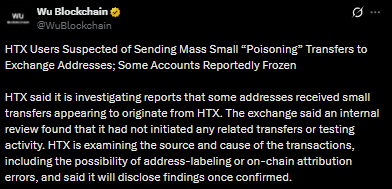
It responded the same day, stating it had launched an internal review after the reports surfaced.
What Happened: Sends Unsolicited USDT Deposits to Multiple Wallets
Community reports described a pattern now being called HTX address poisoning across exchange accounts:
Small USDT transfers, in some cases as little as 7.5 USDT, arrived from addresses tagged by blockchain services as HTX-linked wallets, including one identified as "HTX48"
Recipients had not requested or interacted with the sending addresses in any way
Several users said their accounts on other platforms faced compliance holds shortly after the deposits appeared , with one Coinbase user describing the incoming funds as "poisoning" from a well-known wallet NullTX
Industry commentators, including AB Kuai Dong, said the pattern was reported by multiple insiders on the same morning , consistent with what is being framed as a "compliance poisoning" attack rather than a classic dusting scam NullTX
Why Is Freezing User Accounts? The Compliance Trigger Explained
This is not freezing accounts directly. The exchange account compliance freeze pattern stems from sanctions screening at other platforms.
On May 26, 2026, the UK sanctioned Huobi Global S.A., the entity associated with it. Chainalysis reported that the UK government suspected channeling more than $1.5 billion to Russia through crypto flows involving sanctioned entities.
It disputed the UK sanctions designation, stating in an official announcement on May 27 that Huobi Global S.A. was distinct from the online exchange and that the designation should not affect the platform. HTX said its global operations remained unaffected and that user funds were safe.
The EU's 21st sanctions package, adopted on July 23, 2026, expanded restrictions on crypto-related platforms.
And introduced a mechanism allowing the EU to ban transactions between EU operators and certain third-country crypto providers.
Binance said on August 14 it would block transactions with 11 crypto platforms, including HTX and EXMO, starting August 23, after five smaller platforms were already cut off earlier in the month.
Date | Action | Source |
May 26, 2026 | UK asset freeze on Huobi Global S.A. | UK Treasury |
July 23, 2026 | EU adopts 21st sanctions package naming HTX | EU Council |
Aug 14, 2026 | Binance announces transaction block from Aug 23 | Binance |
Aug 18, 2026 | Users report HTX wallet freeze and dusting reports | WuBlockchain |
Aug 23, 2026 | Binance restriction takes effect | Binance |
Because of this sanctions screening crypto exchange environment, any wallet with an on-chain link to wallet, even an unsolicited deposit, can trigger automated compliance checks and an exchange account compliance freeze at the receiving platform.
Internal Investigation and Official Response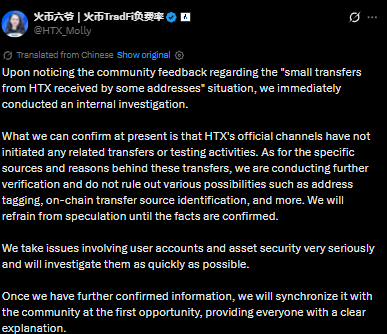
HTX said on X that it had launched an internal investigation into the reported small transfers and had not found evidence that its official channels initiated them.
They said its internal review found that its official channels had not initiated the disputed transfers or conducted any related testing activity.
The exchange said it is examining whether address-labeling or on-chain attribution errors created a misleading origin trail, and that no confirmed transaction list or verified victim count has been disclosed so far.
This is the core of the internal investigation currently underway, with stating it will share confirmed findings once the review concludes.
Is HTX Freezing Accounts Real? On-Chain Review Raises Questions
Not every part of the viral claim has held up. A separate on-chain review by community investigator 0xMoon found that a batch of 7.5 USDT transfers from HTX's hot wallet went exclusively to Kraken addresses, with no evidence the funds reached a Coinbase account as originally alleged.
it's co-founder Justin Sun has publicly disputed the broader freeze narrative, adding uncertainty to the poisoning transfer scam claims still circulating online.
HTX Wallet Freeze Investigation Update: What Comes Next
As of August 19, 2026, HTX has not published a transaction hash list or confirmed the total number of affected wallets.
The wallet freeze investigation update remains open and continues to draw attention across the broader Crypto news landscape. Users are advised to avoid engaging with unsolicited deposits from any HTX-labeled address until findings are confirmed.
Expert View
Market analysts note that this episode reflects a wider industry problem where automated sanctions compliance can penalize recipients of unsolicited transfers regardless of intent, a risk that could grow as more platforms face similar restrictions tied to the EU's Russia-related sanctions framework.
Disclaimer: This article is for informational purposes only and does not constitute financial or investment advice. Details of the wallet freeze remain unconfirmed pending official findings; readers should verify independently before taking any action involving affected wallets or exchange accounts.
Also read:






